

Everything You Need to Know About Lochia (Bleeding After Birth or a Caesarean Section)
Lochia — the postnatal discharge that appears immediately after birth — is entirely normal. It occurs regardless of how you gave birth, whether vaginally or by caesarean section. This is how your body expels the blood and tissue that remained in the womb and supported your baby's growth.
All women bleed after giving birth, most heavily in the first few days — and that's no cause for concern. You should, however, pay attention if the bleeding is still just as heavy several weeks later. Here's what you need to know about lochia and what to look out for.
What is lochia (postnatal bleeding) and why does it happen?
Lochia is vaginal bleeding that begins immediately after birth and can last several weeks. It's heaviest in the first few days, then gradually tails off until it disappears completely. It resembles menstrual bleeding and has a comparable consistency as well as a similar, metallic smell.
Lochia consists of a mixture of blood, secretions and uterine tissue — the remnants of everything that supported your baby's development and growth during pregnancy.
It isn't a negative outcome or a problem, but a natural part of the healing process your body goes through during the postnatal period. Lochia is normal and, in most cases, resolves without complications or any reason to worry.
What normal lochia looks like after birth
Immediately after the birth and in the first few days, lochia can be very heavy — and it may well still be that way when you leave hospital and come home with your baby. Especially if you're moving about a lot and overexerting yourself. You'll notice the discharge most when standing up, which is down to the shape of the vagina.
It's only after a few days that the flow begins to ease. Once the bleeding becomes only occasional, you'll need fewer and fewer pads and can switch to panty liners. It's important to use panty liners made from 100% organic cotton, like those from Enroush — pH-neutral and free from chemicals.
Your vaginal flora is delicate at the best of times, but after giving birth it's particularly prone to irritation and infection. So protect it by using only period products made from pure materials — without dyes or bleaching agents.
Postnatal discharge is different for every woman. Broadly speaking, though, there are three stages of lochia, which present as follows:
- Lochia rubra (the first 3–4 days): bright red or dark red discharge, heavy flow similar to a period, mild abdominal cramping
- Lochia serosa (lasts 4–12 days): more watery discharge, pink or brownish in colour, lighter flow than in the first few days.
- Lochia alba (lasts from day 12 to week 6): the final stage of lochia, appearing as light discharge or spotting, yellowish or whitish in colour, with very little or no blood at all.
Every day is different, and how long it takes for lochia to disappear altogether depends on a number of factors. We explain below in detail how the discharge changes from day to day.
How long vaginal bleeding lasts after birth
Although lochia can continue for up to 8–12 weeks after birth, it usually changes most noticeably within the first 6 weeks. After that, you may still have the light discharge we mentioned — the lochia alba stage.
The most significant changes take place up to week 6. Here's what you can expect on the individual days:
- Day 1: heavy flow, red or brownish bleeding, small clots
- Days 2 to 6: bright red or dark brown bleeding
- Days 7 to 10: also bright red or dark brown bleeding, but varying in heaviness
- Days 11 to 14: lighter flow, dark brown bleeding
- Weeks 3–4: lighter bleeding, the flow continues to decrease
- Weeks 5–6: brownish spotting
What colour and consistency postnatal discharge normally has
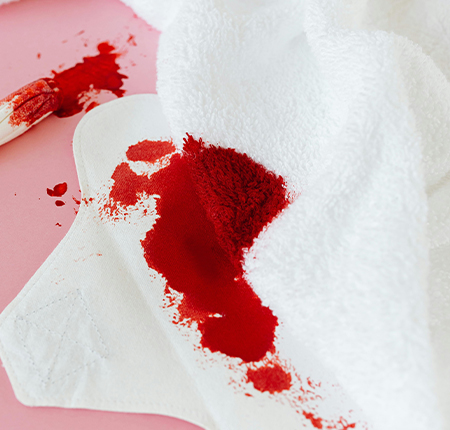
Above, we've already explained how the natural colour of lochia changes depending on the stage of the postnatal period. It can range from bright red and dark red through brown and pink to pale yellow towards the end.
What isn't normal is bleeding of a different colour, such as greenish. Or if it still has the same bright or dark red colour several days after the birth. After the first two weeks, both the shade and the heaviness should change. Speak to your doctor if that isn't the case.
As for consistency, it's normal for lochia to contain small clots in the first few days. These shouldn't, however, be bigger than a coin, and they should reduce over time. After the first 3–4 weeks, there should be very few and very small clots, or none at all.
How postnatal discharge differs from a period
Although there are some similarities between lochia and menstruation (as mentioned above: abdominal pain, smell, heaviness, clots and so on), the biggest difference is the duration.
Depending on your cycle length, a period can last between 2 and 8 days. On our blog you'll find plenty of in-depth articles on everything you need to know about the menstrual cycle. Postnatal discharge, by contrast, lasts considerably longer than a normal period.
For most women, menstrual bleeding lasts around a week. Lochia lasts around 6 weeks in most cases.
How vaginal bleeding after birth (lochia) is affected
Although every mother experiences postnatal discharge differently, there are a few factors that have been shown to influence how much blood is lost. The flow may become heavier if:
- You're breastfeeding: During breastfeeding, the body releases oxytocin, a hormone that encourages the uterus to contract. That's why the discharge flows out more quickly at these moments (you don't actually lose more blood, it simply comes away in bursts).
- You stand up: The vagina has a cup-like shape. When you're lying down or sitting, more fluid can collect inside it. As soon as you stand up, the vagina changes position and the accumulated fluid starts to flow out.
- You exert yourself physically: Any kind of movement or physical activity, including climbing stairs, can speed up the flow of lochia.
When to see a doctor about bleeding after birth
As a rule, lochia causes no complications, but there are exceptions. Always keep an eye out for unusual bleeding or changes, and see a doctor as soon as possible if you notice the following symptoms:
- Greenish discharge
- Swelling around the vagina
- Pain in the vaginal area
- An unpleasant smell that differs from normal period odour
- Blood clots larger than 4 cm
- A great many blood clots
- Severe abdominal pain and intense cramping
- Very heavy bleeding (you have to change your pad every hour)
- Dizziness and faintness
- Flu-like symptoms, fever or chills
Causes of postpartum haemorrhage
Postpartum haemorrhage is the term used when lochia is excessively heavy. The most common cause is uterine atony.
Normally, the uterus contracts after birth in order to stop the bleeding at the site where the placenta was attached during pregnancy (the organ that supplies the baby with nutrients). With uterine atony, these normal contractions don't happen, which is why the lochia becomes very heavy.
In addition, women who give birth by caesarean section are more susceptible to postpartum haemorrhage than women who give birth vaginally. There are, however, other factors that can increase the risk of excessive bleeding or trigger it, including:
- A long labour
- Oxytocin used to induce labour
- Giving birth to a baby weighing more than 4 kg
- Giving birth to twins/triplets or having had several births
- Injuries to the vagina, cervix or uterus during the birth
- General anaesthetic for a caesarean section
- Problems with the placenta
- Being overweight
- Pre-eclampsia (excess protein in the urine and high blood pressure during pregnancy)
How postpartum haemorrhage is treated
Depending on the cause and the symptoms, your doctor may suggest various treatment options to stop a postpartum haemorrhage. The different treatment methods for heavy bleeding include:
- Administering oxytocin or other medications that trigger uterine contractions
- Administering medication to stop the bleeding
- Massaging the uterus to stimulate contractions
- Removing retained placental tissue from the uterus
- A blood transfusion to replace significant blood loss
- Uterine artery embolisation, to reduce the blood supply to the uterus
- Inserting a Bakri balloon, which inflates inside the uterus and applies pressure to stop the bleeding
- Surgery: if the cause of the bleeding is unclear, the abdomen may be opened (laparotomy) to identify the cause and stop the bleeding; in certain cases a hysterectomy (complete removal of the uterus) may also be necessary
Tips and advice on postnatal discharge after birth (lochia)
Lochia is a normal stage in your body's natural healing process after birth. As long as there's no heavy bleeding or any of the other complications mentioned above, it isn't a problem requiring treatment, but rather another reason to treat your body with gentleness and patience.
Here are some recommendations to help you look after your body well during postnatal bleeding.
Use only pads for the first 6 weeks
Your vagina and your entire reproductive tract are very sensitive immediately after birth. They're still healing, and there may still be injuries to the vaginal walls and cervix. Inserting any foreign object into the vagina can introduce bacteria, which can travel up to the uterus and cause infection.
Do speak to your doctor and get the all-clear before you start using tampons again. For the first 6 weeks, use only pads that are as long as possible and highly absorbent, to avoid staining your clothes.
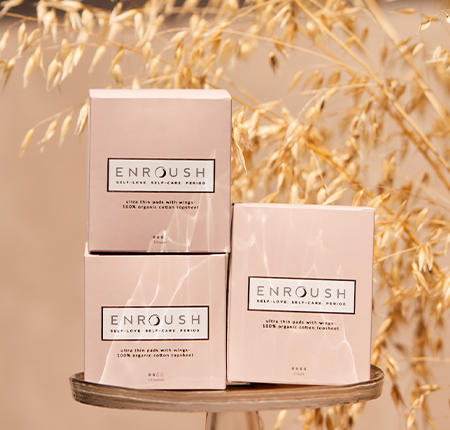
Enroush pads are made from 100% organic cotton and offer you reliable protection — without the toxic substances that can cause irritation and infection in the intimate area. Thanks to the bottom layer made from 100% natural fibres, the anatomical fit and the cotton wings, they're also exceptionally absorbent and prevent accidental stains or leaks onto your clothes.
Don't overexert yourself
We know there's so much to do around the house and that you're needed everywhere — but all of that will still be there in a few weeks' time, when the lochia has eased. The most important thing now, for your baby too, is that you look after yourself properly. Only then can you give your little one the attention and care they need. So focus on rest and recovery.
Be patient and avoid strenuous tasks: even hoovering is a considerable physical effort and can make the discharge heavier. Don't overexert yourself, and don't hesitate to ask your partner, family or friends for help when you need it.
Wear clothes and underwear you don't mind ruining
However effective pads are, lochia can be very heavy, particularly in the first few days, especially in the mornings or when you stand up suddenly. Sometimes leaks and stains are unavoidable — and that shouldn't cause you any extra stress.
So choose clothes and underwear you won't mind getting stained. That way you can move about freely and feel comfortable, without worrying about keeping your clothes spotless.

Medium, super or extra absorption

Low, medium or super absorption

Low or medium absorption


and happily breaking taboos!


