

Bacterial vaginosis (Gardnerella vaginalis) – from symptoms to treatment
If you notice unusual discharge, itching, burning or other uncomfortable sensations in your intimate area, bacterial vaginosis could be the cause. It's a common, very treatable condition that develops when too many harmful bacteria build up in the vagina.
There are many possible causes – and conversely, this problem can increase your risk of contracting a sexually transmitted infection. So let's look at what to do. Here you'll find everything you need to know about bacterial vaginosis: how it presents itself and how to treat it.
What is bacterial vaginosis?
Bacterial vaginosis is a vaginal condition that occurs when there's an imbalance and certain bacteria multiply excessively. Usually Gardnerella vaginalis is the cause – a bacterium that forms part of the vaginal microbiome and triggers this infection when the balance is disturbed and it outnumbers the remaining bacteria of the vaginal flora.
It's neither rare nor dramatic, as many women between the ages of 15 and 44 – particularly those who are sexually active – are affected at some point in their lives. A simple visit to the gynaecologist is all it takes to get it treated.
It's important, however, to get treatment as quickly as possible, because bacterial vaginosis rarely occurs in people who aren't sexually active, and when it does occur, it increases the risk of contracting sexually transmitted diseases.
How does this infection present itself?
There are cases – up to 50% – in which a woman has bacterial vaginosis without knowing it, because the symptoms are absent or go unnoticed. When the infection does make itself known, however, the main signs are:
- Burning or pain in the vagina
- Itching in or around the vagina
- Burning when passing urine
- An unpleasant odour that becomes stronger after intercourse
- Whitish or grey, thin discharge
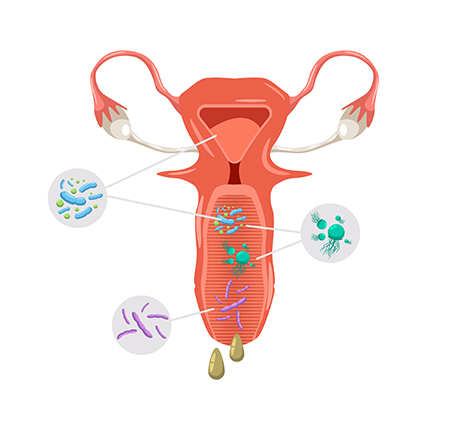
Let's go through them one by one.
Itching in the vaginal area
Bacterial vaginosis can cause pruritus – that itching in or around the vagina.
However, there are many other causes of itching in the intimate area, and since half of all bacterial vaginosis cases are symptom-free, it's entirely possible that it isn't the source of the itching. In another blog article we discussed why you might feel itching in your intimate area, as there can be many other reasons.
The best thing to do, therefore, is to see a doctor as soon as possible if this sensation appears, so as to rule out all other possible causes and determine whether vaginosis is present or not.
Changes in vaginal discharge
There are many types of vaginal discharge and secretions that are completely normal – but just as many that aren't. We've discussed their types and causes in more detail in this article.
Essentially, any unusual change in vaginal discharge can indicate an imbalance or a problem in the vagina – and that's exactly what happens with bacterial vaginosis. Typical changes in consistency and colour include discharge that becomes:
- thin
- watery
- frothy
- whitish
- grey
- greenish
So pay attention to the consistency and colour of your vaginal discharge to learn how it normally fluctuates throughout your cycle (because it's completely normal for it to change depending on the phase of your cycle) – that way you'll notice any unusual change as early as possible.
Unpleasant odour
An unpleasant odour in the intimate area can also be the result of excessive growth of Gardnerella vaginalis – an odour commonly described as "fishy".
As a rule, any activity that raises the vaginal pH intensifies this odour. This means it becomes stronger after intercourse or after menstruation.
Burning when passing urine
Sometimes bacterial vaginosis can also cause discomfort when urinating – particularly when the imbalance in the vaginal flora is accompanied by a urinary tract infection.
In other words, alongside itching you may also experience burning, a stinging sensation or even pain when passing urine. Usually this irritating sensation disappears as soon as you've finished urinating.
What causes bacterial vaginosis?
The actual causes of bacterial vaginosis aren't known precisely. What we do know is this: it occurs most frequently in people with an active sex life, in whom an imbalance of the vaginal flora develops one way or another. Put differently: when the ratio between beneficial bacteria (lactobacilli) and harmful bacteria (anaerobes) is disturbed, the latter multiply excessively – and that's when we talk about bacterial vaginosis.
According to research, you don't develop this kind of problem simply by using a public toilet or swimming in a pool. Vaginal douching, intercourse without a condom or frequently changing sexual partners, on the other hand, can be possible causes. Let's go through them one by one and look at the details.

Intercourse with multiple partners or with a new partner
Because it develops when the imbalance in the vaginal microbiome described above occurs, bacterial vaginosis isn't classed as a sexually transmitted infection or disease. It isn't a sexually transmitted virus or parasite, but rather a disruption of the normal balance between the bacteria in the vagina.
Even so, the condition can also appear after intercourse. Not through transmission from a partner, though, but as a direct result of contact with the partner's body. This is precisely why the risk of vaginosis increases with intercourse with a new partner or when frequently changing sexual partners.
When a partner's natural genital chemistry interferes with your intimate balance, certain bacteria can multiply excessively – and bacterial vaginosis can develop as a result.
Using a vaginal douche
No, a healthy vagina doesn't need a vaginal douche. It's enough to wash externally around the vulva with water and a natural intimate gel.
A woman's vagina is so intricately designed that vaginal douches simply aren't necessary for daily intimate hygiene. Except in cases where they're medically recommended (for example with an infection and the use of vaginal pessaries), vaginal rinses and any substances inserted into the vagina can do more harm than good. Even if you feel you're cleaning yourself, in reality you're only disturbing the natural balance of the vaginal flora.
Thanks to the vagina's self-cleaning function, it expels everything that needs to be expelled along with the vaginal discharge, all by itself. So it doesn't even need water – let alone any other substance – to keep the inside of the vagina clean. In a healthy vagina, intravaginal rinses can throw the pH out of balance and lead to anaerobic growth, thereby causing bacterial vaginosis.
Recent use of antibiotics
Antibiotics are among the best-known treatments for bacterial infections, as they kill the bacteria and with them the cause of the infection. The problem is that they also have a side effect: they can kill off the good bacteria in the body too (including lactobacilli).
If you take antibiotics without protecting your gut and vaginal flora (that is, without taking probiotics), the medication can cause an imbalance of bacteria in the vagina and thus lead to bacterial vaginosis.
Using scented sanitary towels
Any substance that isn't a natural component, that comes into contact with your intimate area and doesn't normally belong there, can throw your vaginal flora out of balance. And here a word of warning about the sanitary towels and tampons you use – because they come into contact with your vagina and vulva month after month, for several days at a time.
So you should pay close attention to what's in the sanitary towel you're using, because it's by no means unusual for it to be the very cause of itching and burning in the intimate area. Conventional menstrual products often contain fragrances and other toxic chemicals that can disrupt your vaginal pH and thus lead to bacterial vaginosis.
That's why we recommend choosing sanitary towels made from the most natural materials possible – without fragrances or other chemicals, ideally made only from organic cotton that lets your skin breathe, and nothing more. We covered this topic in more depth in an earlier blog article, where we discussed why you should use organic sanitary towels.

Unprotected intercourse
As well as contracting a sexually transmitted disease, unprotected intercourse also increases the risk of a vaginal infection. Semen has a high pH, usually between 7.2 and 7.8, and this high value can disrupt your own vaginal pH if your partner ejaculates without a condom.
So if your partner's pH isn't compatible with the pH of your vagina, intercourse without barrier protection can lead to an imbalance of the vaginal flora and therefore to bacterial vaginosis.

Complications of bacterial vaginosis
As a rule, bacterial vaginosis runs its course without complications and can even clear up on its own, without treatment. That doesn't mean it should be ignored, though. If you notice any of the symptoms, see a doctor as soon as possible to establish whether it's bacterial vaginosis, whether another vaginal, urological or sexually transmitted infection is present, and whether you need treatment.
Even if the symptoms disappear on their own, the condition can return a few months later. Or, in some cases, untreated vaginosis can lead to various health problems, which we'll discuss now.
Sexually transmitted infections
Let's return to what we mentioned at the beginning of the article: bacterial vaginosis increases the risk of contracting a virus, a parasite or a sexually transmitted disease – and early treatment can help you avoid this. Among the most unpleasant and serious of these infections are:
- HIV
- Chlamydia
- Gonorrhoea
- Herpes simplex virus, etc.
Pelvic inflammatory disease
If chlamydia or gonorrhoea infections go untreated, the bacteria can trigger pelvic inflammatory disease (PID) – a problem also known as adnexitis, which attacks the female reproductive organs. The ovaries, cervix, uterus and fallopian tubes can all be affected, which may increase the risk of infertility.
At the same time, bacterial vaginosis or other untreated conditions of the reproductive system can also cause problems during pregnancy, including premature birth. We'll discuss this in a separate section shortly.
Infections following a gynaecological procedure
Bacterial vaginosis can also increase the risk of post-operative infection. If the flora isn't normal and there's an imbalance in the vaginal microbiome following a gynaecological procedure (for example a hysterectomy or a dilatation and curettage), the likelihood of developing a post-operative infection also rises.
How can bacterial vaginosis affect pregnancy?
Statistics show that around 10–30% of expectant mothers are affected by bacterial vaginosis at some point during pregnancy. It develops primarily against the backdrop of the hormonal changes that take place constantly during pregnancy (e.g. fluctuations in oestrogen and progesterone, rising HCG levels, etc.).
Without treatment, complications can arise that endanger both the mother's health and the pregnancy and foetus. You'll find out what these are below.
Complications of bacterial vaginosis during pregnancy
If you have bacterial vaginosis during pregnancy and it isn't monitored or treated, you and the foetus face the following dangers and risks:
- Premature birth: that is, before the 37th week of pregnancy
- Low birth weight: which can cause health problems for the little one later on
- Possible rupture of the membranes (perforation of the amniotic sac)
- Chorioamnionitis: infection of the amniotic fluid and inflammation of the membranes surrounding the foetus
- Postpartum endometritis: an infection in which the lining of the uterus is irritated or inflamed, occurring shortly after birth when the body is still sensitive, in its recovery phase and in need of attentive postnatal care.
Diagnosing bacterial vaginosis
Because the symptoms may be absent or identical to those of other conditions affecting the intimate area, a diagnosis of bacterial vaginosis is made exclusively by a specialist – following an examination of the vagina and a laboratory analysis of the vaginal discharge.
Essentially, the examination used to determine whether or not you have this condition is similar to an ordinary routine gynaecological check-up. Here's what to expect:
- The doctor examines the vagina to identify visible signs of vaginosis (e.g. an increased amount of whitish or grey discharge)
- A sample of the discharge is then taken with a sterile swab for laboratory testing.
To make the results as accurate as possible, you should prepare for the examination as you would for any vaginal swab: avoid vaginal douches, sprays and intercourse for 24 hours beforehand.

How is BV treated?
As we've already mentioned: if symptoms are absent, the vaginal flora can regulate itself and return to normal, so that the bacterial vaginosis clears up on its own. In this case, no treatment is necessary.
There's also the possibility, however, that symptoms appear or that the condition returns after a few months (which apparently can't be prevented by treating your partner as well – though this assumption is still being investigated). In this case, your gynaecologist will prescribe the appropriate treatment.
Treatment is also necessary if you're pregnant, about to give birth or facing a surgical procedure that could allow bacteria to enter the uterus – or if the symptoms are affecting your everyday life and your sex life.
To treat the condition and prevent complications, the following is generally recommended:
- Antibiotic treatments (metronidazole)
- Vaginal creams (clindamycin)
- Vaginal probiotics with sufficient amounts of micronutrients (manganese, zinc, iron), which are necessary for a lactobacilli-rich flora and a healthy vaginal microbiome
- Abstaining from intercourse until the treatment is complete

How do we prevent bacterial vaginosis?
A healthy, balanced vaginal flora is the best and most effective form of prevention. Practically everything that supports the balance between the beneficial and the harmful bacteria in the vagina – and everything that prevents this balance from being disturbed – therefore counts as a preventive measure. More specifically, there are a few key ways to prevent bacterial vaginosis:
- Taking probiotics: together with a healthy lifestyle and a proper diet rich in vitamins and nutrients, probiotics help to populate the vaginal flora with lactobacilli – those beneficial bacteria the vagina needs to function perfectly
- Intimate hygiene that's as natural as possible: using only water, soaps, intimate gels, tampons and sanitary towels with natural ingredients, without fragrances or harmful chemicals
- Wearing cotton underwear: it lets your skin breathe and doesn't trap moisture in the intimate area, so no favourable environment is created for harmful bacteria to accumulate
- Avoiding vaginal douches and over-washing
- Regular testing: for yourself, but also for your partners, for sexually transmitted infections
- Using a barrier method: a condom, for example
Vaginal candidiasis VS bacterial vaginosis
Candidiasis, which we've discussed in more detail HERE, is a common fungal infection caused by a fungus called Candida. Most often women are infected with Candida albicans, a fungus that normally lives in the mouth, throat, gut and vagina without causing problems – but which multiplies excessively and triggers an infection when its environment changes.
Bacterial vaginosis, on the other hand, develops when the harmful bacteria in the vagina multiply excessively and outnumber the lactobacilli. This happens when an imbalance occurs in the vagina.
So when we compare candidiasis with bacterial vaginosis, we're actually comparing an infection with an imbalance – that is, a problem caused by a fungus with one caused by bacteria.
Although both can manifest through unusual discharge, itching and discomfort in the intimate area, they are two different conditions – right down to the nature of the infection. In addition, vaginosis involves an unpleasant odour, whereas discharge associated with candidiasis is odourless.
In summary: candidiasis is caused by a fungal infection, while bacterial vaginosis stems from an imbalance of the vaginal flora. Despite the similarity of the symptoms, the treatment is completely different – and that's precisely why it's important for a doctor to make the diagnosis and recommend the appropriate treatment after a gynaecological examination and analysis of the discharge.

Medium, super or extra absorption

Low, medium or super absorption

Low or medium absorption


and happily breaking taboos!


