

Caesarean Section – When It Is Necessary & What the Caesarean Procedure Involves
Did you know that in England almost half of births (45% in 2024-25) are by caesarean section - more than natural vaginal births for the first time (NHS England)? That shows just how common and safe this procedure is.
Even so, the type of delivery is a decision that depends on many factors, and one in which your health and your baby's come first. As a rule, your doctor will recommend a caesarean if a vaginal birth carries risks, if complications arise during pregnancy, or if surgery is simply the safer option. Whatever the reasons, if a caesarean lies ahead for you, stay with us to the end of this article to find out everything about how the operation works and the healing process.
What is a caesarean section?
A caesarean section is a surgical procedure used to deliver a baby when a vaginal birth isn't safely possible. An incision is made in the lower abdomen, through to the womb.
A caesarean may be carried out as an emergency procedure or planned in advance – for example, if the patient has previously given birth by caesarean, or if the baby's development has been monitored since the first signs of pregnancy and possible complications of a natural birth are already known.
Compared with a vaginal birth, a caesarean carries more risks and requires a longer recovery period. That's why it's only performed when it's the safest option for mother and baby.
When is a caesarean section necessary?
There are situations in which a vaginal birth poses a risk to the health or life of both mother and baby. In these cases, if a caesarean is the safer option, your consultant will recommend it.
A caesarean can also be carried out on request. In principle, it isn't recommended without a genuine medical indication, but it is possible if the patient wishes and the doctor agrees after a detailed discussion.
Medical indications for a caesarean section
The most common situations in which a caesarean is necessary for the safety of mother and baby include:
- Abnormal position of the baby: when the baby is lying transversely or obliquely in the womb.
- The baby is too large in relation to the mother's pelvis: where there is a disproportion between the baby's head and the mother's pelvis, the pelvis is too narrow for a vaginal birth.
- Placenta praevia or other placental problems: in such cases, the placenta may block the birth canal across the cervix.
- Twin or multiple pregnancy with complications: twins can certainly be born vaginally, but a caesarean is usually safer in multiple pregnancies or where complications arise.
- Maternal complications: Certain conditions such as cardiovascular disease, poorly controlled gestational diabetes or severe pre-eclampsia can worsen during labour in a vaginal birth, which is why surgery is recommended. A caesarean is also recommended if the mother has genital herpes at the time of birth, to avoid passing it on to the baby.
A caesarean may also be necessary if the mother has already had two or more caesareans, if large uterine fibroids make a natural birth difficult, or if the baby has congenital abnormalities.

Caesarean section on request
Some women want a caesarean for non-medical reasons: they're afraid of the pain or risks of a natural birth, or they'd like to give birth on a planned date.
All these fears and motivations should be discussed with your doctor, who will explain the benefits and risks of each type of birth. If you're afraid of the pain, they can refer you to a specialist who will also support you through labour and delivery.
If you understand the risks of a caesarean compared with a natural birth and still don't want a vaginal delivery, you can agree a birth date together with your doctor.
How a caesarean section works
A caesarean takes around 45 minutes, provided there are no complications, and is performed under anaesthetic – either regional anaesthesia (epidural or spinal) or a general anaesthetic.
In short, the procedure goes like this: the doctor makes an incision in the abdominal wall and the womb and lifts the baby out. After the umbilical cord has been cut and the placenta removed, the incision is stitched up and the procedure is complete.
If you'd like to know in more detail what to expect, we explain everything below.
Preparing for the procedure
Before the operation itself there's a preparation process made up of several steps. We've already touched on the first: your doctor will explain exactly how the operation will proceed and what risks are involved. You can also ask any questions you have at this point.
You'll then sign a consent form for the procedure. Read the whole document carefully and speak to your doctor if any new questions come up.
Also during the preparation stage, you'll need to tell your doctor whether you have any allergies (for example to certain medicines, latex, iodine or anaesthetics), inform them about absolutely every medication you're taking (whether treatments, vitamins or herbal preparations), and let them know whether you're taking anticoagulants, aspirin or any other medicines that affect blood clotting.
For a planned caesarean, you'll be told not to eat or drink anything for 8 hours beforehand. Otherwise, you'll be asked when you last ate or drank.
The stages of a caesarean section
During the operation you'll be asleep if you've opted for a general anaesthetic, or awake with the lower half of your body numbed if you've chosen regional anaesthesia. You'll be lying on the operating table, with a screen positioned so that you can't see what's happening.
A cannula will be inserted into your hand or arm, and the anaesthetist or a nurse will continuously monitor your heart rate, blood pressure, blood oxygen levels and breathing.
Once the anaesthetic has taken effect, the doctor makes an incision of around 10–20 cm in the abdomen, cutting through six separate layers of the abdominal wall and womb. The incision may be horizontal (this option is usually chosen as healing is quicker) or vertical.
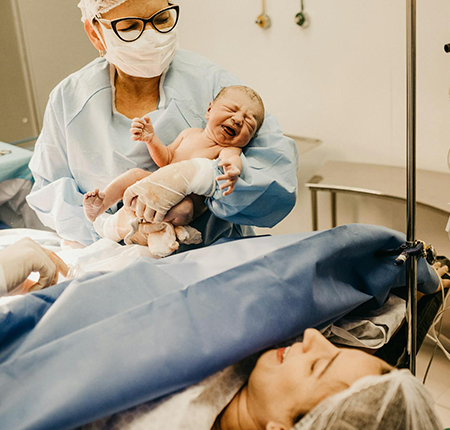
The doctor opens the amniotic sac to lift the baby out, then cuts the umbilical cord. Through the cannula you'll be given medication to help the womb contract and expel the placenta.
Once the placenta has been removed from the womb, the doctor stitches the incision and applies a sterile dressing. Without complications, the whole procedure takes around 45–60 minutes.
Recovery after a caesarean section
Postnatal recovery begins immediately after the procedure. You'll stay in the recovery room for 1–2 hours and will then be transferred to your room for the remainder of your hospital stay – usually 2–5 days.
The nursing staff will continue to monitor your breathing, blood pressure, pulse, bleeding and the firmness of your womb. You can usually see your baby while still in the recovery room, where breastfeeding can even begin – just as with a vaginal birth.
The first 24–48 hours after a caesarean
As the anaesthetic wears off, you can be given pain relief if needed – either as tablets or through a drip. In some cases, medication can also be given directly via the epidural catheter until it's removed.
You'll also be encouraged to start moving as soon as possible after the operation. At first you may need help to sit up or stand, but it's important to get out of bed and move about soon in order to speed up healing. Moving around also helps relieve pain from trapped wind, which occurs once your bowel starts working again.
Caring for the wound after a caesarean
The stitches dissolve on their own a few days after the operation, leaving only a scar. Even so, it's important to follow your doctor's advice to prevent possible infection and complications.
You should keep the wound away from water and cover it with a sterile dressing for as long as your doctor recommends, to avoid infection (to clean it gently, you can use a sterile compress soaked in Betadine solution).
You'll also be advised to avoid physical exertion, climbing stairs and sexual intercourse for the first 6–8 weeks, not to lift anything heavier than your baby, and to wear comfortable clothing that doesn't press on the wound. You should also avoid tampons until your body has recovered – so it's better to use highly absorbent organic sanitary pads for reliable protection.
If non-dissolvable stitches were used, your doctor will remove them around 10 days after the operation.
How long complete healing takes varies from woman to woman, as every pregnancy is unique and every body responds differently. Generally speaking, however, recovery takes around 4–8 weeks.
Diet and lifestyle
Your lifestyle also plays an important part in the recovery process after birth.
You should make rest a priority, drink plenty of fluids and eat as nutritiously as possible – with enough protein, calcium, vitamins and minerals to support the regeneration of the uterine wall after the procedure.
Eat fruit, vegetables, eggs and lean meat, and try to avoid fizzy drinks, spicy food and foods that cause wind, to prevent digestive discomfort and dehydration.
You can gradually return to physical activity as your body heals – starting with gentle exertion such as climbing stairs after the first 4–6 weeks.
Breastfeeding after a caesarean
When breastfeeding your baby, it's important to find a comfortable position for you both. Feeding while lying on your side, for example, can be a good choice so that the baby's weight doesn't press on the still-healing scar.
It's not unusual for your milk to come in later after a caesarean, partly because of the after-effects of the anaesthetic – so be patient. In the first few days you can use a breast pump to stimulate milk production until you and your baby have settled into an effective feeding rhythm.
Natural birth vs caesarean section
Both natural birth and caesarean section have their own advantages and disadvantages.
With a natural birth, the main benefits are faster recovery and a shorter hospital stay (just 24–48 hours). The risk of infection, scarring and heavy bleeding is also lower with a vaginal birth. On the other hand, there's a higher risk of tears to the tissue and skin around the vagina, of unforeseen complications during labour, and of pain in the area between the vagina and anus. Fear of giving birth is also an important factor here.
A natural birth also brings benefits for the baby, such as a lower risk of breathing problems and contact with beneficial bacteria while passing through the birth canal. These bacteria stimulate the baby's immune system and protect its digestive system.
The main advantage of a caesarean is that, in certain situations, it is by far the safer option for mother and baby. The mother is also more comfortable during the birth, and the risk of urinary incontinence and sexual dysfunction is lower. The risk of birth injuries and oxygen deprivation for the baby is also reduced.
On the other hand, a caesarean brings considerably more drawbacks: the hospital stay is longer (2–5 days), recovery takes longer, and there are increased risks of bleeding and blood clots, infection, depression and complications in future births. The higher cost of delivery is another disadvantage.

Risks and possible complications of a caesarean section
Around 45% of births in England are by caesarean (NHS England, 2024-25) - which shows how common and safe this procedure is. But like any operation, it carries a number of risks that every expectant mother should be aware of:
- Bleeding (heavy postnatal bleeding can occur and blood clots may form)
- Infection (in the area of the wound)
- Injury to the bladder
- Adverse reactions to the anaesthetic
- Weakening of the uterine wall
- Placental abnormalities in future pregnancies
- Risks associated with a general anaesthetic
- Higher risks for the baby (mortality or birth injuries, premature birth, breathing problems, or being overweight in childhood and adulthood).
Myths and facts about caesarean sections
Whichever way a woman gives birth, she is bringing a new life into the world. Both options have risks and benefits, which is why a mother's decision should never be judged.
In this section, then, we'll clear up some of the most common myths surrounding caesarean sections:
- "Once you've had a caesarean, you can't give birth naturally again." – In principle, provided no complications arise, mothers can choose a natural birth even after a previous caesarean. Doctors only recommend a caesarean instead of a vaginal birth if the mother has already had two or more caesareans.
- "Recovery after a caesarean takes months." – Healing after a caesarean does take longer than after a normal birth, but the body usually recovers within around 4–8 weeks.
- "A caesarean is easier than a natural birth." – Just because the mother is more comfortable during the birth doesn't mean the whole process is easier. Both routes have pros and cons, and recovering from surgery is not easy. The hospital stay is longer (2–5 days), the wound needs care and can be painful, and there are numerous risks that don't exist with a natural birth.
- "A caesarean isn't a real birth." – Whichever route is chosen, vaginal or caesarean, bringing a child into the world is always a birth experience.
- "Your milk doesn't come in after a caesarean." – In most cases, mothers who give birth by caesarean can breastfeed just as well as mothers who have had a natural birth. Milk production may take a little longer to get going, but the new mother is still perfectly able to breastfeed her baby.
Frequently asked questions about caesarean sections
If you have further questions about caesarean sections, take a look at the section below. We've put together brief answers to the most common questions about this type of birth:
How long does a caesarean section take?
A caesarean usually takes around 45–60 minutes, provided there are no complications; the baby is delivered within the first 5–10 minutes.
Can a caesarean wound split open?
Yes – if pressure or significant strain is placed on the wound, the stitches can tear and the wound can open. That's why it's advisable to avoid physical exertion, climbing stairs and lifting anything other than your baby during the first few weeks.
How long does it take to heal after a caesarean?
If you follow your doctor's advice on preventing infection and other complications, your body will recover fully within around 4–8 weeks.
What should you clean a caesarean wound with?
To care for your wound properly after a caesarean, you'll be advised not to wash it with soap and water. Instead, you can clean the area with a sterile compress soaked in Betadine.
How long does a caesarean wound hurt for?
Pain in the wound area can last for up to 1–2 weeks after the operation; during this time you can be given pain relief. However, it takes around 6 weeks to recover fully.
What can you eat after a caesarean?
After a caesarean you can enjoy plenty of fruit and vegetables, as well as wholegrains, protein sources and vitamins that support your body's regeneration.
It's advisable to avoid foods that cause wind, spicy food and fast food, as well as fizzy drinks, to prevent dehydration and digestive discomfort.
How long does recovery after a caesarean take?
Every body recovers at its own pace, but complete healing after a caesarean can take up to 4–8 weeks. After that, having checked with your doctor, you can gradually start light physical activity, resume your sex life and return to your usual daily routine.
Image source: Pexels.com

Medium, super or extra absorption

Low, medium or super absorption

Low or medium absorption


and happily breaking taboos!


