

Everything You Need to Know About Ovarian Cysts
Ovarian cysts – what are they? Symptoms, causes & treatment
Conditions affecting the womb or another part of the reproductive system are known as uterine disorders. The most common uterine problems include ovarian cysts, fibroids, endometriosis, uterine prolapse and genital tuberculosis.
What is an ovarian cyst?
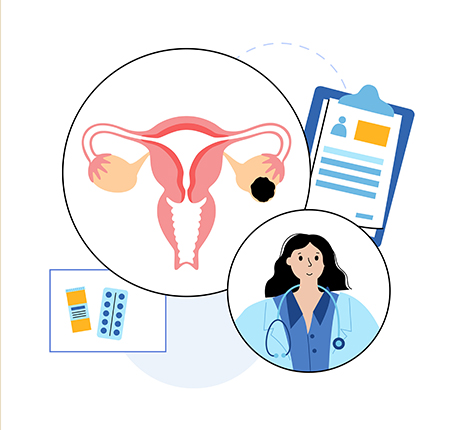
An ovarian cyst is a sac filled with fluid or semi-solid material that forms on or inside one or both ovaries. The ovaries are small organs in the pelvis that contain the eggs and produce hormones such as oestrogen and progesterone.
There are various types of ovarian cyst, most of which are painless and harmless (benign). As a rule, ovarian cysts don't announce themselves with any specific symptoms. You probably won't even know you have one – unless your doctor spots it during a routine gynaecological examination or an imaging scan.
Rarely, ovarian cysts can cause complications. Regular gynaecological check-ups and open conversations with your specialist about any symptoms you may be experiencing help prevent your health from deteriorating. Ovarian pain with no obvious cause can be a sign of an ovarian cyst that may lead to complications. (read more on the ENROUSH blog)
Ovarian cyst – symptoms
An ovarian cyst usually only causes symptoms if it ruptures, is very large, or restricts the blood supply to the ovaries.
In these cases, the following symptoms may occur:
- Lower abdominal pain – this can range from a dull sense of pressure to sudden, severe, stabbing pain
- Pain during sex
- Difficulty passing stools
- Needing to urinate more frequently
- Heavy, irregular or lighter bleeding than usual (find out in our article when irregular bleeding is cause for concern)
- Bloating and a swollen tummy
- Feeling full despite having eaten very little
- Difficulty getting pregnant – although fertility is usually unaffected by ovarian cysts
Types of ovarian cyst
There are three main types of ovarian cyst, each of which can be divided into various subtypes.
Functional ovarian cysts
Functional ovarian cysts develop as part of the menstrual cycle. They are generally harmless and short-lived, and are common in women of all ages.
Follicular ovarian cyst
In the middle of the menstrual cycle, an egg is released from its follicle and then travels down the fallopian tube. A follicular cyst forms when the follicle fails to rupture. It doesn't release the egg and continues to grow. Most follicular cysts are painless and harmless. They are not cancerous. Happily, these cysts often disappear on their own within a few menstrual cycles. In most cases you won't even notice you have a follicular cyst.
Corpus luteum cyst
After a follicle has released its egg, it shrinks and begins to produce oestrogen and progesterone. These hormones are necessary for fertilisation. The follicle is now called the corpus luteum, or yellow body. Sometimes the opening through which the egg was released seals over. Fluid then collects inside the corpus luteum and a cyst forms. In most cases these cysts disappear on their own within a few months, but occasionally they can rupture and cause complications.
Haemorrhagic ovarian cysts
Haemorrhagic ovarian cysts develop in women who ovulate when a follicle bleeds and a fluid-filled sac forms around it (a follicular or corpus luteum cyst). They aren't unusual, but only occur in women of childbearing age. They can vary considerably in size – from very small to quite large. Although most cause no symptoms at all, some haemorrhagic ovarian cysts can trigger complaints such as abdominal or pelvic pain, a feeling of pressure and persistent bloating.
Pathological ovarian cysts
There are also a number of other types of ovarian cyst that are unrelated to the menstrual cycle. These are known as pathological ovarian cysts.
Polycystic ovary syndrome
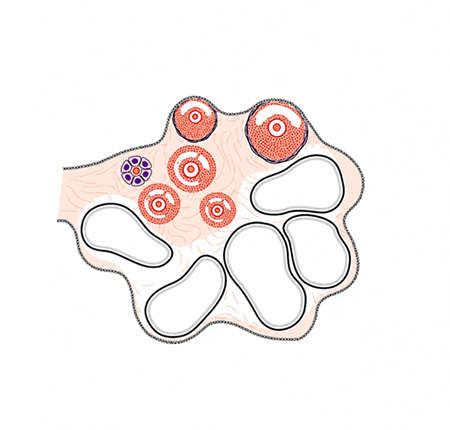
Polycystic ovary syndrome (PCOS) is a condition in which the ovaries produce an abnormally high amount of androgens – male sex hormones that are normally present in women only in small quantities. The name polycystic ovary syndrome refers to the numerous small cysts that form in the ovaries. This condition can lead to various menstrual cycle disturbances and have a negative impact on fertility. PCOS is often treated with specific medications. These cannot cure PCOS completely, but they do help ease the symptoms and prevent more serious health problems.
Dermoid ovarian cyst
Also known as a teratoma, this cyst develops from the germ cells that produce the eggs in the ovary. The cyst may also contain tissue such as hair, skin or teeth. This type of cyst is rarely malignant. It has to be removed surgically and is most common in women under 30.
Endometriotic ovarian cyst
Endometriosis is a condition in which cells similar to the lining of the womb grow outside the uterus. This tissue can attach itself to the ovary and form a cyst there. This is called an endometrioma. Although they often remain symptomless, endometriotic cysts can cause pain during menstruation or sex.
Cystadenoma
A cystadenoma develops from the cells on the surface of the ovary. The cyst usually fills with either watery or mucus-like material. A cystadenoma can grow very large and cause complications. Although it is rarely malignant, this type of cyst must be removed surgically. It is most common in women over 40.
How do ovarian cysts affect menstruation?
Ovarian cysts can also lead to cycle disturbances, such as heavy or irregular bleeding and spotting (abnormal vaginal bleeding between periods). Cycle problems arise when the cyst produces sex hormones that cause the womb lining to grow more than it normally would. In such cases, it's worth switching to menstrual products with greater absorbency and using panty liners between periods.
ENROUSH pads and tampons come in three absorbency levels, making them perfect for every fluctuation in your flow during your period. They're also made from 100% organic cotton and natural fibres, are exceptionally gentle on the skin and help reduce vaginal irritation. If your ovarian cysts are causing severe period cramps as a side effect, ENROUSH heat patches offer fast, natural and effective relief from the pain.

Risk factors – ovarian cysts
There are a number of risk factors that increase the likelihood of developing ovarian cysts:
- Hormonal changes. This includes taking fertility drugs that trigger ovulation, such as clomifene or letrozole (Femara).
- Pregnancy. Sometimes the follicle that forms at ovulation remains on the ovary throughout the pregnancy. It may increase in size, resulting in a cyst.
- Endometriosis. Some of the tissue can attach to the ovary and form an endometriotic cyst.
- Severe pelvic infection. If the infection spreads to the ovaries, cysts can develop.
- Previous ovarian cysts. If you've had an ovarian cyst before, you may develop more.
When should you see a doctor?
In most cases, ovarian cysts pass without complications and resolve on their own. Sometimes you won't even know you have one unless it's been diagnosed during a routine examination. Cysts that cause physical symptoms and continue to grow unchecked, however, require closer monitoring.
Make a list of any symptoms you experience so that you can report them to your gynaecologist. Follow the advice on how often you should book follow-up appointments to monitor any cysts. Regular check-ups can prevent cysts from worsening or other serious health problems from developing.
Contact your gynaecologist if you experience any of the following symptoms:
- Your period is late, irregular or painful.
- The abdominal pain doesn't ease.
- Your tummy is enlarged or bloated.
- You have problems urinating or emptying your bladder completely.
- You experience pain during sex.
- You feel bloated, or have pressure or discomfort in the abdomen.
- You're losing weight for no apparent reason.
- You feel generally unwell.
- You experience sudden, severe abdominal pain accompanied by vomiting or fever.
Diagnosing ovarian cysts
An ovarian cyst may be discovered during a gynaecological examination or an imaging scan, such as a transvaginal ultrasound. Depending on its size and whether it's filled with fluid or solid in consistency, your doctor will recommend various tests to determine the type and establish whether treatment is necessary.
Possible tests include:
- Pregnancy test. A positive pregnancy test may indicate that you have a corpus luteum cyst.
- Transvaginal ultrasound. A wand-shaped device sends and receives high-frequency sound waves to create an image of the womb and ovaries on a screen. This image is used to confirm that a cyst is present, determine its location and establish whether it's solid or fluid-filled.
- Laparoscopy (keyhole surgery). A thin, lighted instrument (laparoscope) is inserted into the abdomen through a small cut (incision). The laparoscope allows your doctor to view your ovaries and any cysts directly. If a cyst is found, treatment usually takes place during the same procedure. This is a surgical procedure requiring an anaesthetic.
Tumour marker tests. Blood levels of a protein called cancer antigen are often raised in ovarian cancer. If the cyst appears solid and you are at increased risk of ovarian cancer, your doctor may order a cancer antigen 125 (CA 125) test or further blood tests.
Treating ovarian cysts
Depending on the cyst, its size and its type, your gynaecologist may suggest various invasive or non-invasive treatments.
Medical treatment of ovarian cysts
Hormonal contraceptives such as the pill prevent ovulation. This can stop further ovarian cysts from forming. The pill won't shrink a cyst that's already there, but it can be used as a supporting treatment.
Surgery for an ovarian cyst
Your gynaecologist may suggest surgically removing a cyst that is large, continues to grow or causes pain. This form of treatment is also used for cysts with an unusual shape. Some cysts can be removed without affecting the ovary (cystectomy). In some cases, the ovary is removed entirely (oophorectomy) to resolve the problems caused by the ovarian cyst.
The procedure can often be performed using minimally invasive surgery (laparoscopy), in which a laparoscope and instruments are inserted through small incisions in the abdominal wall. If the cyst is large or cancer is suspected, open surgery with a larger incision may be necessary.
An ovarian cyst that develops after the menopause may in some cases be malignant. In this instance, you'll need to consult a specialist in gynaecological oncology. Surgery may be required to remove the womb, cervix, fallopian tubes and ovaries. With malignant cysts, radiotherapy and chemotherapy may also be necessary.
Can ovarian cysts be treated with natural remedies?
Natural remedies cannot treat a cyst that requires monitoring and surgery. With gynaecological conditions, always follow your specialist's advice on effective treatment methods.
For small cysts that are no cause for concern, however, chamomile and ginger tea can ease certain symptoms such as pain or bloating. Massage and gentle exercise can also reduce the intensity of period cramps made worse by cysts.
In addition, a balanced diet rich in fruit, vegetables and wholegrains has a positive effect on your overall health and may help prevent ovarian cysts from developing.
Your sex life after ovarian cyst surgery
Libido is a deeply personal thing that can be influenced by numerous factors. It stands to reason, then, that surgery on the reproductive organs can have a considerable impact. An oophorectomy is major surgery – so it's entirely normal not to feel ready for sex for a certain period. What matters is giving yourself the time you need to recover physically and emotionally.
If you've had an oophorectomy alongside a hysterectomy, you may find that you enjoy penetrative sex less than you used to. This change in preference may be because the procedure has altered the position and length of the vagina, although that isn't always the case.
Most importantly, follow all your doctor's advice about sex and other physical activities after surgery. Most women who have needed an oophorectomy go on to enjoy a fulfilling sex life once they've recovered. That said, it's worth bearing in mind that removing one or both ovaries also affects libido, as it leads to a drop in the hormone levels that directly influence sexual desire.
Complications – untreated ovarian cysts
The vast majority of ovarian cysts resolve on their own. Some, however, require specialist treatment. If left untreated, they can lead to certain complications, such as:
- Ovarian torsion: Cysts that grow large can cause the ovary to shift position. This increases the risk of the ovary twisting painfully (ovarian torsion). When this happens, you may experience sudden, severe pelvic pain along with nausea and vomiting. This condition can restrict or even completely cut off the blood supply to the ovary.
Cyst rupture: A ruptured cyst can cause severe pain and bleeding in the pelvic area. Larger cysts carry a higher risk of rupture. Intense physical activity that puts strain on the pelvic area – such as vaginal sex – also increases the risk of rupture.
Preventing ovarian cysts
Most ovarian cysts can't be prevented. Regular gynaecological examinations do, however, help detect changes in the ovaries as early as possible. Pay attention to changes in your menstrual cycle. Make a note of any unusual period symptoms, particularly those that persist over several cycles. Talk to your gynaecologist about any unusual changes that raise questions for you.
Certain lifestyle changes can also lower your risk of ovarian cysts:
- Keep your body weight within a healthy range
- Avoid taking fertility drugs wherever possible
- Avoid alcohol and tobacco
- In consultation with your doctor, certain hormonal contraceptive methods can help prevent cysts from forming

Medium, super or extra absorption

Low, medium or super absorption

Low or medium absorption


and happily breaking taboos!


