

Everything you need to know about pregnancy tests
A pregnancy test can be a source of worry: perhaps your period is late and you didn't use contraception the last time you had sex, even though you don't want to be pregnant. Or maybe you're waiting for a positive result for the second time! Whatever the case may be – what should you do? When can you take a pregnancy test? How do you read the result, and how reliable is it? We'll cover it all in this article!
The pregnancy test – what is it and how does it work?
Most pregnancy tests are based on the same principle, and every version you'll find at the pharmacy comes with instructions for use – which you really should read carefully.
The basic principle is simple and identical across most tests: pregnancy tests detect human chorionic gonadotropin (hCG) in urine. They're quick and easy to do at home.
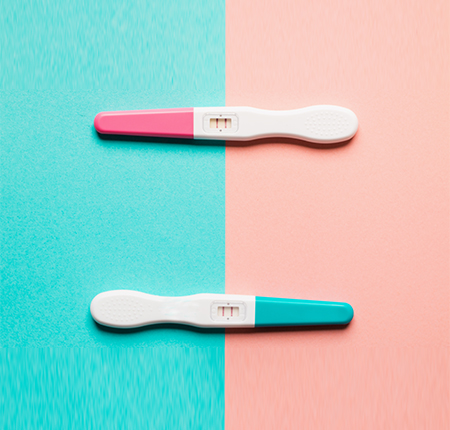
When does it make sense to take a pregnancy test?
You can take a pregnancy test from the first day your period is late. If you're not sure exactly when your period is due, it's best to take the test at least 21 days after unprotected sex. Worth knowing: some tests can even be used before your period is due – and, of course, everyone can experience different symptoms.
Here are some of the most common early signs of pregnancy:
- Abdominal cramps. When a fertilised egg implants in the lining of the womb, you may feel cramping.
- Spotting. This may be implantation bleeding, which can occur 6 to 12 days after the egg is fertilised.
- Whitish discharge. Immediately after conception, the vaginal walls begin to thicken and the body produces a characteristic secretion.
- Swollen, tender breasts. Breast changes occur very early in pregnancy due to hormonal shifts, and the area around the nipples may darken.
- Feeling more tired than usual. This may be down to hormones (progesterone rises), lower blood pressure, or increased blood production.
- A missed period. The most common sign of pregnancy is a missed period – although a cycle without bleeding doesn't always indicate pregnancy.
- Nausea. Particularly in the morning, this can be an early sign of pregnancy, though not everyone experiences it.
- Other signs may include: frequent urination, constipation, mood swings, dizziness, headaches, and muscle aches, especially in the back.
Not everyone experiences the same symptoms in early pregnancy. It can also be difficult to distinguish signs of pregnancy from premenstrual symptoms, as the two are often very similar.
How much does a pregnancy test cost and where can I buy one?
If you've noticed some of the symptoms above and want to know whether you're pregnant, it's time to get hold of a pregnancy test. Where can you buy one and how much does it cost? You can buy a pregnancy test online – both from online pharmacies and from other websites and online shops. You'll also find them in any local pharmacy. The cost of a pregnancy test depends on the brand, the type of test and, of course, the pharmacy or shop where you buy it. Prices vary, but for a standard test you'll generally pay a modest amount.
So the good news is: pregnancy tests are very easy to get hold of. You can buy them without a prescription, without spending much, and you can take them either at home or supervised at a medical centre or clinic.
You can buy a pregnancy test online through various platforms or online pharmacies. You'll also find them in any pharmacy. For a supervised pregnancy test, you can visit a medical centre or clinic. Prices vary, and the tests are available over the counter.
How do you take a pregnancy test?
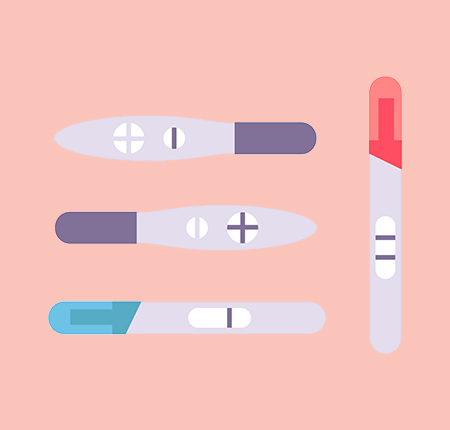
Most pregnancy tests are very straightforward to use. They have either an absorbent tip or a well for collecting urine.
Depending on the design of the test, the way you read it may differ. Every test has a time window within which it must be read for the result to be accurate. In most cases the result can be read after 5 or 10 minutes, with any changes after 10 minutes no longer being relevant. But don't worry – you'll find all these details in the packaging of whichever test you buy.
The result may appear as a + or − symbol, or as a colour change or the appearance of lines.
What is the hormone hCG or beta-hCG?
hCG is a hormone produced by the placenta. It can help follicles mature and trigger ovulation – and it's this hormone that a pregnancy test uses to determine whether or not you're pregnant.
The hormone hCG, or beta-hCG, can be detectable 6 to 10 days after the fertilised egg implants: an hCG level below 5 mIU/ml means a negative result, while an hCG level >= 35 mIU/ml indicates pregnancy.
The result – what does a positive pregnancy test look like?
Before taking a test, bear in mind that the result can be affected by how you take it and the time of day (first thing in the morning is best). Errors aren't impossible.
So how do you read the result of a pregnancy test?
Most tests show two red lines (C + T), indicating a positive result.
Let's take a Clearblue as an example.
- A single pink line at position 1 indicates that the hCG level is between 25 mIU/ml and 100 mIU/ml – a concentration seen in a pregnancy of up to 2 weeks
- Two pink lines at positions 1 and 2 indicate an hCG level between 100 mIU/ml and 300 mIU/ml. This occurs in the third week of pregnancy.
- 3 pink lines at positions 1, 2 and 3 indicate a pregnancy of up to 4 weeks
- 4 pink lines indicate a pregnancy of more than 4 weeks
- If no line appears in the C area, the result is invalid.
What can cause a false positive result?
In rare cases a false positive result can occur, namely if:
- you were recently pregnant, following a miscarriage or a termination
- you have rare types of ovarian cyst
- you're taking certain medicines containing the hormone hCG – such as fertility treatments
A negative pregnancy test result
A negative result is indicated by a pink line in the C area only.
What can cause a false negative result?
There's a chance of getting a false negative result – which happens more often than a false positive. If you're not sure whether the test result is accurate, it's best to get in touch with a clinic.
Invalid result
If the first line doesn't appear, or is only visible next to the T symbol, it means the pregnancy test is invalid and you'll need to repeat it.
How reliable is a pregnancy test?
Although most tests promise 99% certain, accurate results from the first day of a missed period, studies show that not all tests are quite so reliable when taken very early in pregnancy. Most are recommended for use a week after a missed period for greater accuracy.
Errors that can occur with a pregnancy test
The likelihood of an error with a pregnancy test is low – but possible. As a rule, each test's margin of error is stated on the packaging, with most tests being 99% reliable.
So there's a chance – albeit a rare one – of getting a positive result when you're not pregnant (a false positive), particularly if you were recently pregnant, are taking certain hormone preparations such as fertility medication, or have conditions such as ovarian cysts or adenomyosis.
Test results can also be skewed by human error. The most common mistakes that can lead to an incorrect result include:
- not checking the expiry date and using an out-of-date test
- taking the test too soon after unprotected sex (can lead to a false negative)
- taking the test too soon after a termination, miscarriage or birth (can lead to a false positive)
- drinking a lot of fluid before the test (can dilute the hormone concentration in your urine)
- removing the test strip from the urine stream sooner than recommended
- reading the result earlier or later than the recommended time window
To avoid these mistakes, always read the instructions carefully and follow them. They may be printed on the packaging, which sometimes also states how reliable the test is or how much it costs, or they may come as a separate leaflet inside the box.
The second line on the pregnancy test is faint
In principle, a second line on a pregnancy test indicates that you're pregnant – whether it's faint or clearly visible. However, if it's very faint, it means the test has detected only a small amount of hCG in your urine, suggesting that implantation has taken place and the pregnancy is still at a very early stage. To be sure, it's recommended that you repeat the test after a few days or weeks. A second positive test can confirm the first result – and the thicker and darker the second line becomes, the clearer the sign that the pregnancy has progressed.
Types of pregnancy test
There are various types of pregnancy test you can buy at the pharmacy and take at home – and even though they come from different brands or in different formats, most work in the same way. Don't worry: every pregnancy test comes with instructions for use that you should read carefully before taking it. Let's take a look at the types available.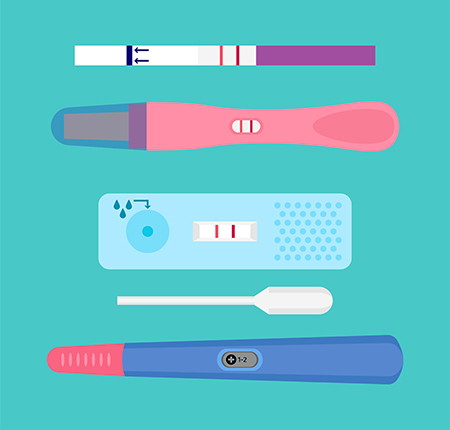
Strip pregnancy test
The test strip is simple to use: collect a urine sample in a clean, dry container and dip the test in, arrow tip down, up to the marked line for a few seconds. Then place the test on a flat surface, and after 3 minutes the result will appear.
Many test strips can detect even low hCG levels and may give accurate results from the first day of a missed period. The result should be read within the first 5 minutes, and no later.
Cassette pregnancy test
The cassette test works on the same principle as the strip test. Collect a urine sample in a clean, dry container, then use a pipette to place 3–4 drops of urine into the test window. The result is read after 5 minutes, but no later than 10 minutes.
Midstream (pen-style) pregnancy test
Another type of test that can detect hCG in the first days of pregnancy is the pen-style pregnancy test. Collect a urine sample in a dry, clean container, dip the absorbent tip in for 3 seconds, and after 3 minutes you can read the result. The absorbent tip can also be held directly in the urine stream without collecting the urine separately.
Digital pregnancy test
This is a more advanced pregnancy test, because it can tell you how far along the pregnancy is. As with the strip test, the digital test is dipped into a clean, dry container holding a urine sample. The test stays in for 20 seconds, is then laid flat for 3 minutes, and afterwards displays the result – which remains visible for 24 hours.
Ultra-sensitive pregnancy tests – how do they work?
Pregnancy tests can also be ultra-sensitive, detecting hCG levels in the very first days of pregnancy. They can be used up to 5 days before a missed period and at any time of day.
Pregnancy tests 8 days after conception
And if you're looking for a particularly sensitive test, there are versions that can detect a pregnancy as early as 8 days after conception. One example is the highly sensitive test that can detect the lowest hCG levels (down to 5 IU/l). It is, however, recommended that you use it in the morning with the first urine of the day.
A negative pregnancy test at 5 weeks
Sometimes tests fail to detect an existing pregnancy – yes, even at 5 weeks. Although it's highly unlikely, a pregnancy test can come back negative at 5 weeks if the amount of hCG in your urine is too low to be picked up by a home test.
An ectopic pregnancy can occasionally lead to a negative result too, although this is very rare. Generally speaking, tests can also detect an ectopic pregnancy, which requires immediate medical attention, as it cannot be carried to term and poses a risk to the mother.
Are there substances that can affect the test result?
Some medicines can affect the result of a pregnancy test, particularly infertility treatments or preparations containing hCG. Contraceptives (the pill) and antibiotics do not affect the result of a pregnancy test.
Even so, a false negative result can have various causes, such as:
- a chemical pregnancy – a miscarriage that occurs very shortly after implantation
- an ectopic pregnancy – when the fertilised egg implants outside the uterine cavity. If you suspect an ectopic pregnancy (symptoms include increasing abdominal pain, heavy bleeding or spotting, and dizziness), contact your gynaecologist.
Common questions about pregnancy tests:
How long does it take for a test to show a pregnancy?
If you want a result as early as possible, you can opt for an ultra-sensitive test that can detect even the lowest hCG levels right at the start of pregnancy (8 days after conception). Most pregnancy tests, however, work from the first day of a missed period or during the first week afterwards.
Can you take a pregnancy test during your period?
Yes. Menstruation doesn't change the test result, and hCG levels remain the same. Some people experience bleeding during pregnancy that resembles a period. It may be implantation bleeding.
If you're bleeding, we recommend using organic period products – free from chemicals and plastic – to protect your hormonal balance.
Does a pregnancy test have to be taken at a particular time of day?
Most brands recommend taking it in the morning, because urine is more concentrated then. But if you're taking the test when your period has already been late for a while, you can do it at any time of day, as the amount of pregnancy hormone will already be high enough to be detected.
Can you detect a pregnancy without a test (using oil/sugar)?
In short: no.
In ancient Egypt and Greece, using garlic or onion was a common method. Also in Greece, one test involved drinking a mixture of honey and water in the evening – if the person felt bloated the next morning, they were considered pregnant.
Another version was the oil test: two drops of oil were added to a container of urine, and if the drops merged, the result was positive. Although this method remained popular until relatively recently, there's no scientific evidence for its reliability.
The sugar method was also widely used: a few spoonfuls of sugar were mixed with urine, and if the liquid became homogeneous, the result was positive. This test, too, has no scientific basis.
More information – what happens next?
Depending on the result, you can plan your next steps. If the test is positive, start by booking an appointment for an additional blood test and/or an ultrasound scan to confirm the pregnancy.
If the test is negative and your period still doesn't arrive, you can repeat the test after a few days or a week. If it remains negative – and your period still hasn't come – see a gynaecologist. There can be many reasons for a missed period, including periods of significant stress, intense exercise or hormonal disorders.
The pregnancy is wanted

What happens after your visit to the gynaecologist? If you're pregnant and wish to continue the pregnancy, you can begin antenatal care. Your doctor will calculate your estimated due date and recommend the necessary vaccinations as well as antenatal screening to make sure the baby is developing healthily.
The pregnancy is not wanted
If the pregnancy isn't wanted, there are options for terminating it. Here too, the first step is to speak to your doctor.
In the UK, a termination is legal up to 24 weeks of pregnancy (England, Scotland and Wales), and you can contact your GP, a sexual health clinic or an abortion provider such as BPAS or MSI Reproductive Choices directly. The available methods include early medical abortion (abortion pills), which can be used up to 10
weeks of pregnancy and, in England and Wales, can be done at home after a remote consultation and provided there are no contraindications to the medication, and surgical abortion, which can be carried out under local or general anaesthetic.
Recommended tests after a positive pregnancy test
It's worth taking a second pregnancy test to make sure the result is accurate. The immediate next step after confirming a positive result is to book an appointment with a gynaecologist. It's important that the pregnancy is monitored from the outset and that you have all the tests needed during pregnancy to avoid complications and ensure you give birth to a healthy baby.
At your first appointment, your medical history will usually be taken and a gynaecological examination carried out (to identify any risk factors); you'll then be advised on the standard tests for the first trimester of pregnancy. These may include an ultrasound scan, a urine test, a full blood count and blood glucose measurement, blood group and rhesus factor testing, and other tests that you'll discuss and decide on together with your specialist.
Sources used for this article
To provide the information and answers in this article, we consulted the following online sources:
1. Cleveland Clinic, “Pregnancy Tests”: https://my.clevelandclinic.org/health/diagnostics/9703-pregnancy-tests
2. WebMD, “Pregnancy Tests”: https://www.webmd.com/baby/pregnancy-tests
3. Healthline, “Tests Used To Confirm Pregnancy”: https://www.healthline.com/health/pregnancy/tests
4. MedicalNewsToday, “What To Know About Pregnancy Testing”: https://www.medicalnewstoday.com/articles/316463
5. Mayo Clinic, “Home pregnancy tests: Can you trust the results?”: https://www.mayoclinic.org/healthy-lifestyle/getting-pregnant/in-depth/home-pregnancy-tests/art-20047940
6. The Source: “7 Reasons Your Pregnancy Test Gave A False-Positive”: https://www.thesource.org/post/reasons-your-pregnancy-test-gave-a-false-positive
7. MedicalNewsToday, “Five reasons for false-positive pregnancy test”: https://www.medicalnewstoday.com/articles/319803
8. Healthline, “Causes of a Negative Pregnancy Test with No Period”: https://www.healthline.com/health/pregnancy/causes-of-negative-test-no-period#ectopic-pregnancy
9. Healthline, “7 Possible Causes of a False Pregnancy Test”: https://www.healthline.com/health/pregnancy/false-positive-pregnancy-test
10. Healthline, “Faint Positive Home Pregnancy Test: Am I Pregnant?”: nhttps://www.healthline.com/health/pregnancy/faint-positive-home-pregnancy-test

Medium, super or extra absorption

Low, medium or super absorption

Low or medium absorption


and happily breaking taboos!


