

False Positive Pregnancy Test – Causes of a False Positive Result on a Pregnancy Test
If your period is late and the pregnancy test comes out positive, yet you notice no signs of pregnancy whatsoever, you may be dealing with a false positive result. Although most tests are highly reliable, they cannot guarantee 100 per cent accuracy – and that can cause a great deal of confusion.
Taking a pregnancy test and waiting for the result is emotionally charged enough as it is – whether you're hoping for long-awaited confirmation that you're going to be a mum, or facing an unwanted pregnancy. But the uncertainty of an invalid result can become a genuine source of stress and anxiety. Read on to find out what can cause a false positive result and how to carry out a pregnancy test correctly at home.
What a pregnancy test is and how it works
A pregnancy test is a tool you can use at home at any time to find out whether or not you're pregnant.
The test measures the concentration of hCG in your urine (levels of this hormone rise during pregnancy) and, if you use it correctly, the result is theoretically 99% accurate. On the Enroush blog we have an article explaining everything you need to know about pregnancy tests: how they work, how much they cost and what types are available.
If the test result is negative, you're not pregnant. If it's positive, there's a strong likelihood that you are. However, there is also the possibility of a false positive result, which indicates a pregnancy when you're not actually pregnant at all.
When should you take a pregnancy test?
It's a good idea to take a pregnancy test if, for whatever reason, you suspect you may have conceived.
That might be because your period hasn't arrived following unprotected sex, because you're feeling nauseous and needing to pass water frequently, or because you've noticed some other early sign of pregnancy. We've written HERE about all the early pregnancy signs that might prompt you to take a test.
Ideally, you should take the test a week after your missed period. By then, hCG levels are high enough to be detected in your urine. If you test too early, you could get a false negative result. If you can't wait: there are ultra-sensitive tests that can detect a pregnancy even before your period is due. The important thing is to read the instructions on the packaging, as they specify exactly how early you can take the test.
And if you're wondering what time of day is best for taking a pregnancy test: hCG concentration in urine is at its highest first thing in the morning. That's why it used to be recommended that you take the test as soon as you wake up. These days, tests are sensitive enough to detect even low concentrations of hCG – so there's no need to worry and you can take the test at any time of day.
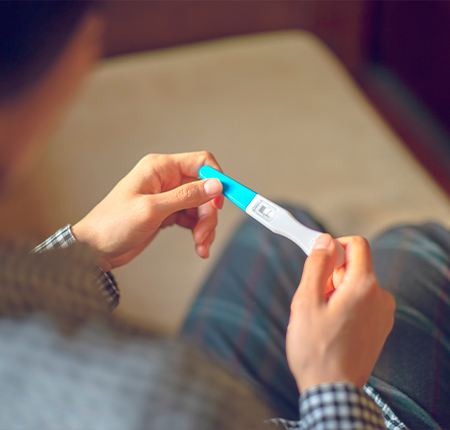
How to carry out a pregnancy test correctly
There are various types of pregnancy test – from the stick test to the test strip. How you use them correctly differs from one to another.
If you have a cassette test, for example, you'll need to collect a urine sample in a clean container and then use a pipette to place 3 drops into the relevant window on the test. With a stick test, you can hold the absorbent end directly in your urine stream for a few seconds.
Always read and follow the instructions on the packaging. They'll take you through, step by step, how to carry out the test correctly and interpret the results properly. Also check the expiry date and never use an out-of-date pregnancy test.
Interpreting the result
It's not enough to carry out the test according to the instructions – you also need to read it correctly. Take the same examples as above: with a cassette test, you read the result after 5 minutes, but no later than 10 minutes; with a stick test, you can read the result after just 3 minutes.
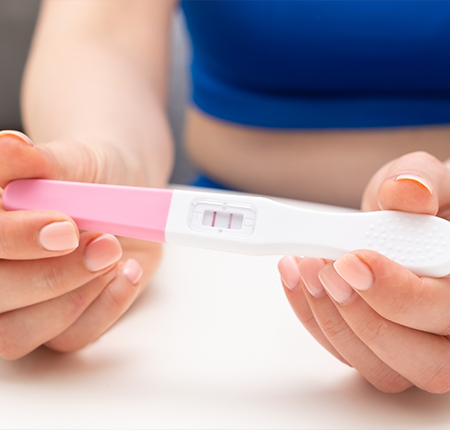
Results are also displayed differently. A positive result may appear as a plus sign (+) or as two lines, while a negative result is shown by a minus sign (-) or a single line.
Pay attention to the control and test windows too, because if lines appear in the wrong places or are missing from them, the test is invalid and you'll need to repeat it. As mentioned, you'll find all this information on the packaging of your particular test.
What does a false positive pregnancy test result mean?
When a pregnancy test result is positive without you being pregnant or having any other sign of pregnancy, this is known as a false positive result.
There are many reasons for an inaccurate result. A false positive can therefore mean that you have certain medical conditions, that you're undergoing particular treatments, or simply that you used the test incorrectly.
Causes of a false positive pregnancy test result
Sometimes you may get a false positive result even if you're careful and follow every step exactly as described on the packaging.
It's an unpleasant situation that can cause you needless worry if you don't want to be pregnant – or raise false hopes followed by disappointment if you're longing for a baby. Here are some of the reasons why it can happen:
Chemical pregnancy
When an embryo forms after fertilisation but is unable to implant in the wall of the womb, this is known as a chemical pregnancy. The body has already begun producing hCG, which the pregnancy test can detect in your urine – even though the embryo doesn't develop any further and the pregnancy is lost.
Most chemical pregnancies actually go undetected, precisely because the only way to identify them is with a pregnancy test.
Miscarriage
After a miscarriage, hCG levels begin to fall. This happens gradually and slowly, however, so the hormone can remain detectable in urine for up to 6 weeks. A pregnancy test taken during this period may still detect the hormone, even though the previous pregnancy has been lost and there is no new pregnancy.
Ectopic pregnancy
An ectopic pregnancy is when an egg is fertilised but implants outside the womb rather than inside it. It may remain in the fallopian tubes, in an ovary, in the cervix or elsewhere in the abdominal cavity.
Such a pregnancy cannot continue, as a baby can only develop within the womb. It also requires urgent treatment, as it can become dangerous for the mother. We have another blog article in which we discuss in detail what an ectopic pregnancy involves.
With an ectopic pregnancy, hCG levels are usually lower and considerably harder to detect than in a normal pregnancy. Even so, some tests will pick it up and show you a false positive result, despite the pregnancy being unable to continue.
Certain medications
Medications used to treat infertility or to improve the chances of conceiving contain hCG. It may also be present in anticonvulsants and diuretics. If you're undergoing such treatment, the test may detect the raised hCG level and you could get a false positive result.
Medical conditions
There are a number of health problems that can lead to a rise in the body's hCG levels. These include kidney or liver disease, disorders of the endocrine glands, and ovarian, lung, breast, stomach or bladder cancer. If you have any of these problems, there's a risk of getting a false positive result after taking a pregnancy test.
Other conditions that can cause a false positive result include ovarian cysts, the perimenopause, the menopause and gestational trophoblastic disease, which can cause tumours in the cells that would normally go on to form the placenta.
Incorrect use of the pregnancy test
There are many situations in which incorrect use reduces the accuracy of the test. For example, if you use an out-of-date test. Or if you wait longer than stated on the packaging and read the result too late. If this applies to you, the result isn't valid and it's best to take a new test.
The appearance of an evaporation line
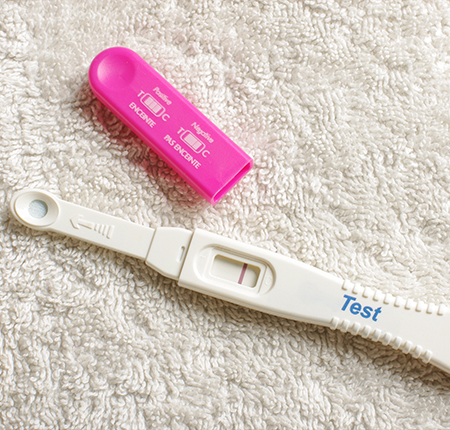
With tests that display the result using lines, you need to be particularly attentive when reading them. A second line may appear, but it might be smudged or only very faintly coloured. This doesn't necessarily mean you're pregnant – it may simply be an evaporation line. The result is a false positive if you interpret the evaporation line as a pregnancy.
When to see a doctor about a false positive pregnancy test
The first step after a positive pregnancy test – whether false or genuine – is to repeat it. The likelihood of getting an inaccurate result twice in a row is low, and a second positive result can confirm the pregnancy. Once it's confirmed, you should see a doctor for antenatal care.
Even if there's no pregnancy, it's important to see a doctor as soon as possible if you get a false positive result and then experience vaginal bleeding, abdominal cramps or any other unusual symptoms. At the surgery, blood tests or an ultrasound scan can be carried out to establish with certainty whether or not you're pregnant.
Treatment for a false positive pregnancy test
What you can do if you get a false positive pregnancy test is discuss it with your doctor. They will determine the exact cause – whether you're undergoing certain treatments or have a condition that raises your body's hCG levels.
Depending on this, they will either recommend a change of medication or the treatment required for particular conditions.
How to avoid a false positive pregnancy test
A false positive pregnancy test can become a real source of stress, confusion and disappointment – so it's understandable that no woman wants to find herself in that situation. Here are some recommendations to help you avoid a false positive pregnancy test result:
-
Always read the instructions. Follow the guidance on the pregnancy test packaging step by step – from carrying out the test to reading the result.
-
Check the expiry date. Don't use tests where the date shown on the packaging has passed.
-
Talk to your doctor about the medication you're taking. Don't self-medicate, and let your doctor know if you want to become pregnant so they can adjust your treatment in a way that doesn't affect your body's hCG levels.
-
Have a blood test. If you want to be completely certain and leave no room for doubt, opt for a pregnancy blood test. The downside is that you can't do it yourself at home – but an inaccurate result is extremely rare.

Medium, super or extra absorption

Low, medium or super absorption

Low or medium absorption


and happily breaking taboos!


