

Menstruation before the invention of tampons
Menstruation has always been a taboo subject – particularly during the period when the industry was just beginning to take shape. Yet the prejudices surrounding menstrual hygiene are still with our society today.
Did you know that the word “menstruation” was never spoken on television until 1985?
Almost 100 years after the first tampons came onto the market, innovation is finally taking hold – and we have an ever-growing range of sustainable options to choose from, ones that are safe for both our health and the planet. But how did it all begin?
When did the first sanitary towels appear?
Long before disposable sanitary towels were invented, history offers plenty of references to their “ancestors”. The earliest mention comes from Greece in the 10th century: cloths made of cotton or wool, rabbit fur, bundles of grass – these were just some of the options menstruating people turned to when needed.
In the 19th century, in both Europe and the United States, most “menstrual cloths” were sewn at home from various fabrics – hence the American euphemism “on the rag”, which emerged in the 19th century to describe someone who was menstruating.
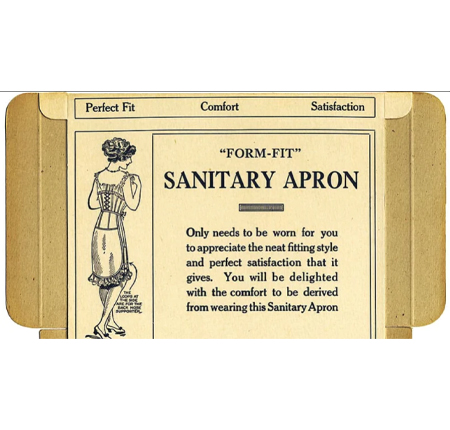
Sanitary shorts in the 1850s
At the start of the 20th century, women's intimate hygiene came into focus, as inadequate cleaning of menstrual cloths was harming their health.
During this period a variety of products were patented: the first menstrual cups (made of aluminium or hard rubber!), rubber-lined underwear and much more.
The first disposable sanitary towels, however, were developed by nurses on the front lines of the First World War to stem heavy bleeding.
The nurses discovered that cellulose was more absorbent than fabric dressings and began using the material for menstruation too. In 1921, the first Kotex sanitary towels made from “Cellucotton” – this highly absorbent plant-based material – came onto the market.
The arrival of sanitary towels in the 1920s gave women greater control over their own bodies and greater independence: they could work and take part in activities outside the home to a far greater extent than before – an important step towards emancipation.
For those leading active lives – dancers, athletes – the menstrual products market expanded with an innovation that met the need for greater flexibility: and so tampons came into being in the 1930s. Curiously, while the first tampons were very similar to today's, they were considerably more sustainable: a cardboard applicator, a cotton tampon and a cotton withdrawal string.
Even so, tampons remained unpopular until the 1980s. In the meantime, sanitary towels underwent two improvements: the first, decisive one in 1969, when the StayFree brand introduced towels with an adhesive strip, and the second in the 1980s, when wings were added.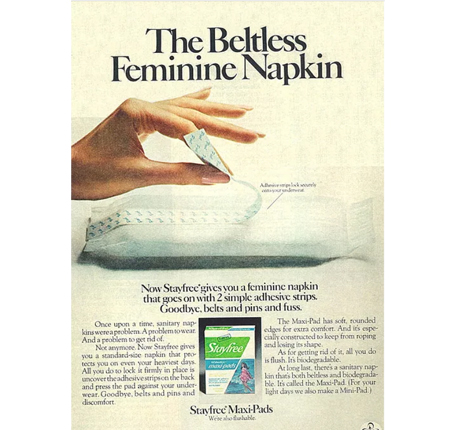
In 1969, Stayfree launched the first sanitary towels without a belt, using an adhesive strip instead!
Tampons grew ever more popular, but health problems emerged: between 1979 and 1996, over 5,000 cases of toxic shock syndrome (TSS) were reported, many of them linked to one particular tampon brand and the toxic materials used in it.
The 2000s brought new sustainable products to the market – alongside organic tampons and organic sanitary towels, there were also washable towels, period underwear and the menstrual cup – as well as a raft of new, stricter regulations.
What do we use during our periods today?
Demand for menstrual products has risen – and so has awareness of sustainability. Today, around 2 billion girls and women menstruate, and it comes as no surprise that the amount of menstrual waste has increased significantly. The UK alone produces 200,000 tonnes of menstrual waste every year! A large proportion of it ends up in the oceans. How much of an environmental impact does your period have? Read more here
Conventional menstrual products have seen little innovation in recent years and still consist of up to 90% plastic, synthetic fibres and toxic substances. What's more, the “classic” menstrual product brands aren't transparent – so you're highly unlikely to find a list of ingredients on your packaging.
And because your vulva and vagina are extremely absorbent and in direct contact with these products, your body takes in any harmful ingredients. This can lead to unpleasant side effects, such as:
- Hormonal imbalances
- Thyroid disorders
- Irritation and allergies
- Various infections
- Heavy menstrual bleeding
- Endometriosis
- Diabetes
Organic menstrual products – biodegradable / sustainable / reusable – are the responsible choice, both for your body and for the planet.
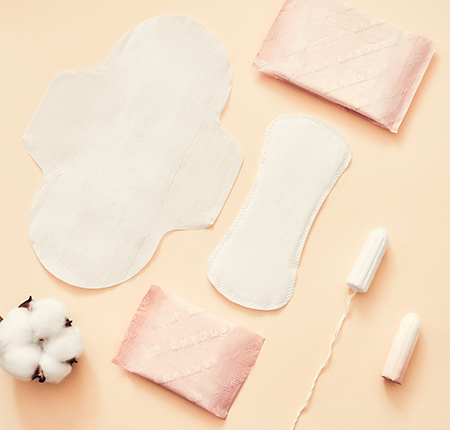
This is especially true of organic products: because they're made entirely from 100% organic cotton, with no chemicals or plastic, they have no side effects whatsoever on your body. With tampons, you should of course still follow the rule of changing them every 4 hours – just as with “conventional” ones. And since they're biodegradable or compostable, they break down within 12 months. That means zero environmental impact.
In the last few years alone, growing awareness of the environmental problems surrounding menstrual products has brought about positive change. And fortunately, sustainable alternatives are just a click away.

Medium, super or extra absorption

Low, medium or super absorption

Low or medium absorption


and happily breaking taboos!


