

Ovarian Torsion / Twisted Ovary: Causes & Symptoms
Ovarian torsion refers to the twisting of the ovary along with the ligaments that attach it to neighbouring organs. It's vital to recognise the symptoms immediately and to see a doctor at the very first signs. Ovarian tissue can suffer irreversible damage if the blood supply remains cut off for a prolonged period.
Surgery is urgently required, and time becomes the decisive factor in saving the ovary and preventing further complications. Read on to find out how ovarian torsion presents itself, why it occurs and how it is treated.
What is ovarian torsion
Ovarian torsion is a gynaecological emergency in which the ovary — and sometimes the fallopian tube as well — twists around its own ligaments. This twisting blocks the blood supply to the ovary and leads to ischaemia and necrosis if prompt action isn't taken.
The condition occurs more frequently in young women of childbearing age, but it can happen at any stage of life. Because of the risk of permanent damage to the ovary, ovarian torsion requires rapid diagnosis and emergency surgery.
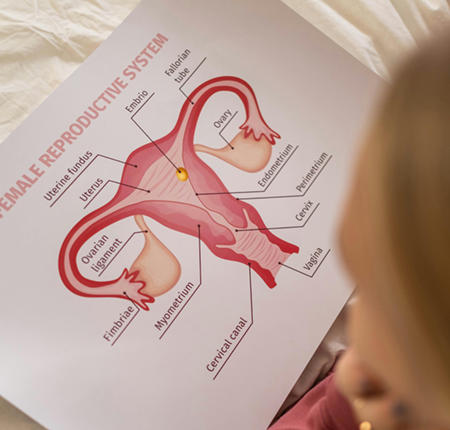
To better understand what happens, picture how the reproductive organs are arranged in your body.
The two ovaries sit on either side of the uterus and are held in position by thin ligaments which at the same time allow them a certain degree of mobility. The blood vessels that supply the ovary run through these ligaments. As soon as the ovary rotates around its own axis, these vessels are compressed and blood flow is interrupted. Without sufficient oxygen, ovarian tissue is quickly damaged.
For this reason, ovarian torsion is a medical emergency. The sooner intervention takes place, the greater the chances of preserving the ovary and its function. The longer surgery is delayed, the higher the risk of peritonitis (infection within the abdominal cavity) and necrosis (death of the ovary).
How ovarian torsion develops
Ovarian torsion occurs when the ovary rotates around the structures supporting it. The twisting may be complete or only partial and, in the long term, can lead to peritonitis or loss of the ovary if it isn't treated surgically.
Torsion can occur suddenly and on one side only, and is usually accompanied by severe pain and vomiting.

The mechanism of ovarian torsion
When the ovary rotates around the axis formed by its supporting ligaments, venous drainage is affected first. This leads to congestion and swelling of the ovary. If the twisting persists, arterial blood supply is also compromised.
The lack of oxygen and nutrients causes ischaemia, meaning the ovary no longer receives any blood supply. If the situation isn't resolved swiftly through surgery, necrosis of the ovarian tissue can set in.
The anatomy involved in ovarian torsion
The ovaries lie to the sides of the uterus and are held in position by thin ligaments which also give them a certain degree of mobility. Under certain circumstances, this mobility can predispose the ovary to twisting.
Ligament laxity or an enlarged ovarian cyst increase the risk of torsion, as they alter the weight and stability of the ovary.
There are also cases in which not only the ovary but also the adjacent fallopian tube (the narrow passage connecting the ovary and uterus) twists as well. This situation is known as adnexal torsion and describes the rotation of the fallopian tube around its own axis.
Causes and risk factors for ovarian torsion
There are several anatomical and physiological factors that influence the position and stability of the ovary and can therefore predispose a woman to ovarian torsion. The causes that can lead to twisting of the ovary include:
- The presence of an ovarian cyst or tumour, which can cause the ovary to shift and twist, particularly in cases of cyst torsion.
- Pregnancy and the associated hormonal changes, which cause the ovarian ligaments to slacken and can increase the risk of torsion. According to statistics, pregnancy accounts for 20% of all torsion cases.
- Ovarian stimulation as part of fertility treatment (ovarian hyperstimulation).
- Excessively long ovarian ligaments or congenital anatomical anomalies, which allow the ovary to rotate.
- Pelvic injuries or post-surgical adhesions.
- Polycystic ovary syndrome, as the presence of multiple small cysts can alter the weight and size of the ovaries as well as the elasticity of the supporting tissue, thereby increasing susceptibility to torsion.
- A previous episode of ovarian torsion, since anatomical changes and the formation of post-surgical adhesions increase the risk of recurrence.
Symptoms of ovarian torsion
The symptoms of ovarian torsion usually appear suddenly and may initially include the following:
- Severe, stabbing lower abdominal pain on one side (left or right).
- Frequent nausea and vomiting.
- Fever, sweating and a generally unwell feeling.
- An abdomen tender to the touch, or abdominal cramping.
- Occasionally, light vaginal bleeding.
The more time passes since the twisting occurred, the more likely the pain is to radiate to the back or thigh, and bleeding within the abdomen may occur.
The intensity and duration of symptoms can vary, and fever may persist for several weeks. The severe, previously unfamiliar pain, however, is a constant feature and a clear sign that a medical examination is needed.
Diagnosing ovarian torsion
Ovarian torsion is usually suspected on the basis of the symptoms and clinical examination, with the diagnosis confirmed by imaging.
There are also situations in which the condition is only confirmed with certainty during surgery, as time directly affects the chances of saving the ovary, meaning emergency surgery may be necessary.
Clinical examination and medical history
The first step of the consultation consists of a clinical examination and a discussion in which the doctor aims to learn as much as possible about the patient's medical history.
The physical examination involves palpating the lower abdomen and pelvic region to determine the location and intensity of the pain as well as any signs of peritoneal irritation. To establish the diagnosis, the patient will be asked about the sudden onset of pain and accompanying symptoms such as nausea or vomiting.
The doctor will also look for tenderness on pressure and signs of guarding — key indicators for differential diagnosis. These can help rule out other acute causes such as appendicitis or renal colic, which can produce similar complaints.

Transvaginal ultrasound with Doppler in ovarian torsion
Transvaginal ultrasound is the most important investigation for diagnosing ovarian torsion, with colour Doppler analysis being a specialised imaging technique for assessing the blood supply to the ovary.
This examination allows detailed visualisation of the organs in the pelvic region as well as any characteristic changes such as enlargement of the ovary, the presence of cysts, ovarian masses or twisted adnexal structures, along with any changes in ovarian blood flow. In other words, if blood flow in an ovary is reduced or absent, this can be detected on transvaginal Doppler ultrasound.
Apparently normal blood flow does not, however, entirely rule out the diagnosis, particularly in the early stages. There are cases in which the condition is present despite blood flow being detectable, since torsion can be partial or intermittent.
Other imaging investigations in ovarian torsion
As part of the diagnostic process, additional investigations may be carried out to rule out other possible causes of acute abdominal pain.
Computed tomography (CT) or magnetic resonance imaging (MRI) allow a more precise assessment of the pelvic structures in order to distinguish the condition from other abdominal disorders. Blood tests for inflammatory markers, pregnancy tests and urine tests may also be recommended.
Nevertheless, a definitive diagnosis is frequently made intraoperatively, during laparoscopy. This procedure allows direct visualisation of the twisted ovary while also offering the opportunity for immediate treatment.
Treatment of ovarian torsion
Ovarian torsion is a surgical emergency and treatment must begin as quickly as possible to improve the chances of preserving the ovary and its function.
Laparoscopic surgery is the standard procedure; its aim is to restore blood circulation and prevent irreversible damage to the ovarian tissue. The procedure is minimally invasive and allows both confirmation of the diagnosis and immediate treatment.
Where laparoscopy isn't possible — for example with large ovarian masses that need to be removed, or in cases of severe complications — a laparotomy may be performed. The abdominal incision is larger, giving the surgeon better access to and a better view of the pelvic structures.
Before surgery, painkillers may be given intravenously to relieve the pain quickly. Antibiotic therapy may also be recommended if there is a risk of infection or if the ovarian torsion is complicated by ischaemic changes.
During the procedure, the surgeon performs detorsion of the ovary to restore blood flow and assesses the viability of the ovarian tissue in order to decide on the next steps:
- Preserving the ovary, which is possible where there are no signs of necrosis and involves returning the ovary to its normal position. This is also the ideal outcome, particularly in young patients.
- Oophoropexy, a procedure in which the ovary is secured in place to reduce the risk of recurrent torsion.
- Oophorectomy, that is, removal of the damaged ovary where the tissue is severely compromised and necrotic.
Following the procedure, post-operative monitoring is required — to check healing, assess ovarian function and protect fertility in the long term.
Complications of ovarian torsion
Left untreated, ovarian torsion can have consequences for reproductive health and the ability to conceive; their severity depends largely on how long blood flow has been interrupted. The most common complications include:
- Ovarian necrosis, that is, death of the tissue through lack of oxygen — in this case the ovary can no longer be saved and must be removed surgically.
- Secondary infertility, where ovarian function is significantly impaired or the ovary has to be removed.
- Infection in the pelvic region.
- Peritonitis (inflammation of the peritoneum) in severe cases.
- Risk of recurrence in the same ovary (particularly if no oophoropexy was performed) or in the opposite ovary.
Ovarian torsion and menstruation
Menstruation is not a direct cause of ovarian torsion, but the characteristic pain can be mistaken for period cramps because of the similar location and nature of the discomfort. Here, the intensity of the symptoms and the response to treatment can be useful clues in distinguishing between the two types of pain.
During menstruation, pain caused by torsion is generally considerably more severe and one-sided. Unlike period cramps, this pain doesn't ease with common anti-inflammatories and an intimate care routine using gentle menstrual products. If lower abdominal pain lasts longer than 24 hours and is accompanied by nausea or fever, an ultrasound is needed to confirm or rule out twisting of the ovary.
Ovarian torsion can also be influenced by other phases of the menstrual cycle. In the premenstrual phase, the ovaries may be more voluminous due to functional cysts, which increases the risk of cyst torsion. After menstruation, torsion can occur in connection with ovulation or a persistent cyst. And in some cases, periods may be absent or delayed if ovarian function is impaired.
When you should go to A&E with ovarian torsion
Saving a twisted ovary depends directly on how quickly surgery is performed. That's why any suspicion of ovarian torsion is an emergency, and you should see a doctor at the very first signs. Seek medical help immediately if you notice the following:
- Sudden, severe, one-sided lower abdominal pain.
- Persistent nausea and vomiting.
- Fever, dizziness, rapid pulse or cold sweats.
Frequently asked questions about ovarian torsion (FAQ)
Are you worried about the possible consequences of ovarian torsion and need more information? Below you'll find clear, concise answers to the questions patients ask most often about the risk of recurrence, recovery after surgery and the effects of ovarian torsion on fertility.
Can ovarian torsion be prevented?
There is no guaranteed way to prevent it, but monitoring ovarian cysts and treating gynaecological conditions can reduce the risk of ovarian torsion. In patients who have already been diagnosed, the risk of a further episode of torsion can be reduced by oophoropexy.
Can ovarian torsion occur during pregnancy?
Yes, ovarian torsion is possible, particularly in the first trimester, when hormonal changes can cause an increase in ovarian volume and slackening of the ligaments. Around 20% of cases occur during pregnancy.
What happens if treatment for ovarian torsion is delayed?
The longer the procedure is delayed and the blood supply to the ovary remains interrupted, the higher the risk of inflammation and ovarian necrosis, which in turn may necessitate removal of the ovary and affect fertility.
Can you live normally with only one ovary?
A single functioning ovary is sufficient in most cases to maintain the menstrual cycle and to conceive.
What does the pain of ovarian torsion feel like?
The characteristic pain of ovarian torsion begins suddenly and is experienced as intense and one-sided. It may be accompanied by nausea and vomiting and cannot be significantly relieved with ordinary painkillers.
Can ovarian torsion recur after surgery?
Yes, recurrence after surgical treatment of ovarian torsion is possible, but oophoropexy (securing the ovary in place) can reduce this risk.
How long does recovery take after surgery for ovarian torsion?
Recovery following laparoscopy is generally quick. Most patients are able to resume their usual activities within one to two weeks.
Which investigations confirm a diagnosis of ovarian torsion?
Transvaginal Doppler ultrasound is the fundamental method for diagnosing ovarian torsion; this may be supplemented by blood, urine and pregnancy tests as well as CT or MRI scans. In some cases, the diagnosis is only definitively confirmed during laparoscopy.
Is fertility affected after ovarian torsion?
If the ovary can be preserved, fertility is not affected by the twisting. Difficulties conceiving may arise if the damaged ovary has to be removed; generally, however, the healthy ovary can continue to carry out the ovulatory function and thus prevent infertility.
What are the warning signs of ovarian torsion in adolescents?
Sudden, severe and persistent one-sided lower abdominal pain, nausea, vomiting and fever must be investigated immediately — including in adolescents with no known gynaecological history.
Image source: Pexels.com

Medium, super or extra absorption

Low, medium or super absorption

Low or medium absorption


and happily breaking taboos!


