

Pre-ejaculate – what is it and can you get pregnant from it?
Pre-ejaculate isn't the same thing as semen. And yet – how can you get pregnant if there hasn't been any ejaculation?
We know questions like these are on your mind, especially if you rely on the withdrawal method, or if you and your partner only put the condom on partway through sex. Let's clear all of this up so there's no doubt left. Find out what pre-ejaculate is, what risks come with it and whether it can get you pregnant.
What is pre-ejaculate?
Pre-ejaculate, also known as pre-seminal fluid or Cowper's fluid, is – as the name suggests – a fluid that leaks from the penis before your partner ejaculates. It's a natural, viscous, clear lubricant that resembles semen – but isn't the same thing.
One of the key differences lies in where each fluid is produced:
-
Semen is produced in the testicles.
-
Pre-ejaculate is produced in the bulbourethral glands. These glands are also called Cowper's glands, hence the name Cowper's fluid. The glands of Littré and Morgagni also play a part in producing this fluid.
Another difference is the number of sperm each contains.
-
The semen released during ejaculation contains sperm capable of causing a pregnancy.
-
Pre-ejaculate, in theory, contains no sperm.
Even so, sperm may already be present in the urethra and can mix with the pre-ejaculate before it leaks out. That's why it can contain small amounts of sperm, which can lead to pregnancy.

What pre-ejaculate does
If its main job isn't to transport sperm (because that's semen's role), then why does pre-ejaculate exist at all, and what does it actually do? Well, it essentially has two functions:
-
It reduces friction and irritation during intercourse, acting as a natural lubricant.
-
It protects sperm and supports their health.
In its role as a lubricant, pre-ejaculate is comparable to the fluid your vagina produces when you're aroused. Its glycoprotein content provides the slipperiness during sex. It's designed to make penetration easier and more comfortable, and to prevent irritation.
As for its protective function: it contains nutrients (proteins, calcium, potassium, sodium and zinc) as well as other substances that keep semen healthy (water, fructose and so on). Semen and urine are expelled through the same channel, and urine's more acidic pH can kill sperm. Because pre-ejaculate is rather alkaline, however, it can neutralise the acidity in the urethra so that sperm survive and are transported safely.
When does pre-ejaculate appear?
Pre-ejaculate is released involuntarily when a man is aroused. It can appear during masturbation or intercourse, but always before ejaculation.
It's really important to know this: the release of this fluid can't be controlled. Some men can sense when orgasm (and ejaculation) is coming and can manage the timing – but with pre-ejaculate that's simply impossible.
Can you get pregnant from pre-ejaculate?
Because pre-ejaculate is released involuntarily and can contain sperm, there is a risk that it enters the vagina and causes a pregnancy – even if your partner doesn't ejaculate.
That's why couples who use the withdrawal method – which we've told you all about HERE – aren't protected against an unwanted pregnancy. The likelihood of pregnancy is lower, admittedly, because pre-ejaculate contains considerably fewer sperm. Yet statistics show that around 27% of sexual encounters "protected" solely by withdrawal, with no other form of contraception, resulted in a pregnancy.

The risk of pregnancy outside ovulation
Naturally, the risk of getting pregnant from pre-ejaculate is also influenced by other factors, such as the timing of ovulation. The chance of the egg being fertilised by a sperm is much higher, for instance, if you have sex during your fertile window than outside ovulation.
Even so, withdrawal combined with timing sex outside ovulation isn't a reliable method of contraception. Sperm can survive in the female reproductive tract for up to 5 days, so fertilisation can still happen if you have sex up to 5 days before ovulation rather than on the day itself.
What's more, it's very difficult to work out your fertile days if your cycle is irregular – so there's a real risk of pregnancy even when you believe you're not ovulating.
Can pre-ejaculate transmit diseases?
Yes! Pre-ejaculate can pass numerous bacteria, viruses and microorganisms from your partner's body into your vagina during intimate contact.
So if your partner is infected with HIV, chlamydia, gonorrhoea, hepatitis B or other bacteria and viruses – even without symptoms – he can pass them on to you during intercourse. HERE you can read everything you need to know about sexually transmitted infections and how to protect yourself.
In short: always use a condom right from the start so that no pre-ejaculate enters the vagina. That way you're protected not only against an unwanted pregnancy, but also against sexually transmitted infections.
Can the release of pre-ejaculate be avoided or prevented?
No – no more than you can control or stop your vagina's natural lubrication. The release of pre-seminal fluid is involuntary and often happens without any awareness of it. So even a partner who can control his orgasm and the timing of ejaculation won't be able to avoid or control pre-ejaculate.
The only way to be certain of preventing a pregnancy caused by pre-ejaculate is for your partner to have a vasectomy. In that case, after a few months neither the pre-ejaculate nor the semen will contain any sperm, as they are cleared entirely from your partner's body.
But even after a vasectomy, pre-seminal fluid is still released and still provides lubrication – without being controllable.
Reliable methods of contraception
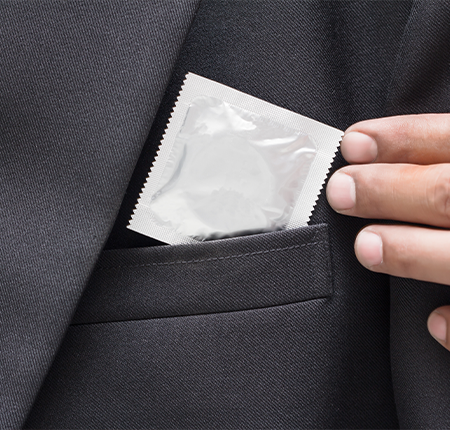
For a condom to genuinely protect you against an unwanted pregnancy, it must be worn from the very start of intercourse, so that no pre-ejaculate can enter the vagina.
So if you'd like to have sex without a condom, there are other reliable methods of contraception that will prevent pregnancy even when pre-ejaculate is released. Some of them are:
-
The coil: it protects against pregnancy even when fitted up to 5 days after unprotected intercourse. It's a long-acting method of contraception that, on average, only needs replacing every 7–10 years, and it doesn't affect your fertility once removed. You can find out more about how the coil is fitted, which types are available and how it's removed HERE.
-
The contraceptive pill: one of the most widely used methods of contraception is the pill. It prevents ovulation and therefore the release of an egg – so even if sperm do reach the female reproductive tract, there's no egg for them to fertilise and no pregnancy can occur.
-
The morning-after pill: if you have had unprotected sex after all, there's Plan B. The morning-after pill is a form of emergency contraception that should be taken as soon as possible, and no later than 5 days after unprotected intercourse. It delays ovulation and thickens cervical mucus in order to prevent the release of an egg and block the sperm's path.
Worth knowing: all of these methods only prevent pregnancy – they don't protect you from catching a sexually transmitted infection. So use them alongside a condom or another barrier method if you have a new partner or multiple partners, or if there's any chance your partner is infected – that's the only way to be fully protected.

Medium, super or extra absorption

Low, medium or super absorption

Low or medium absorption


and happily breaking taboos!


