

Progesterone: what it is and the role it plays in the body
A hormone we tend to associate with the female body – and rightly so, since it performs a great many important jobs within a woman's body. Nevertheless, progesterone carries out numerous functions in both women and men. In the male body, progesterone regulates the release of testosterone. In women, however, it exerts a far stronger influence throughout life – at key moments and during significant life stages.
The menstrual cycle, pregnancy, sleep quality, mood and sexual desire are all affected by the amount of progesterone in a woman's body. In this article, you'll find out everything you need to know. Let's look at what progesterone is, how it affects us, and what happens when levels are too low or too high.
What is progesterone
Progesterone is a steroid hormone belonging to the progestogen group. It is present in the bodies of both men and women, but plays a considerably more important role in various biological stages and functions in a woman's life, such as pregnancy and menstruation.
In women, progesterone is produced in the adrenal glands, the ovaries and – during pregnancy – the placenta. Its level in the body influences your state of health and your mood. Exactly how it does this, and what other jobs it has, you'll discover now.
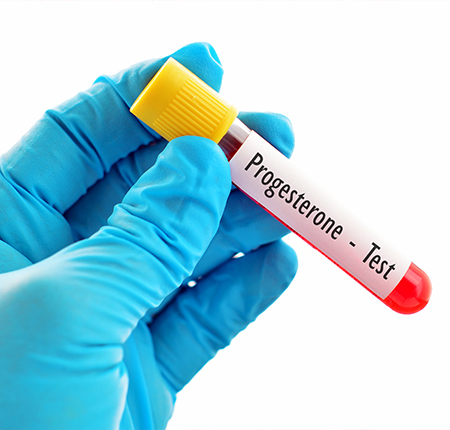
The role of progesterone in the body
Progesterone levels in the body are directly linked to mental health and energy levels. This means that a normal level promotes rest and inner calm, while a low level goes hand in hand with fatigue.
Since progesterone also influences sexual desire and regulates the menstrual cycle, progesterone levels play a part in contraception too.
Above all, though, menstruation and pregnancy are the two areas to which progesterone contributes most. Exactly how, you'll find out below.
Importance during the menstrual cycle
Progesterone rises naturally after ovulation and prepares the uterus for the implantation of a fertilised egg and thus for the beginning of a pregnancy. If the uterine lining is too thin, or if there are other reasons why implantation doesn't occur, progesterone levels drop again and the uterine lining is shed during menstruation.
On those days of the month, we recommend using only organic tampons or organic pads made from 100% organic cotton and pure ingredients – free from dioxins and other toxic chemicals that could disrupt your hormonal balance and affect your progesterone levels.
If implantation does occur, however, the placenta becomes the main site of progesterone production in the body, and the hormone's role becomes especially important in the early stages of pregnancy.
If ovulation stops occurring in the years leading up to the menopause, progesterone levels fall ever lower.
The role of progesterone in pregnancy
From week 8 of pregnancy, the placenta takes over progesterone production, and the hormone's main task is now to support the baby's development. This is why levels rise continuously until week 32, when they reach their peak – up to 100 times higher than the baseline value.
Progesterone also inhibits contractions of the myometrium (the uterine muscle), allowing the foetus to develop undisturbed throughout the pregnancy. Together with oestradiol, it also prepares the body for milk production.
Oestradiol is a form of oestrogen, the most important female sex hormone, which is at least as important in a woman's life as progesterone and contributes to the menstrual cycle, pregnancy and the menopause. We've written about oestrogen in more detail in a blog article – if you'd like to read it, you'll find it HERE.
Also in conjunction with oestrogen, progesterone suppresses ovulation during pregnancy, which is why you don't menstruate while pregnant.
Supports mental health
Last but not least, progesterone influences sleep quality, as mentioned, which in turn is extremely important for mental health. Indirectly – via the quality of your daily rest – progesterone levels therefore contribute to:
- Maintaining a positive, balanced mood
- Reducing anxiety and depression
- Easing restlessness, migraine or general malaise
- Regulating how much sleep you need
Types of progesterone
Depending on its origin, progesterone falls into two categories: that produced naturally by the body (in the adrenal glands, ovaries and placenta) and the synthetic kind, manufactured outside the body to mimic the functions of natural progesterone as closely as possible.
Natural progesterone
Natural progesterone is the kind the body produces by itself quite normally throughout life.
If there is no pregnancy, the largest amount of progesterone is produced in the second half of the cycle after ovulation, in the corpus luteum of the ovaries (also known as the yellow body). It can also be produced in the adrenal glands. The progesterone the placenta produces during pregnancy is natural progesterone too.
Synthetic progesterone
With a hormonal imbalance – arising for all sorts of reasons – the body may not produce enough natural progesterone. This can have unpleasant health consequences, which is why supplementation with synthetic progesterone is recommended.
Synthetic progesterone, also known as progestin, is produced by specialists in a laboratory – as a tablet to be taken orally, as a pessary, or as an injectable solution.
It works in a similar way to natural progesterone and takes over its roles in regulating the menstrual cycle and balancing the hormonal system as effectively as possible. Synthetic progesterone is also used for contraception (that is, to prevent unwanted pregnancy), to treat endometriosis, to relieve period pain and to reduce abnormal uterine bleeding.
Causes of progesterone deficiency
Because progesterone supports the development of pregnancy and regulates the menstrual cycle, it plays a central role in reproductive health. This means that an imbalance such as progesterone deficiency – in other words, too low a progesterone level in the body – can cause a whole range of other problems, including difficulty conceiving or maintaining and carrying a pregnancy to term.
You'll find out shortly what happens with progesterone deficiency – but first, here are the possible causes:
- Ovulation (progesterone drops naturally after ovulation)
- Ovarian problems (outside pregnancy, the bulk of progesterone is produced mainly in the corpus luteum of the ovaries; if there are ovarian problems, these can also lead to reduced progesterone production)
- A possible miscarriage (progesterone reaches very high levels during pregnancy and rises continuously once the placenta takes over hormone production; a miscarriage – the sudden end of a pregnancy – can cause an abrupt and marked drop in progesterone levels)
- Taking synthetic hormones (if you take synthetic progesterone, the body no longer needs to produce natural progesterone and gets out of the habit; this can result in very low levels after a course of synthetic hormones has finished, until natural production returns to normal)
- Stress
- Intense training or excessive physical strain
- Insulin resistance
- Taking synthetic hormones
Symptoms of progesterone deficiency
Like any imbalance in the body – and all the more so because it affects the hormonal system – progesterone deficiency brings with it a whole host of unpleasant symptoms and complaints, as well as further risks and health problems.
The best-known symptoms of a low progesterone level in a woman's body include:
- Premenstrual syndrome
- Cycle irregularities
- Hot flushes
- Headaches and migraine
- Anxiety
- Depression
- Reduced or absent libido
- Fatigue and drowsiness
- The development of uterine fibroids
In pregnant women, the symptoms of progesterone deficiency may additionally include:
- Pain in the breasts/abdominal area
- Marked drowsiness and exhaustion
- A drop in blood sugar levels
- The appearance of vaginal discharge
- The onset of vaginal dryness
- Complications during pregnancy (ectopic pregnancy, miscarriage or premature birth)
Men can also be affected by low progesterone levels. In their case, the deficiency manifests itself as reduced libido, erectile dysfunction or impotence, loss of muscle mass, reduced bone density, hair loss, fatigue and depression – because there isn't enough progesterone available to regulate testosterone levels as well.
When should you have a progesterone test
Progesterone levels can be determined with blood tests to establish how severe the deficiency is and what the sensible next steps are. Your doctor may recommend a progesterone test if:
- You aren't becoming pregnant
- You want confirmation as to whether you are ovulating
- Hormone replacement therapy needs to be monitored
- You want to know whether there is a high-risk pregnancy
- The function of the corpus luteum needs to be assessed
- The function of the placenta during pregnancy needs to be assessed
- Ovarian function needs to be checked
- There has been a miscarriage, intrauterine foetal death or pregnancy toxaemia
Progesterone tests are recommended for men if they suffer from erectile dysfunction, depression, severe fatigue, reduced libido or other sexual problems with no identifiable cause.
Normal values in a progesterone test
Sex, age, cycle phase and life stage are all factors that influence which progesterone level counts as normal. In addition, each laboratory uses its own reference ranges for what constitutes a normal level.
Broadly speaking, however, the normal values for non-pregnant women are given as follows:
- less than 0.616 nmol/l before ovulation
- more than 13 nmol/l during ovulation
- between 13 and 46 nmol/l after ovulation
In men, a progesterone level of less than 0.47 nmol/l is considered normal.
In pregnant women, normal values are considerably higher and vary according to trimester. They are estimated at:
- between 35 and 141 nmol/l in the first trimester
- between 80 and 265 nmol/l in the second trimester
- between 187 and 679 nmol/l in the third trimester.
How is progesterone deficiency diagnosed
A diagnosis of progesterone deficiency is made by a specialist on the basis of blood tests. Once the results have been evaluated and compared with the normal values for the relevant category – age, sex, cycle phase or pregnancy – it can be established whether or not a progesterone deficiency is present.
How do you prepare for a progesterone test
As a rule, no preparation whatsoever is needed before a progesterone test. Unlike other tests, the blood sample for a progesterone test can be taken at any time of day – whether fasting or after eating.
Your doctor may well recommend a particular day of your cycle for the test, since the hormone is usually measured on day 21 of the cycle and can confirm whether or not ovulation has taken place.
What happens if my progesterone is raised?
There are also situations in which the body produces more progesterone. A raised natural progesterone level can indicate a number of things in women, including:
- Recent ovulation
- An existing pregnancy
- Other health problems, if pregnancy is not the cause of the raised progesterone level (for example ovarian cysts, ovarian or adrenal cancer, or congenital hyperplasia).
In men, progesterone can rise as a result of treatment with artificial hormones, for instance for prostate complaints or infertility.
Treating progesterone deficiency
Progesterone deficiency can be treated – that is precisely what artificial hormones were developed for. If your body doesn't produce enough natural progesterone to support a pregnancy, regulate the menstrual cycle or keep your health in balance, hormone therapy (with synthetic progesterone) may be recommended to make up the shortfall and ease the symptoms.
Your doctor may recommend hormone therapy with progesterone and oestrogen if menopausal symptoms are affecting your quality of life.
Natural remedies for progesterone deficiency (though it's best to wait for your doctor's approval before trying them) also include:
- Eating zinc-rich foods (for example: mussels and other seafood, pumpkin seeds, cashew nuts, dark chocolate and so on)
- Taking supplements containing vitamin B and vitamin C, which help to regulate progesterone in the body
- Stress management techniques (during stressful periods, the release of the hormone cortisol increases, which can cause progesterone levels to fall).
Frequently asked questions about progesterone
What else is worth knowing about progesterone? Here you'll find the answers to some of the most common questions about this hormone's effects and what happens when it's lacking.
How does progesterone work alongside oestrogen?
Progesterone and oestrogen are two hormones that complement one another and work together to regulate the menstrual cycle and ovulation, support pregnancy and milk production, initiate the menopause, and maintain balance in the body and mental health.
The balance between these two hormones is very important for your health: if you have a progesterone deficiency, it means oestrogen is dominant – and high oestrogen levels are linked to more pronounced PMS symptoms, bloating, tender breasts and breast lumps, an enlarged thyroid and so on. If, on the other hand, you have too much progesterone, it means there is too little oestrogen – a situation associated with cycle irregularities, fertility problems, difficulties in sustaining a pregnancy and so forth.
Can progesterone make me put on weight?
Weight gain is not one of progesterone's side effects. The hormone doesn't directly increase body mass. Hormonal fluctuations can, however, genuinely affect your appetite. And if you feel hungrier, that can lead to eating more, creating a calorie surplus – which ultimately results in weight gain.
How can I tell that my body needs progesterone?
Your body needs progesterone when levels of this hormone are low, that is, below the normal range. Only a doctor can make this diagnosis – and only on the basis of progesterone tests (blood tests).
Which foods can raise progesterone levels naturally?
B vitamins, particularly B6, as well as vitamin C and zinc can be helpful nutrients for raising progesterone levels naturally. So you could try eating more foods rich in these nutrients, such as seafood (mussels, oysters), pumpkin seeds, cashew nuts, vegetables, dairy products, meat, salmon, eggs, spinach, beef, avocado, citrus fruits, broccoli and so on.
What happens if I don't treat a progesterone deficiency?
A low progesterone level can lead to disruptions in the menstrual cycle and ovulation which, in the long term, may affect your ability to conceive and your fertility. In pregnancy, a low progesterone level cannot support the pregnancy's development and, left untreated, may lead to miscarriage or premature birth. It's important to speak to a specialist as early as possible if you notice signs and symptoms of such a deficiency.

Medium, super or extra absorption

Low, medium or super absorption

Low or medium absorption


and happily breaking taboos!


