

Tests during pregnancy – Find out which laboratory tests are carried out in each trimester of pregnancy
Once your pregnancy is confirmed and you know you're going to be a mum, your health and your baby's become the top priority. On this journey, it's very important to have a specialist by your side to monitor your pregnancy. Regular appointments and the right tests for each trimester are essential for tracking your baby's development and supporting it as well as possible.
Let's talk about which tests are carried out in each trimester of pregnancy.
Why tests matter during pregnancy
Throughout pregnancy, the mother's body changes and adapts. For a baby to be healthy at birth, how it develops in the womb is crucial. That's precisely why it's so important to monitor every stage of pregnancy.
With the tests specific to each trimester, your doctor can follow the progress of the pregnancy and spot any irregularities early on. That means action can be taken in good time to support the health of both baby and mother, and to prevent and treat any potential complications.
There are even test packages and genetic screenings that may be recommended before pregnancy, in order to check the mother's state of health.
Tests in the first weeks of pregnancy
Early blood test in pregnancy
The first signs of pregnancy can appear relatively late. Women often only find out they are pregnant some time after conception. That's why all expectant mothers are advised to have their first tests as soon as the pregnancy is confirmed, including an early blood test.
These tests assess the mother's general state of health and usually include:
-
Blood group and rhesus factor
-
Full blood count
-
Urine culture and urinalysis
-
Blood glucose
-
Specific tests for communicable diseases (e.g. sexually transmitted infections, HIV, hepatitis viruses, rubella, tuberculosis)
Depending on the mother's medical history and family history, or if the results of the routine tests already carried out are less than ideal, your doctor may recommend additional, tailored investigations.

Tests in the 1st trimester of pregnancy
The first trimester is when most of the changes take place in the body. This period requires the closest monitoring, and screening tests are key to estimating the most likely course of the pregnancy.
If you'd like to read more about how your baby develops in each week of pregnancy, we've covered the baby's development by trimester in detail HERE.
The tests your doctor recommends will be tailored to the mother's health, her history and the particulars of the pregnancy. In principle, however, there is a standard package of tests recommended to all women in the 1st trimester – and that's exactly what we'll outline below.
The obstetric examination
The obstetric examination – the gynaecological check-up specifically for pregnant women – is the first appointment due once your pregnancy has been confirmed. If you'd like to find out more about how to confirm your pregnancy, read our article on how to tell whether you're pregnant.
During the obstetric examination, your doctor will identify risk factors, recommend the tests you need for your pregnancy and make an initial assessment. In short, this first check-up gives you an initial answer to questions such as 'How will the pregnancy go?' and 'What are the next steps?'.
In addition, a cervicovaginal smear (Pap test) is recommended once during pregnancy (whenever you're in for a check-up).
Blood group and rhesus factor
When you're pregnant, it's important to know whether you are rhesus positive or rhesus negative, as this can affect both your baby's health and your own.
If the baby's father is rhesus positive, the baby will inherit this factor. If your rhesus factor is negative, your body will produce antibodies against the rhesus factor, which can attack the baby's red blood cells and cause anaemia in you.
In this case, additional monitoring is needed during pregnancy – which is why it's important that you and your doctor know about it from the outset.
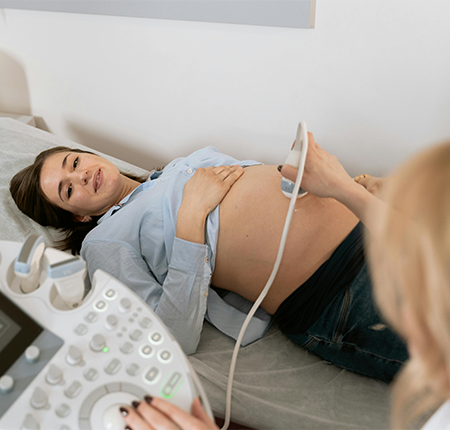
The ultrasound scan
At the first scan, your doctor can confirm that the pregnancy is in the normal location. The baby should be developing inside the womb (intrauterine), not outside it. An ectopic pregnancy cannot allow a baby to develop and can put the mother's life at risk – we've discussed all the associated risks in more detail HERE.
The first scan also establishes the gestational age and the viability of the embryo. If you'd like to work out how many weeks pregnant you are yourself, you can get an approximate figure using a pregnancy calculator.
This isn't the only scan in the 1st trimester. The next one is recommended between weeks 12 and 13 and is considered the most important scan of this trimester. The doctor checks that the baby is forming correctly and can determine whether there are any problems with structural development.
The full blood count
A very common condition in pregnancy that requires attention and treatment, in order to avoid complications such as severe exhaustion or a more difficult labour, is anaemia. It is caused either by a deficiency of iron or folic acid, or by other health problems (such as a haemoglobinopathy).
The full blood count is the blood test in pregnancy used to detect anaemia. It measures haemoglobin levels and other red blood cell parameters.
An effective way to prevent anaemia in pregnancy is a personalised plan of prenatal vitamins combined with a balanced, iron-rich diet. This way of eating should continue after the birth and throughout breastfeeding, because through your breast milk you pass on the nutrients from your body to your baby. We've discussed nutrition while breastfeeding HERE.
Blood glucose
Blood glucose (sugar) levels are also measured as part of the blood tests. This makes it possible to detect and treat early on whether the mother is unknowingly living with type I or type II diabetes mellitus from before the pregnancy, or is developing gestational diabetes.
Urinalysis
Urine culture and urinalysis are further routine tests that can identify and allow treatment of certain health problems. For example, infections, gestational diabetes, kidney disease and pre-eclampsia can all be detected through this examination of the urine sediment.
Tests for sexually transmitted infections
A great many sexually transmitted infections, including HIV, syphilis and hepatitis viruses, can be passed from mother to baby during birth. Some of them can also affect the course of the pregnancy and potentially cause malformations or health problems for the baby after birth.
All mums-to-be are advised to be tested for these infections.
Thyroid function
During the first 12 weeks of pregnancy, the baby's thyroid gland is not yet active. The baby gets all the hormones it needs from its mother. Even at the end of the first trimester, when the little one's thyroid function begins, the baby still depends on the hormonal balance in the mother's body.
So if the mother has an imbalance of thyroid hormones, the baby's thyroid function will be affected too.
The first trimester combined screening (double test)
The combined screening, or double test, is used to detect possible genetic problems (chromosomal abnormalities) in the baby.
To identify such irregularities, the double test takes into account the baby's ultrasound parameters (nuchal translucency), the relevant hormones in the mother's blood (beta-hCG and PAPP-A) and the mother's state of health (age, lifestyle, habits such as smoking, etc.).
Tests in the 2nd trimester of pregnancy
In the second trimester, the pregnancy develops much more visibly. The baby grows more quickly, and measurements can be taken to determine its sex.
At this stage, the risk factors are no longer as significant as in the 1st trimester, and the baby isn't as vulnerable. Even so, it remains important to keep monitoring the pregnancy. The tests specific to this trimester help to detect any more serious conditions in the baby.
Amniocentesis
As the name suggests, amniocentesis involves examining a small amount of the amniotic fluid surrounding the baby. The aim of this procedure is to obtain important information about the baby's health and development.
It is a screening test that allows the doctor to determine whether there is an intrauterine infection and whether the baby has any genetic conditions or chromosomal abnormalities.
The glucose tolerance test
Between weeks 24 and 28 of pregnancy, the glucose tolerance test is carried out to detect gestational diabetes, which increases the risk of complications for the mother during birth and of various health conditions.
The first step of this test is measuring fasting blood glucose. You are then given 75 mg of glucose orally, and your blood glucose is measured again after 1 and 2 hours.
The AFP test
The AFP test measures alpha-fetoprotein, a protein produced by the baby's liver. AFP passes through the placenta into the mother's body and reaches its highest concentration between weeks 32 and 36.
The level can point to more serious problems, such as spina bifida, structural defects in the abdominal area, Down's syndrome and other genetic conditions.
The anomaly scan (detailed ultrasound)
The anomaly scan is carried out between weeks 22 and 24. It is central to monitoring the pregnancy, as it can detect numerous conditions and malformations in the baby, with an average detection rate of 56%.
This detailed second-trimester scan involves a thorough examination of the baby's organs and their development. At this point the doctor also assesses the amniotic fluid and the cervix, determines the size and position of the placenta, and checks blood flow in the umbilical cord and in the mother's uterine arteries.
Oestriol, inhibin and hCG
These are three placental markers that can tell your doctor about your baby's health. Their concentrations in the second trimester of pregnancy can help to assess the risk of Down's syndrome.
Repeating the routine tests from the first trimester
The routine tests from the 1st trimester are repeated in the 2nd trimester as well. These are the full blood count, urinalysis and blood glucose, which can indicate infections, diabetes or anaemia. The sooner these are detected and treated, the lower the risk of complications.
Tests in the 3rd trimester of pregnancy
In the third trimester of pregnancy, the risk of conditions that could endanger the baby is at its lowest. As a result, you usually only need to repeat the routine tests you've had at every check-up throughout the pregnancy.
Of course, depending on any problems identified in the first two trimesters – for example if you've had an infection or bleeding during pregnancy – your doctor may recommend additional tests. The package of tests is therefore always based on how your own pregnancy is progressing, your individual circumstances and needs, and your state of health.
Below you'll find the most common tests in the 3rd trimester of pregnancy.
Group B streptococcus screening
Group B streptococci are bacteria that normally live in the body of healthy adults without causing serious problems. In newborns, however, they can be dangerous and may be fatal even with immediate treatment.
It is not a sexually transmitted infection, but in women these bacteria are found mainly in the vaginal and rectal area. This means they can be passed to the baby during birth. The risk of transmission drops sharply, however – to a rate of 1–2% – if the mother is given an antibiotic during labour. That's why it's important for your doctor to know about any colonisation.
The test for group B streptococcus is called a culture and is carried out between weeks 36 and 38 of pregnancy by taking a small sample of secretions from the vagina and rectum.
Foetal ultrasound with biometry
Between weeks 32 and 34 of pregnancy, your doctor carries out the 3rd trimester scan. This is known as a foetal ultrasound with biometry and has the following aims:
-
Determining the baby's weight and size
-
Examining the placenta
-
Assessing the baby's position in the womb
-
Detecting any abnormalities of the heart, nervous system, muscles or bones
A Doppler examination is also carried out, allowing the doctor to measure the baby's blood flow in particular areas of the body.
Repeating the routine tests
In the third trimester, the routine tests from the 1st and 2nd trimesters are generally repeated. These include urinalysis, bacteriological examination of vaginal secretions, the full blood count, blood glucose, and so on.
If you've dealt with certain conditions during pregnancy, specific tests may also be repeated or additional investigations carried out. The doctor caring for you will always recommend the tests that suit your individual needs.
The contraction stress test
One test specific to the 3rd trimester of pregnancy is the contraction stress test, carried out when certain irregularities are present in the baby. Using an oxytocin analogue – the hormone that stimulates uterine contractions during labour – the doctor can determine whether a vaginal birth is possible or whether a caesarean section would be more appropriate.

Medium, super or extra absorption

Low, medium or super absorption

Low or medium absorption


and happily breaking taboos!


