

Your Baby's Sex – From Which Week of Pregnancy Can the Baby's Sex Be Determined?
Would you like to find out your baby's sex while they're still in your tummy?
The moment you're holding a positive pregnancy test, that curiosity kicks in. Whether you can't wait to throw a gender reveal party to officially announce that you're going to be the mum of a girl or a boy, or you'd rather keep the secret until the birth – that's entirely up to you. Either way, the chance to find out already exists in the first trimester.
Do you know at which week the baby's sex can be seen on an ultrasound scan? And is it true that you can tell even earlier – from the shape of your bump or with the wedding ring test? Read the article to the end to find out everything.
How a baby's sex is determined
Humans have two specific sex chromosomes: X and Y. The combination of these chromosomes (XX or XY) is inherited from the parents – one from the mother, one from the father – and determines the child's sex:
- The XX chromosome pair determines the female sex.
- The XY chromosome pair determines the male sex, as the Y chromosome controls the development of the male gonads.
The mother is female and has an XX chromosome pair, so she can only pass on an X chromosome. From the father (XY), the foetus can inherit either the X or the Y chromosome, which then combines with the mother's X chromosome to form a new pair – XX or XY.
An XX combination therefore means the baby is a girl. An XY combination means the baby is a boy.
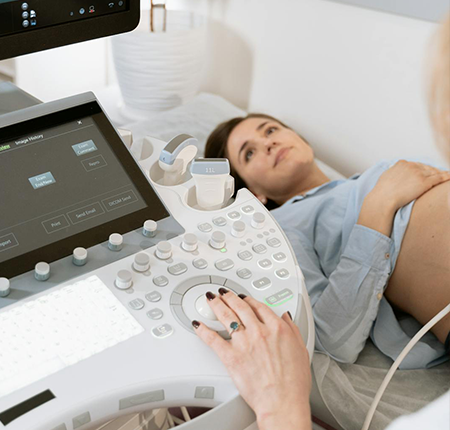
Once it has been confirmed that you are pregnant, your gynaecologist can use various tests to determine the baby's sex – we explain them below. Most commonly, you'll find out whether it's a girl or a boy during a routine ultrasound scan.
When the baby's sex can be seen on an ultrasound scan
As a rule, the baby's sex is determined during the routine ultrasound scan between weeks 18 and 20 of pregnancy. That's roughly the middle of the second trimester, when the foetus is already growing rapidly, developing swallowing and sucking reflexes and moving more and more.
During this time you may also notice heavier vaginal discharge – around a teaspoon of whitish secretion a day, which protects the womb and the vaginal pH. If that's the case, it's worth wearing breathable, thin pads made from 100% organic cotton, free from fragrances or other substances that can increase the risk of irritation.
If you're especially excited and curious: there are modern ultrasound techniques that can reveal the baby's sex as early as week 16, sometimes even from week 14. The further along the pregnancy is, however, the more reliably your doctor can confirm whether you're having a girl or a boy.

Weeks 12–14
By week 12 of pregnancy, the foetus doubles in size and develops further with every passing week. Its digestive system starts working during this time, and you can hear its heartbeat.
The genitals, however, are only just beginning to differentiate. They are small and difficult to see on an ultrasound scan, especially if the position of the foetus limits the view. At this stage, your doctor can only make an educated guess, with low accuracy (around 70%).
Weeks 14–16
Between weeks 14 and 16, the likelihood of a correct determination rises considerably, particularly when modern ultrasound technology is used.
You'll be advised to drink plenty of fluids and arrive for the scan with a full bladder, as this can improve image quality. Even so, the baby's position may still obscure the genitals, reducing the accuracy of what can be observed.
Week 20 (second-trimester anomaly scan)
After week 20, the baby's sex can usually be confirmed during the second-trimester anomaly scan with an accuracy of 95–99%. This scan also provides a detailed view of the baby's limbs, spine, diaphragm, chest and face, as well as a risk assessment for Down's syndrome, Edwards' syndrome and so on.
Other methods for determining a baby's sex
Of all the ways currently available to find out a baby's sex, ultrasound is the most widely used method.
There are, however, other tests during pregnancy based on modern techniques for analysing chromosomes or amniotic fluid that also allow the sex to be determined. These can be carried out considerably earlier, from week 10 of pregnancy. Here are the main ones:
Foetal DNA test from maternal blood (NIPT)
If you opt for this test, your doctor can determine the baby's sex as early as week 9 of pregnancy. The price of this analysis is usually higher – but so is the accuracy: over 99%.
It is a non-invasive prenatal test (NIPT) that analyses the foetal DNA in the mother's blood to determine both the baby's sex and the risk of the most common chromosomal disorders (Down's syndrome, Edwards' syndrome, Patau's syndrome, Turner syndrome and others).
If the male chromosome (Y) is detected, the baby is assumed to be a boy. Otherwise, it is assumed to be a girl.
Amniocentesis or chorionic villus sampling (CVS)
Like the DNA test, amniocentesis (testing the amniotic fluid) and chorionic villus sampling (CVS) are used for genetic analysis. They are intended to detect possible conditions and at the same time allow the sex to be determined.
Unlike NIPT, however, these are two invasive procedures that carry a risk of miscarriage. In addition, cramping, bleeding or amniotic fluid leakage can occur after CVS. For this reason, amniocentesis and CVS are only recommended in certain situations, such as:
- abnormalities seen on an ultrasound scan;
- an increased risk of genetic disorders identified by NIPT;
- a family history of chromosomal abnormalities.
During amniocentesis, the doctor uses a fine needle to take a small sample of amniotic fluid for testing. The procedure is carried out on medical advice between weeks 16 and 24 of pregnancy and takes no longer than 2 minutes.
With CVS, the doctor takes chorionic villi (samples of placental tissue) from the uterine cavity. These are tested for genetic abnormalities between weeks 11 and 14 of pregnancy, particularly where Down's syndrome is suspected.

Myths about determining a baby's sex
Since today's modern medical procedures weren't available for a very long time, people have looked for all sorts of ways over the years to predict a baby's sex – for instance by linking it to the mother's menstrual cycle, the shape of her bump or her pregnancy symptoms.
The Shettles theory from the 1960s, for example, suggests that conceiving before ovulation increases the chances of having a girl. The Whelan theory from the 1970s, on the other hand, claims the opposite: that conceiving before ovulation increases the chances of having a boy.
None of these methods has been confirmed, and today we have far more precise tests available. Yet the old methods haven't disappeared. They still circulate as myths with no scientific basis and can be used for a bit of fun when guessing a baby's sex. Here are some of the best known:
The shape of your bump
It's said that you're having a boy if your bump is oval in shape and the foetus sits lower. If your bump is round and high, on the other hand, it's supposedly a girl.
Science, however, tells us that the shape is influenced by many other factors. The position of the foetus, the mother's muscle tone and the number of previous pregnancies have a far greater effect on the shape of the bump than the baby's sex.
Cravings
Another widespread folk belief is that cravings offer clues about a baby's sex. Supposedly you're having a girl if you fancy sweet things, and a boy if you prefer savoury. These claims, too, have no scientific backing.
The foetal heartbeat
Another theory holds that the baby's heartbeat indicates its sex. It's said to be a girl if the heartbeat is fast (over 140 beats per minute), and a boy if it's slower (under 140 beats per minute).
The method has been investigated by researchers, but it turned out that the accuracy is low, at just 50%.
The wedding ring test
One of the more amusing yet equally unreliable myths claims that you can guess a baby's sex using the wedding ring test. You can use a ring, a needle or a hair tie, suspended from a strand of hair and held over the mum-to-be's bump.
It's said to be a girl if the ring moves in circles, and a boy if it swings back and forth in a straight line.
Morning sickness
According to tradition, girls cause more morning sickness in pregnancy than boys. Hence the persistent myth that you're having a girl if you suffer from nausea, and a boy if you have no morning sickness at all.
In reality, though, nausea doesn't depend on the baby's sex but is the result of several physical and metabolic factors: hormonal fluctuations, blood pressure and so on.
Frequently asked questions about determining a baby's sex
Still have questions about finding out your baby's sex? In this section we'll clear everything up.
Which factors can lead to an incorrect sex determination?
A restricted view of the genitals on an ultrasound scan can lead to the sex being determined incorrectly. Factors such as early gestational age, the baby's position in the womb, the thickness of the abdominal wall and the mother's body shape can all affect the accuracy of the result.
The doctor's experience in carrying out ultrasound scans also plays an important role.
Are there any traditional methods of sex determination that actually work?
Studies have been unable to confirm the effectiveness of traditional methods. These are methods based on observation that attempt to link a baby's sex with the mother's menstrual cycle, the shape of her bump, morning sickness or cravings. Yet all of these factors are themselves determined by numerous other influences – not by the baby's sex – and point to coincidence rather than any causal relationship.
Today's medical procedures, by contrast, are based on clear-cut testing. They use ultrasound images or analyse chromosomes, amniotic fluid or placental samples, delivering concrete, precise results.
Is it possible for the sex to be determined differently at consecutive ultrasound scans?
If the first ultrasound scan is carried out between weeks 10 and 12, the foetus's organs are only just beginning to develop and are still very small. As a result, the doctor may make an incorrect guess about the baby's sex. In that case, the result can change at the next scan, when the doctor has a better view and can see more clearly whether it's a girl or a boy.
Once the sex has been confirmed during the second-trimester anomaly scan, however – with an accuracy of over 95% – it's highly unlikely that the doctor's observations are wrong.
Why can a doctor sometimes not confirm a baby's sex even after week 20?
There are situations in which the hands, feet or simply the position of the foetus obscure the genitals. As long as there's no clear view, the doctor cannot confirm the baby's sex on an ultrasound scan – even if you're already past week 20 of pregnancy.
If the doctor cannot confirm the baby's sex after a DNA test, it means there isn't yet enough foetal DNA circulating in the mother's blood to detect the presence of the Y chromosome.
Image source: Pexels.com

Medium, super or extra absorption

Low, medium or super absorption

Low or medium absorption


and happily breaking taboos!


