

Everything You Need to Know About Tampons
Tampons are among the most practical period products on the market – but if you've only just started your period, the thought of inserting one can feel pretty daunting! Tampons are, however, safe and an extremely popular way to absorb menstrual blood, because they give you far more freedom of movement. You just need to understand how they work and get comfortable with the idea of using them!
What are tampons?
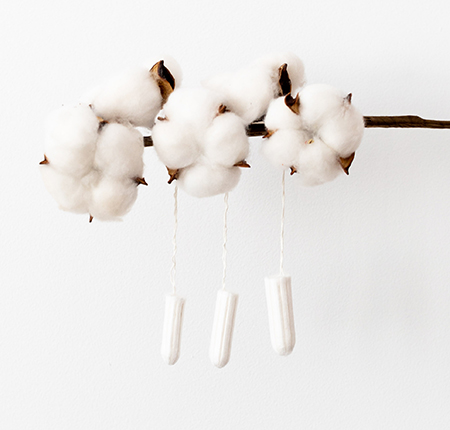
Tampons are small cotton products that are inserted into the vagina to absorb menstrual blood. Some tampons come with an applicator to help you insert them, while others don't. Tampons usually have a withdrawal string at the end so you can remove them easily.
When did the first tampons appear?
“In 1945, the Journal of the American Medical Association published the first comprehensive study on tampons. Some of the new, popular applicator tampons were made from absorbent cotton, explained the study's author, Robert L. Dickinson, while one was made from cotton yarn and another from crepe paper held together by a mesh of threads. All had a waterproof withdrawal string and ‘an inserter that allows the tampon to be placed at any depth thanks to a cardboard tube'. In Germany, at around the same time, the gynaecologist Judith Esser-Mittag developed a digital tampon (that is, one without an applicator) that would later be called the o.b. tampon – and which became enormously popular in many parts of the world,” writes Ashley Fetters in The Tampon: A History
The benefits of tampons have been known for centuries: the ancient Egyptians were the first to use them! Theirs were made from softened papyrus. In ancient Rome, women made their own tampons from wool, and in Indonesia they were made from plant fibres or grass.
What are tampons made from?
Today, FDA-approved tampons are made from cotton, viscose or a blend of the two. The absorbent fibres in commercially available tampons are now produced using an elemental chlorine-free bleaching process, which prevents the products from containing dangerous levels of dioxin (dioxin is an environmental pollutant).
Essentially, a tampon consists of several parts:
- an applicator with a plunger
- the tampon itself, which absorbs the blood
- a withdrawal string
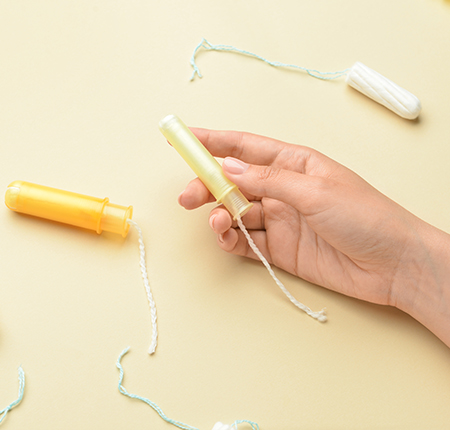
Not all tampons have an applicator. All of them, however, are single-use products, meaning they're thrown away after use. Applicators can be made of cardboard or plastic.
How do I choose the right tampon size?
Tampons come in different absorbencies, from mini to super. Whether you go for light, regular or super, the size indicates the absorbency. When choosing, always opt for the lowest absorbency that's sufficient for your flow on that particular day.
So there are several sizes to choose from, and it may take a bit of trial and error before you find the right one. It's important to know that the right size is the one that absorbs your flow without any leaks, while you can't feel it inside you at all. If you can feel the tampon, it may not be inserted far enough.
Your flow can vary a great deal between the first and last day of your period – which is why it's a good idea to keep several sizes to hand, just in case.
Types of tampon
- Mini tampons are suitable for light flow days, such as at the beginning or end of your period.
- Regular tampons are suitable for light to medium flow.
- Super tampons are suitable for heavy flow.
Today you'll find tampons both with and without applicators on the market.

What is toxic shock syndrome?
Although it's associated with using tampons during menstruation, toxic shock syndrome can affect anyone – regardless of age or gender. The symptoms come on suddenly and develop rapidly: if it is diagnosed, treatment must begin immediately, as it is a serious, potentially life-threatening condition.
People who use tampons during their period are at greater risk of developing this syndrome. The mechanisms aren't yet fully understood, but have been linked to the presence of highly toxic ingredients that act as hormone disruptors. Do read our in-depth article on this subject to find out more!
How to use tampons safely
The first few times you use a tampon can feel strange – but when positioned correctly, a tampon gives you both comfort and security.
How to insert a tampon
If you're using a tampon without an applicator (less plastic and easier to carry around), wash your hands first and check that the tampon's wrapper is completely sealed.
Remove the wrapper and dispose of it as directed on the packaging, then unroll the withdrawal string. Place your index finger at the base of the tampon and hold it at the sides with your thumb and middle finger. Whether you're sitting (on the loo) or standing with one foot propped up, remember to relax and breathe. With your free hand, you can gently hold the vaginal opening slightly open.
Then gently insert the tampon using the full length of your index finger, aiming towards your lower back. When the tampon is in the right place, you won't feel it at all. And if you can feel it, push it in a little further. Leave the string hanging outside your body and wash your hands.
How do I know the tampon is in correctly?
When a tampon is used correctly, you shouldn't be able to feel it at all. If it isn't positioned properly, you'll feel discomfort or even pain. So always make sure you insert it at the right angle and far enough in.
What do I do with the string hanging out?
The withdrawal string is essential for removing the tampon later on. You can simply leave it hanging outside. Don't tuck it inside the vagina.
How to remove a tampon
Right, it's time to remove the tampon. How do you do it? First, relax your pelvic muscles and your body. You can sit on the loo or stand with one leg propped up, if that's easier for you. Removing it is simple: just pull on the withdrawal string.
What you should know: a tampon can't get lost inside your body and can't slip through your cervix into your womb! The cervical canal is far too narrow. It only allows menstrual blood to flow out – it's nowhere near big enough for a tampon!
What's the difference between conventional and organic tampons?
If you've ever wondered what the difference is between tampons made from conventional cotton and those made from 100% organic cotton – there are several!
Most of the time, we don't even stop to think about what a tampon is actually made of. But anyone who looks a little closer will know that conventional tampons can contain toxic ingredients that are readily absorbed into the bloodstream, along with endocrine disruptors, fragrances and pesticides. Yes, that sounds rather alarming … and rightly so! But have you ever wondered why the ingredients matter so much?
Your vagina is extremely absorbent, and direct contact with these substances increases the risk of:
- Hormonal imbalance
- Thyroid disorders
- Irritation and allergies
- Various infections
- Menorrhagia
- Endometriosis
- Diabetes
The chemicals, plastics and toxins found in most period products – tampons included – can cause vaginitis, bacterial vaginosis and infections.

Gynaecologists recommend tampons made from organic cotton – free from fragrances, chlorine and dyes. And the good news is that ENROUSH tampons contain just one single ingredient: 100% organic cotton. No plastic, no fragrances, no chlorine, no pesticides, no GMOs and no other toxins.
ENROUSH organic tampons are made from 100% organic cotton – with no side effects for your health and no harm to the environment. No pesticides are used in growing organic cotton, and the farming is sustainable, protecting natural resources and biodiversity.
Myths about tampons
A tampon can get lost or stuck inside your body
False. A tampon can't get lost inside you! From the moment you insert it until you remove it, it stays exactly where it is. It can't pass through the cervix and it can't get lost inside you. A tampon also can't get into the womb, because the cervical opening is far too small. If, for whatever reason, you have difficulty removing a tampon, don't hesitate to seek medical help.
Tampons don't get stuck! If it feels like nothing's budging when you pull the string, it's most likely not full yet, or your vaginal muscles are too tense. When you want to remove it, it's important to relax.
You shouldn't wear a tampon overnight
False. A tampon can be worn overnight, and you can sleep with one in without any problem. The general recommendation, however, is not to wear a tampon for longer than 8 hours – ideally 4 to 6 hours. You just need to make sure you change your tampon right before going to bed and as soon as you wake up! And if you'd like a lie-in, opt for an organic night pad instead.
A tampon that's too small won't protect me properly
False. Because more absorbency isn't always the best option! Why? High-absorbency tampons are designed solely for heavy flow days. If that's not the case, it's better to use lower-absorbency tampons and change them regularly.
What's more, the fibres in a 100% organic cotton tampon are extremely absorbent regardless of size, with evenly distributed absorbency. It holds the menstrual blood until you change it – and when choosing a size, make sure you find the right absorbency for your flow. If you're using a tampon for the first time, choose ENROUSH Mini, as it's the easiest to insert. For medium or heavy flow, go for ENROUSH Regular.
You have to change your tampon every time you go to the loo
No, you don't! Even though it might feel a bit unpleasant, there's no need to remove it every time you use the loo: the vagina, urethra and bowel are separate organs, each with its own opening. So the choice is yours.
Tampons take away your virginity and can't be used for your first period
False. You can use tampons from your very first period, the menarche. The hymen is elastic and has an opening, or only partially covers the vagina, so that menstrual blood can flow out. A tampon therefore can't “take your virginity”. What's more, virginity is a social construct, not a thing (or rather, a membrane) that you “lose” – we've written more about this in this article!
Tampons increase your cancer risk
False. Tampons can't increase your risk of cervical cancer, as in over 90% of cases it's caused by HPV. That said, using a tampon incorrectly, using tampons containing dioxin, fragrances, chlorine and hidden substances, or wearing a tampon for too long can increase the risk of toxic shock syndrome. As long as you use them correctly and choose a product with a single ingredient – certified 100% organic cotton – you've nothing to worry about.
It's dangerous to wear a tampon for longer than 4 hours
False. Tampons can be worn for up to 8 hours – it all depends on your flow. Normally you'd change a tampon every 3 to 6 hours with a medium or heavy flow, and a mini tampon every 6 to 8 hours with a light flow.
So your flow alone determines when you need to change your tampon. How do you check whether it's time? Easy! Gently pull on the withdrawal string: if the tampon moves easily, it's full enough. If it doesn't move, it isn't saturated yet and you can keep it in for longer.

Medium, super or extra absorption

Low, medium or super absorption

Low or medium absorption


and happily breaking taboos!


