

Everything you need to know about your first period (menarche) – what it is, when it happens and what you should know
Your first period is a memorable experience that shows you your body is ready for pregnancy – and it's something you'll almost certainly remember for years to come. But when does the first period arrive? How long does it last and how much blood do you lose? And how do you use a pad or a tampon?
We know: you don't always have someone you can talk to about these things. Sadly, it's still an awkward subject, surrounded by myths and misinformation, discussed only in whispers and with hesitation. It doesn't have to be this way! There's nothing taboo or shameful about the menstrual cycle – and today we're talking openly about everything you need to know about your first period. Find out what to expect from your first bleed, what happens inside your body during a menstrual cycle, and much more.
What is the first period (menarche)?
Your first period, known medically as menarche, marks the beginning of your menstrual cycle and means your reproductive system is ready to conceive a child. It's a natural function that all women with a healthy reproductive system experience.
The age at which the first bleed occurs, how you feel before and during it, and the circumstances in which it happens – all of this is different for every one of us.
What all these situations have in common: the start of your menstrual cycle shows that your reproductive system is working as it should and is prepared for a possible pregnancy. And there's something else they share: a first period is almost always memorable. A great many women remember their first period for the rest of their lives.
That's precisely why it's so important to be prepared. The less you know and the more unexpectedly it arrives, the more likely your first period will be an unpleasant surprise, triggering confusion, shock, embarrassment or even fear.
Once you understand what's happening in your body, that menstruation is a completely normal function and can be a perfectly relaxed experience, the event becomes predictable and leaves no negative trace. We're here to talk about all of it.
When does the first period arrive?
There's no one-size-fits-all answer to this question. Periods begin differently for every woman – depending on how quickly your own body develops during puberty. Menarche can occur at any point during adolescence, generally between the ages of 10 and 16.
According to statistics, 98% of girls have had their first period by the age of 15. Most girls get it between 12 and 13, but it's just as normal to start your cycle at 10 or at 14. There's no fixed rule – for a girl who develops quickly, the first period can even begin as early as 9.
Your first period won't come as a complete surprise, though. Before and around your first bleed, plenty of other changes take place in your body that signal your cycle is about to begin. We'll talk about these signs a little further down, when we look at how to tell whether your first period is on its way.
Signs and symptoms of your first period
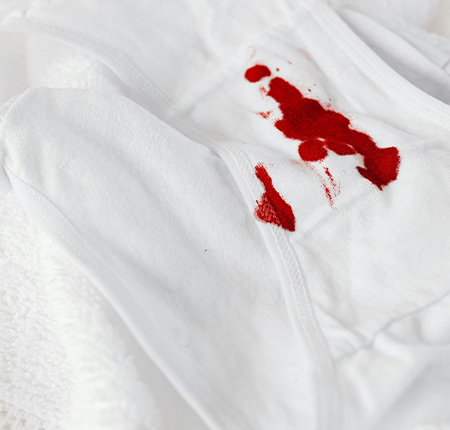
Menstrual blood is the most visible and obvious sign of a first period. It's completely natural and doesn't mean you've injured yourself or that something is wrong – quite the opposite, your body is working perfectly normally. Here are the other ways menarche may announce itself, and what to expect from your first period:
- Red or brownish menstrual blood
- The flow may stain your underwear or clothing
- Cramps, along with tummy, back and leg aches
- Bloating or constipation
- Tenderness in the breasts
- Mood swings
- Tiredness or difficulty sleeping
- Spots or irritated skin
- Food cravings
How long does the first period last?
Just as with timing, the length of your first period can't be predicted precisely. Periods themselves – even once they've settled into a rhythm – last different lengths of time for every woman. That's all the more true of a first period.
As a rule, menarche doesn't last very long. It can take several months for your body to find its natural cycle rhythm and for your period to settle down in terms of length and spacing. Once it has, periods last between 2 and 7 days and occur every 23 to 35 days, depending on how long your cycle is.
How much blood do you lose during your first period?
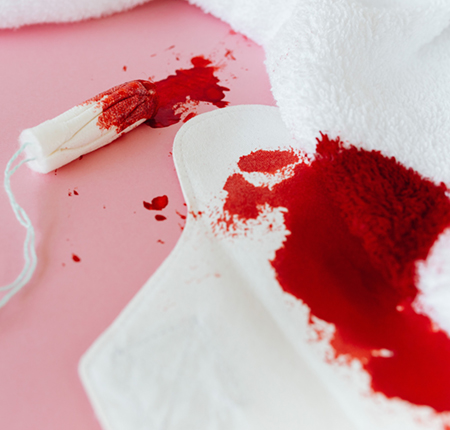
You actually lose far less blood during a period than it seems. In total it's between 20ml and 90ml of blood (roughly 1–5 tablespoons of fluid) across an entire period. Pads or tampons fill up and need changing around 3 to 6 times a day.
We know it feels as though you're bleeding more – especially during your first few periods. In reality, though, menstrual blood also contains a mixture of womb lining tissue and mucus, which adds to the volume.
What is the menstrual cycle and how long does it last?
The menstrual cycle is a natural process in every woman's life, driven by monthly hormonal fluctuations. Menstruation is just one of the cycle's 4 phases – and the most visible one, because it shows itself through bleeding.
Women have their cycle month after month throughout their entire reproductive years, which begin with the first period and end with the menopause. The cycle only pauses during pregnancy (or with certain conditions that have hormonal effects).
The length of a menstrual cycle differs from woman to woman. Normally it repeats monthly and lasts around 21 to 35 days, depending on how long each phase is. There are four phases of the menstrual cycle:
- Follicular phase (pre-ovulatory phase): the longest phase of the cycle, during which the body stimulates the formation of follicles on the surface of an ovary; one of these follicles later matures into an egg. During this phase oestrogen levels also rise and the endometrium (the lining of the womb) begins to thicken.
- Ovulatory phase (ovulation): the egg is ready to be released and breaks down within the next 24–48 hours if it isn't fertilised (that is, if it doesn't fuse with a sperm cell to form an embryo and begin a pregnancy).
- Luteal phase (post-ovulatory phase): the thickened womb lining is now ready to support a pregnancy, should fertilisation have taken place during ovulation. If you're not pregnant, this tissue is shed during menstruation.
- Menstruation: if pregnancy doesn't occur, your period begins and the womb lining is shed through the vagina as menstrual blood. After that, the cycle starts again with a new follicular phase.
That, in a nutshell, is the process by which your body prepares month after month for a possible pregnancy, and which we call the menstrual cycle. A normal but complex process that brings with it many other hormonal changes. If you'd like to learn more about periods and the phases of the cycle, read EVERYTHING you need to know about menstruation on our blog.
What is the average age for a first period?
It's impossible to predict the exact age at which periods will begin, because the average age has fallen across the generations.
Our grandmothers and great-grandmothers had their first period at an average age of 14–18, but that age has steadily dropped.
Today, according to statistics, the average age at which periods begin seems to have settled at 12–13. But that isn't a rule either. Every body has its own rhythm.
How can you tell your first period is on its way?
Menarche is closely linked to puberty, and puberty shows itself in many different ways. These can be excellent clues that your period is about to start. The clearest signs include:
- Breast development: menarche occurs roughly 2–3 years after the breasts begin to grow.
- Pubic and underarm hair: periods begin around 1 year after hair starts growing in the intimate area and under the arms.
- Vaginal discharge: a thick, clear secretion you may notice in your underwear 6–12 months before your periods start. Its job is to clean and moisturise your vagina.
- Premenstrual syndrome (PMS): occurs around a week before your period starts and may show itself through headaches, tiredness, tummy cramps, breast tenderness and mood swings. Not all girls experience PMS, and the symptoms can change from month to month.
- Spots: breakouts are an early sign that puberty has begun and that your period will soon follow. What's more, spots can appear in greater numbers particularly in the days just before a period starts.
First period – which period protection should you choose?
Period care is purely a matter of personal preference. Contrary to old beliefs, you can use any type of protection you like right from your first period – from pads through to tampons.
What matters is that you feel protected, that the menstrual blood is absorbed so your hygiene is taken care of, and that the product feels comfortable for you. And most important of all: choose a healthy period product free from toxic chemicals, one that won't disturb your vaginal pH or irritate your skin.
A first period kit
If you've noticed your body already sending signals that your cycle is about to begin, you can get prepared now with a first period kit. You'll feel far more relaxed and your first experience will be considerably more comfortable if you have everything you need to hand to avoid any unwelcome surprises.
So from puberty onwards, you can carry a first period kit containing the following:
1. Intimate wipes: the vaginal discharge we mentioned above, which appears before your first period, can leave you with the uncomfortable feeling of not being clean. Likewise, your first menstrual bleed may give you the impression that even though you've wiped, you're still not clean and need a shower. And since menarche could easily begin not at home but at school or while travelling, intimate wipes are a quick, practical solution for feeling fresh at any time and refreshing your vulva in moments.
That's why at Enroush we've developed hypoallergenic, pH-neutral intimate wipes enriched with chamomile and prebiotics. They give you back that pleasant feeling of cleanliness while protecting your intimate flora, removing bacteria and helping prevent infections.
2. Heat patches for periods
Periods can come with pain, and as long as it isn't severe, that's completely normal. But it doesn't mean you have to suffer through it. Lower abdominal pain is always unpleasant – all the more so during a first period, which can already feel like an overwhelming change.
You can get rid of those cramps naturally, without any tablets – with Enroush period heat patches. They're made from 100% natural ingredients, warm up in just 10 minutes and keep you pain-free for up to 8 hours.
3. A mini pouch
Everything is easier when you have it all to hand and can find what you need straight away. That's why a small pouch is incredibly handy – one that fits your pad or tampon for your first period as well as your intimate wipes and heat patches.
That's exactly why the Enroush Self-Love mini pouch is so roomy – so you can store all the products for a period day inside. It's also ultra-compact and even fits in your pocket. Its elegant design in powder pink means you can take it anywhere without feeling the need to hide your products.
Pads for your first period
Pads are often the most practical choice for a first period. Not because they're better than tampons, but simply because they're easier to use and you can wear them overnight too. You just stick one into your underwear and you're protected against leaks and stains. Pads are single-use products, which means you throw them away after one use.
It's also important to pay attention to what the pad is made from. Conventional pads can contain plastic, chemical bleaching agents and allergenic fragrances that can irritate the skin and cause itching, burning or small spots in the intimate area.
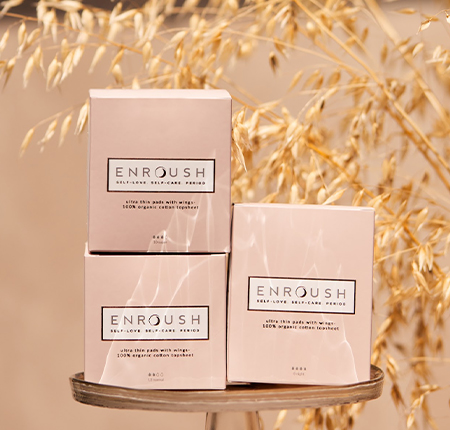
We'd recommend choosing 100% organic pads from the very start, like those from Enroush. Their top layer is 100% organic cotton and the bottom layer is made of 100% natural fibres. Nothing toxic, just pure ingredients that let the skin breathe, feel soft and absorb brilliantly.
Tampons for your first period
Let's answer your question straight away: yes, you can use tampons from your very first period! There's nothing wrong or dangerous about it, as long as you choose a tampon with ingredients that are 100% safe for your vagina and use it correctly. It's simply one form of period care – just like pads.
For your first period, when the flow is still light, you can choose 100% organic mini tampons, which are the smallest size. Do pay close attention to the ingredients, because they go inside your vagina. Enroush tampons are made from 100% organic cotton and nothing else – which means they're hypoallergenic and safe for your body.
The advantage of tampons: you can even wear them for a day at the beach, as they're invisible under your underwear. You do, however, need to be especially careful when using them:
- Washing your hands is a must every time – before and after inserting or removing a tampon.
- You shouldn't be able to feel a tampon if you've inserted it correctly – least of all an Enroush tampon, which is especially flexible and comfortable.
- Make sure not to wear a tampon for longer than 6–8 hours, to help prevent toxic shock syndrome. This is also precisely why wearing tampons overnight isn't recommended.
- Like pads, tampons are single-use products and should be disposed of after use.
Menstrual cups and period underwear
Two other well-known methods of period protection are the menstrual cup and period underwear.
The menstrual cup is a product that's inserted into the vagina and collects menstrual blood by forming a seal, thereby preventing leaks. Unlike pads and tampons, the cup doesn't absorb but collects the fluid, which you then dispose of. The cup is reusable: each time you take it out, you rinse it and can use it again.
Period underwear is reusable too – you can wear it again after washing. As a rule, this underwear is made from materials that absorb menstrual blood and prevent stains on your clothes, without you needing a pad or tampon as well.
How do you talk to someone about your first period?
It's completely normal to want to talk about your first period and to have questions. There's no need to feel embarrassed about the subject. The menstrual cycle is a natural thing, all women have periods, and it's normal to talk openly about it.
So you can speak freely with your mum, your older sister, your friends or even your dad – because both women and men know that menstruation is a natural bodily function. Find a moment and a place where you can talk calmly and comfortably, and ask all the questions on your mind.
How do you handle your first period at school?
You can't control when your first period arrives (or any later one, for that matter). So there's every chance it'll start while you're at school.
No problem! If you don't have a period kit with you and no pad or tampon to hand, don't hesitate to ask your classmates, a teacher or the school nurse. The school medical room should always have period products available for situations like this. There's nothing unusual or embarrassing about it – and everyone knows that.
We know one of the biggest worries at school is staining: your clothes, your chair and so on. That's why Enroush pads and tampons are especially absorbent, to prevent any mishaps. But even if it does happen: it's not the end of the world! It's just menstrual blood, and there's no need to feel ashamed. And if it really does worry you, you can always keep a change of clothes in your bag just in case.
Myths about the first period
Menstruation is one of those phenomena surrounded by the most myths and the most astonishing claims. All of it contributes to misinformation and fear around periods, and none of it has any scientific basis.
Below we'll talk about some of the most common myths you'll come across right from your first period – and which you shouldn't believe.
1. Premenstrual syndrome doesn't really exist
Premenstrual syndrome is absolutely real, not an excuse or a whim on women's part. Before every period, hormonal fluctuations take place in your body that can cause symptoms such as lower abdominal pain, irritability, mood swings, migraines and so on. These symptoms usually begin 5–7 days beforehand and improve during or after your period.
2. You shouldn't swim during your period
There's no reason to give up swimming during your period. Whether you're on your period or not, water doesn't get into your vagina, and it's perfectly safe to carry on swimming. You can't rely on a pad for this, though, as it will soak up water immediately and won't be able to absorb menstrual blood any more. A tampon, on the other hand, is absolutely fine to use.
3. You shouldn't take a bath during your period
There's a myth that women mustn't bathe or sit in warm water during their period because it would cause heavy bleeding. This too is a myth. Water doesn't enter the vagina, and there's no reason to give up baths.
Quite the opposite: warm baths can relax the muscles and help ease period cramps.
4. You shouldn't take part in PE during your period
Quite the opposite! Experts and studies recommend physical activity during your period and confirm the positive effects of exercise at precisely this time. Movement boosts circulation, which can help relieve period pain.
Not only is taking part a good idea – being active does you good, even on days when there's no PE lesson at all. Walks, gentle jogging, yoga: you've got plenty of options!
5. A period should last exactly one week
There's no fixed rule, and every woman's body is different. A period can last anywhere between 2 and 7 days and still be completely normal. Especially in the first few months, while your cycle is still settling down, it's normal for the length of your bleeds to vary.
Frequently asked questions about your first period
Above we've looked at the most common myths about menarche – now let's talk about the questions people ask most often on this subject. Find quick answers to questions you've almost certainly asked yourself about your first period.
What triggers the first period?
During puberty, your body begins preparing to be able to carry a pregnancy. Your breasts develop, pubic and underarm hair grows, and vaginal discharge appears. As part of this natural development, the hormonal fluctuations that trigger your menstrual cycle and your first ovulation also begin. With your first period, your body is signalling that it's ready to conceive a child.
How do I know my next period is coming soon?
It's difficult to predict when your next period will arrive – especially in the first few months. The cycle is irregular at the start, and it can even take a few years to settle down.
As a general rule, a menstrual cycle lasts between 21 and 35 days. You can use a notebook or a tracking app on your phone to note the first day of each period. That way you'll keep an overview, spot a pattern and be able to estimate when your next period will start.
Is it normal to have pain during your first period?
It's normal to feel some discomfort in your lower abdomen at this time of the month, and the pain can be stronger during your first few periods. The most common complaints are tummy cramps and back pain. This pain is normal as long as it doesn't stop you getting on with your daily life.
If period pain is so severe that you can't walk, have to miss school or can't carry on with your usual routine, it is NOT normal! In that case, a visit to a gynaecologist is advisable to establish the causes and find suitable treatment.
Can I carry on exercising after my first period?
Yes, you can carry on exercising after and during your first period and every one that follows. Physical activity is good for your body and can help ease period cramps.
Do I need to see a doctor after my first period?
Periods are a normal thing, and if there are no complications, a first visit to a gynaecologist is generally recommended once you become sexually active. If, however, your period doesn't settle down, is absent for more than 3 months, your bleeding is very heavy, or you have very severe period pain, then you really should have a gynaecological examination. You can also see a gynaecologist if you have questions and would like professional advice and guidance.

Medium, super or extra absorption

Low, medium or super absorption

Low or medium absorption


and happily breaking taboos!


