

In Search of the G-Spot: Where It Is and How to Stimulate It
The G-spot: tips and tricks for finding and exploring the G-spot
Does the G-spot really exist? The evidence is rather puzzling, because the "spot" doesn't appear to be a structure in its own right, but rather a cluster of nerves and tissue whose sensitivity changes with arousal. That's the theory, at least! In practice, not every woman feels it. Some experience intense pleasure when this spot is stimulated, while others feel ... nothing at all.
What does G-spot mean?
Known as the "Gräfenberg spot", the G-spot was introduced by Dr Beverly Whipple after she discovered that a "come here" motion with the finger inside the vagina triggered a physical response in some women. She believed this region might be the key to helping women reach orgasm during sex.
It's important to know, however, that the G-spot isn't a distinct part of your body. In a more recent study, researchers once again attempted to locate the G-spot — without success.
Rather than being a separate spot inside your vagina, this area is part of the clitoral network — that is, the internal structure of your clitoris. When you stimulate the G-spot, you're actually stimulating part of the clitoris, which is far larger than you might think! By the way: find out everything about the mysterious clitoris in our article!
Where is the G-spot located?
The region where the G-spot is said to lie can vary from woman to woman, which explains why it's often hard to find. Once stimulated, though, the G-spot can trigger female ejaculation and help you achieve a vaginal orgasm.
Where can you find the female G-spot?
Every woman's vulva and vagina are different and unique, and those highly sensitive nerve endings can be in different places! That's why some people respond well to a particular technique or position — and others don't.
According to studies, the G-spot in women lies on the front wall of the vagina, at roughly "12 o'clock" when a woman is lying on her back. You can locate it about 3 to 3.5 centimetres inside the vagina, just below the urethra. The angle you'd need to approach it from is reversed when you're doing it yourself, however — which is why it's almost impossible to find with your own fingers.
Location of the male G-spot
Thought only women had a G-spot? It seems experts have identified a similar spot in men too. The male G-spot is called the P-spot and sits in the lower part of the rectal wall, in contact with the prostate. It's a highly touch-sensitive zone with plenty of nerve endings — just like the female G-spot. Stimulating the prostate can trigger an intense orgasm with powerful ejaculation.
This practice isn't widely known, though, and many men aren't open to it — due to preconceptions and a reluctance to explore pleasure beyond familiar positions or forms of stimulation.
Tips and tricks for finding the G-spot
Finding the G-spot can be tricky — especially as it isn't marked on any map of the human body. But that doesn't mean it's impossible! And before you go looking for it during sex, it may be easier to find it through self-exploration — with your fingers or a sex toy. If you're not sure which sex toy is best suited to making the G-spot easier to find, we've got some tips for you in our article on erotic gadgets.
Exercises for women
And if you need some guidance on finding the G-spot, don't worry! We've got a few tips and tricks in the form of exercises you can do at home!
- Before you explore your vagina in search of the G-spot, it's important that you're sufficiently aroused. When you're aroused, the tissue structure of the vagina changes, making sensitive areas easier to find and stimulate.
- The vagina also needs to be sufficiently wet or lubricated for this kind of manual stimulation.
- Lie on your back and relax. Insert your index or middle finger into the vagina so that your palm covers the pubic area and the inserted finger presses against the vaginal wall.
- If you find a spot with a different texture — spongy and slightly rougher — you can make gentle pressing movements with your finger, at a depth of around 3 to 5 cm inside the vagina.
- You'll know you've found the G-spot by the sensations you feel as you massage it: try different movements (circular, back and forth) or varying levels of pressure.
- When stimulated, the G-spot swells slightly — so you shouldn't have much trouble identifying it.
- Another clue can be a strong urge to urinate, caused by the G-spot's position above the urethra.
Exercises for men
Not many men have experienced a prostate orgasm — mainly due to a lack of information. What men should know, though, is that prostate stimulation isn't just a sexual and erotic practice, it's also a preventive health measure.
Unlike the female G-spot, the male P-spot is considerably easier to find. Here are a few exercises:
- Ask your partner to lie on his back in a comfortable position, with his legs slightly raised. If it's more comfortable, he can place a pillow under his bottom to make the anal area easier to reach.
- Start by gently massaging the area around the perineum and anus — but don't forget the lubricant! The stimulation should be gentle.
- After a few light, circular movements, you can gradually apply more pressure around the anus. The muscle also needs to be able to relax.
- Once you reach the P-spot — around 3 to 4 cm inside the rectum — you can begin stimulating internally.
- There are various techniques and stimulation exercises, but one thing is particularly important: the movements should be gradual and the pressure increased step by step, as the body needs time to respond.
- If your partner doesn't want to do these exercises alone, you can support him through these steps — by stimulating the perineum, orally or with your fingers.
How can you improve your G-spot's "performance"?
The surest way to enjoy your erogenous zones more and stimulate the G-spot for stronger orgasms is to practise alone as often as possible and try out different sex positions with your partner. You can also increase the sensitivity of your G-spot by doing Kegel exercises — read more about those here!
By alternating between contracting and relaxing your pelvic floor muscles, you're essentially strengthening the vaginal muscles and thereby increasing the pressure you can apply to the G-spot.
Sex positions for the G-spot
When it comes to sex positions, you can try several to work out what suits you. Generally speaking, some positions are especially well suited, such as cowgirl, missionary or from behind. Find out more about the right positions in our article: https://enroush.co.uk/blog/the-best-sex-positions-have-you-tried-them-yet
Sex toys for the G-spot
Whether as a couple or on your own, you can explore the G-spot with sex toys. Depending on which zone you want to stimulate, there are different types of toys available. So which are the most popular?
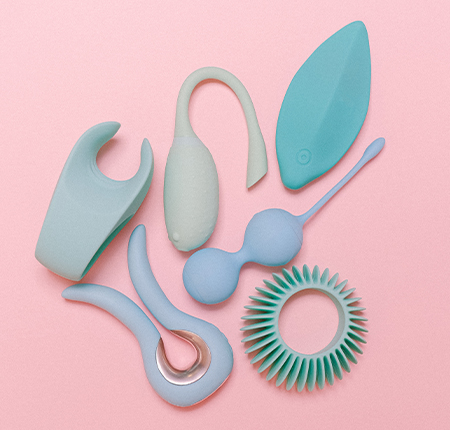
For the vulva, vagina and clitoris you can use dildos, external vibrators such as bullet or finger vibrators, air-pressure clitoral stimulators, internal vibrators for G-spot stimulation, double-ended dildos or rabbit vibrators. You can read all about sex toys and the options available on the market in our article: https://enroush.co.uk/blog/sex-toys-for-anyone-who-fancies-trying-something-new
Because unlike in films, sex isn't always quick and straightforward — and it's not just about finding the G-spot. Good sex means connecting mentally and physically. And above all, it's important that you feel comfortable with your partner and with yourself! So there's only one thing left to do: enjoy the exploration and the erotic experience!

Medium, super or extra absorption

Low, medium or super absorption

Low or medium absorption


and happily breaking taboos!


