

Having a Period Twice a Month – What Does It Mean and Why Does It Happen?
Menstruation is a natural, healthy bodily function and a beautiful phenomenon in a woman's life. It's a sign that the body is ready to create new life, and an expression of femininity. But when it arrives twice in one month, worry tends to creep in...
Is it normal to have your period twice in a month? What does it mean when this happens, and what causes lie behind it? There's no need to panic, because the causes are extremely varied and sometimes even completely harmless. Stay with us for a chat from woman to woman and let's find out together what it means, why it happens and how to cope with having a period twice in one month.
What does a normal menstrual cycle look like?
As a rule, a healthy menstrual cycle lasts an average of 28 days and can vary between 24 and 38 days. During this time the body goes through four phases (menstruation, the follicular phase, ovulation and the luteal phase). In adolescents, a normal menstrual cycle can even be longer than 38 days.
Likewise, the duration of menstruation, on average 5 days, can range between 2 and 7 days. That's what a normal menstrual cycle looks like. But every body is different, and the fact that a healthy period varies from woman to woman is also perfectly normal. If you'd like to learn more about menstruation: HERE we've talked about everything you need to know, without any taboos.
What does it mean if you get your period twice in one month?
Menstruation can occur twice in one month in all sorts of situations – and that isn't always a cause for concern. During puberty, for example, an irregular cycle in the first months is entirely normal – including having a period twice in one month. It simply means that you have an irregular cycle, and it can take a few years to settle down.
It can also mean that your cycle is shorter than 28 days (that is, between 24 and 28 days). If a month has 31 days, for instance, you may well get your period twice within the same month without any underlying health problem.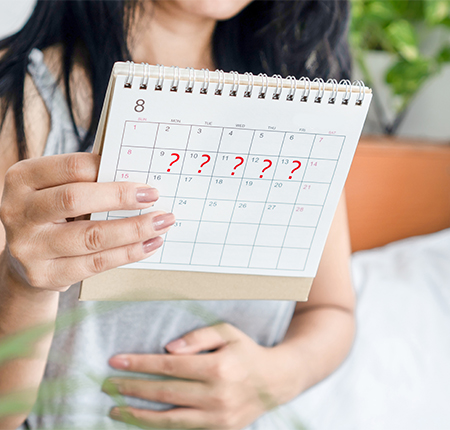
The phenomenon becomes a cause for concern, and may point to other conditions, when the gap between the two bleeds is shorter than 24 days or when additional symptoms appear:
- Two bleeds a month regularly over 2–3 months;
- Bleeding outside of menstruation;
- Heavy bleeding during menstruation;
- Needing to change your pad every 1–2 hours;
- Blood clots larger than a coin.
Spotting or a period twice in one month?
It's important to look closely if you're asking yourself: "Why am I having my period twice in one month?" You shouldn't confuse menstruation with spotting. The amount of blood is the key to telling the two apart.
With menstruation, the bleeding lasts several days and you need pads or tampons to absorb the menstrual blood reliably so your clothes don't get stained.
With spotting, on the other hand, the amount of blood is considerably smaller – often just a few drops – and you don't need a tampon or a regular pad, just a panty liner to protect your underwear. We recommend organic cotton panty liners, which keep your skin dry and let it breathe without irritating it with plastic or other chemicals.
Causes – why do I get my period twice in one month?
There are many very different possible reasons why your period might start early. From harmless causes, such as a perfectly ordinary bleed arriving 5 days early because of an irregular cycle, through to more serious conditions such as hormonal disorders or uterine fibroids. Let's look at each of the causes in turn.
A one-off anomaly
It can occasionally happen that you get your period twice in the same month for no obvious reason, and afterwards everything returns to normal. Such an isolated case is called a one-off anomaly and shouldn't worry you.
It simply means that your cycle was shorter that month and then went back to its usual length. If no other symptoms appear and it doesn't keep happening regularly, you can take this anomaly entirely in your stride.
A period twice in one month in adolescents
In adolescents, too, a period may start early, even twice in one month. Especially during puberty, when hormones fluctuate considerably. This doesn't mean there's a health problem, but it's worth discussing with your gynaecologist.
An irregular cycle is commonly seen in the first years after the first period: duration, frequency, number of bleeding days and flow can all vary from month to month. According to studies, it can take up to 6 years for the body to settle into a rhythm.
Endometriosis
The endometrium is the lining of the inside of the womb, which is shed with every period when no pregnancy occurs. When this endometrium-like tissue takes root outside the womb, the condition known as endometriosis develops.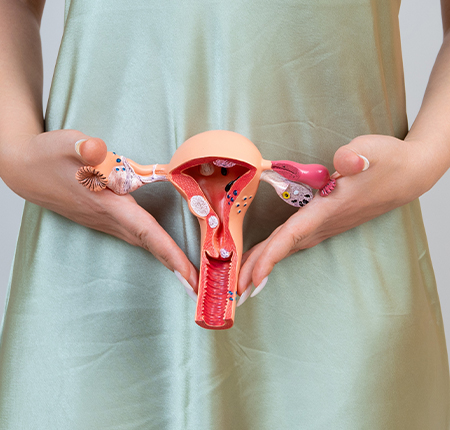
When the endometrium grows excessively, it means there's more tissue to be shed, which can lead to heavier or additional bleeding. Specifically, alongside abdominal pain and other gastrointestinal complaints, endometriosis causes irregular and heavy bleeding. This feels like a period and so gives the impression that you're having two periods in a month. Read more HERE about what life with endometriosis is like and what other challenges come with it.
Perimenopause
Here we're talking about the years leading up to the menopause – sometimes a period of as much as 10 years beforehand – when hormonal fluctuations set in again and the cycle can once more become irregular. Having a period twice in one month at 45, for example, is a natural response to the accelerated rhythm of ovulation.
So a bleed arriving earlier or later, failing to arrive at all, or appearing twice in the same month, as well as a change in flow, may simply be signs that the menopause is approaching. It means a new chapter of life is on the horizon – a natural one that all women experience, and which we've discussed in detail in another article on the Enroush blog, which you can read HERE. If, however, other symptoms appear such as very heavy bleeding or severe pain, speak to your gynaecologist.
Thyroid problems
An irregular menstrual cycle is often linked to thyroid problems, because this hormone's job is to keep the body's hormonal processes in balance.
Too low a level (hypothyroidism) or too high a level (hyperthyroidism) of this hormone can throw your period off balance – from a change in flow to a change in duration. It can even cause amenorrhoea, meaning the absence of menstruation for several months.
So if the thyroid isn't working optimally, the menstrual cycle can lengthen or shorten, and you may get your period 8 days early or even sooner – resulting in two bleeds in one month.
Uterine fibroids
The growths – albeit benign ones – that develop in the womb and that we know as uterine fibroids can cause bleeding and increase the flow during menstruation. Women with a family history of fibroids are at greater risk of developing them too.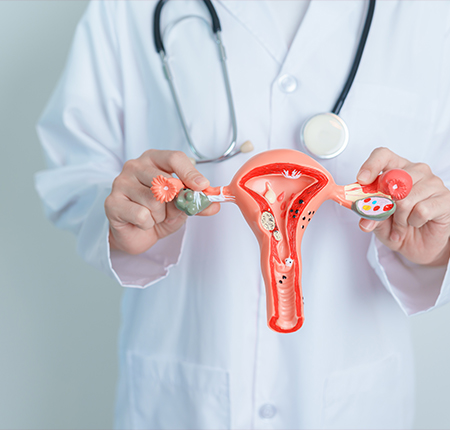
If no other symptoms appear (pain, frequent urination, pain during intercourse), you may not need any treatment at all – because fibroids shrink or disappear after the menopause. It's always worth speaking to your doctor, though, so that you can decide together on the healthiest course of action.
Hormonal disorders
If you have an irregular cycle with two bleeds a month, your body may be signalling a hormonal imbalance. It could be a disruption in oestrogen, progesterone or testosterone levels.
All of these hormones play a role in ovulation, which means that a hormonal disorder is also reflected in disrupted ovulation. What's more, hormonal disorders can affect many other bodily functions, which you can read about in more detail HERE.
Cycle disorder / irregular cycle
If you get your period again after 2 weeks (that is, twice in one month), this may be the result of a cycle disorder. It's called polymenorrhoea and means that your period starts at intervals of fewer than 24 days.
But it can also happen quite naturally that you get your period twice in the same month without this necessarily pointing to a serious problem. Women with an irregular cycle find themselves in this situation.
We need to bear in mind that a menstrual cycle is considered normal as long as it occurs at intervals of between 23 and 38 days. So imagine, for example, that in one month your period comes after 33 days, with the first day falling at the beginning of the month. And because you have an irregular cycle, the next bleed arrives after just 23 days, sometime at the end of that same month.
That means your period starts 10 days earlier than expected, without anything unusual being the matter. It's simply an irregular cycle that has shifted so that it begins at the end of the same month. The same thing can happen if your cycle starts 7 days early.
Side effects of contraceptives
Normally, contraceptives are meant to regulate your menstrual cycle. More than that: they're prescribed for an irregular cycle in order to keep it under control. Find out in our article HERE how contraceptives work and what other effects they have on your cycle.
In the first months of taking a new pill, though, it's perfectly normal to experience spotting, an irregular cycle and, above all, an extra bleed. That's a natural response to the hormonal changes.
The same applies if you forget to take a tablet on a given day. It can take a few months for the body to adjust and for the bleeding to settle into a pattern. If it goes on for longer or other symptoms appear, it becomes a problem and you should speak to your doctor in more detail.
When should you see a doctor?
The first sign that you should seek medical advice is if you get your period twice a month for several months in a row. If it keeps happening, it's very likely pointing to a health problem that needs treating.
A visit to the doctor is also advisable if you have other worrying symptoms, such as:
- Heavy bleeding with large clots;
- Heavy bleeding and needing to change your tampon or pad every hour;
- Abdominal pain;
- Pain or a feeling of bloating during intercourse;
- Migraine, dizziness, headaches, nausea, fatigue, fainting;
- Weight changes with no obvious cause.
Treatment for an irregular cycle with two bleeds a month
The first step in treating two bleeds a month is to find the cause. To diagnose endometriosis or uterine fibroids, for example, your doctor will carry out a gynaecological examination or an ultrasound scan.
Treatment then depends on the cause, your age and your state of health:
- For an irregular cycle during puberty or perimenopause, contraceptives may be prescribed.
- If there's an underlying condition, the main cause is treated first.
- For endometriosis and uterine fibroids, hormone therapy or surgery may be considered.
- Thyroid problems can be treated by giving synthetic hormones.
Most importantly, always discuss any change that worries you with your doctor. Always follow their recommendations so that any health problem is resolved as quickly and effectively as possible, your cycle settles down and you can have a normal period.
Risk factors & complications
Just because certain risk factors make you more prone to having two bleeds in the same month doesn't mean it will actually happen. But it's good to know about them so you're not alarmed and are prepared if it does:
- Puberty: During puberty there's an increased risk of irregular bleeding – your period may come after 20 days, after more than 38 days, or occasionally not at all.
- Genetic factors: These are a risk factor and increase your likelihood of an irregular cycle due to a uterine fibroid, a cyst or early perimenopause if this has already occurred in your family history.
- Hormonal problems: Problems with the thyroid or with oestrogen, hormone therapies and other hormonal imbalances can be the cause of an irregular cycle and two bleeds in the same month.
- A chaotic lifestyle: Significant weight fluctuations, stress, lack of sleep and an unhealthy diet can cause hormonal imbalances and therefore lead to too few or too many bleeds per month.
Without appropriate treatment, repeatedly bleeding twice a month can also lead to certain complications because of the considerable blood loss. Anaemia (with dizziness, fatigue, headaches, an irregular pulse), difficulty determining when you ovulate and therefore difficulty conceiving are complications that can arise if your cycle is irregular over a longer period.
How can you cope well with two bleeds in a month?
You may feel overwhelmed when you get your period twice in the same month, but you're not alone! Between 14% and 25% of women have an irregular cycle, and this doesn't always mean there's a problem.
Did you know that with hormonal imbalances, the cause may even lie in your lifestyle? Exercise, diet and habits can be your allies or your enemies – which is why we want you to know how to cope with two bleeds a month in a healthy way. Here are some useful tips you can put into practice at home:
- Practise stress management techniques: They help you relax, control your breathing and reduce inner restlessness;
- Use suitable intimate care products: Throughout the month – and especially during your bleed – you need appropriate hygiene to avoid irritation or infection;
- Eat a balanced diet: Eat nutrient-rich foods that can help you prevent anaemia, which you're prone to if you bleed heavily twice a month.
- Choose organic pads: We know it isn't easy coping with period symptoms, especially twice a month – and a conventional product with questionable ingredients makes everything even harder. Enroush pads made from 100% organic cotton have excellent absorbency to support you even on heavy-flow days, and protect you from irritation with entirely natural ingredients.

Frequently asked questions
Haven't yet found the answer to the question that's worrying you? You might find it below, where we've answered some of the most common questions about having a period twice in one month.
Can you be pregnant if you get your period twice in one month?
Even though it's harder to track ovulation and pinpoint your fertile days, it's perfectly possible to get pregnant even if you have an irregular cycle with two bleeds a month. What's more, irregular bleeding and spotting during pregnancy are normal, especially in the first trimester.
Is it normal for my period to come after 2 weeks?
That depends directly on your age and your state of health. If it's an isolated case and you're going through puberty or perimenopause, an irregular cycle in which the bleed comes too late or too early – even after just 2 weeks – is normal. What isn't normal is if it keeps happening over several months or if there's an underlying health condition, hormonal or otherwise.
Does a period twice in one month indicate a problem in adolescents?
Particularly in the first years after the first period, an irregular cycle is normal and usually regulates itself. Sometimes this process can take years. A period twice in one month becomes a problem in adolescents when it keeps happening over several months or is accompanied by other worrying symptoms. In that case, the doctor may prescribe contraceptives to regulate the duration and flow of the bleed.
What does a period twice in one month mean from the age of 45?
From the age of 45 we can start talking about the menopause. During this time, the length of the menstrual cycle can also change because of hormonal shifts. If the follicular phase shortens, this can lead to more frequent ovulation and even two bleeds in the same month.
What does it mean if your period comes more than 10 days early?
Your period may start early as a result of hormonal fluctuations. This can happen during puberty or perimenopause, but also because of chronic stress, various health problems or certain medications. It's normal for your period to come early sometimes. If it keeps happening over several months, however, it may point to a more serious condition and a visit to the doctor is advisable.
If my period comes just a week after the last one ended, should I be worried?
Normally the menstrual cycle lasts between 23 and 38 days. Even so, a new bleed can occur after just 1–2 weeks, especially if you're starting to take contraceptives. These bleeds are normal and should stop after 2–3 months, once the body has got used to the new level of hormones.
A new bleed after only 7 days isn't necessarily a cause for concern, but you should definitely speak to your doctor if it happens several times.
What does it mean if I bleed for just one day in the middle of my cycle?
One-day bleeds in the middle of the menstrual cycle are common and are known as intermenstrual bleeding or spotting – HERE we've explained when you should be concerned. The causes can be varied, from stress and intense physical exertion to a change of medication or the onset of health problems. If you suspect the bleeding points to a problem, speak to your doctor.

Medium, super or extra absorption

Low, medium or super absorption

Low or medium absorption


and happily breaking taboos!


