

Pregnancy Calculator: How Is Pregnancy Calculated in Weeks and Months?
How would you like to peer into the future the moment your pregnancy is confirmed and already know the day you'll bring your baby into the world? The good news: you don't need a crystal ball or psychic intuition for that. Today, a pregnancy calculator lets you work out in just a few seconds when your wonderful journey as a mum begins.
And no, there's nothing mystical about a pregnancy calculator – it's just a few simple sums. Unlike tea leaves or other magical aids, a calculator like this is based on concrete information. The tool automatically works out your pregnancy in weeks and months – using solid data about your menstrual cycle.
In this article, you'll discover why a pregnancy calculator is useful, how accurate it is and how it works. And if you're pregnant and can't wait to find out how your pregnancy progresses week by week, simply fill in the required fields in our calculator below to work out your baby's estimated due date.
Why a pregnancy calculator by weeks/months is useful and what information it gives you
The pregnancy calculator's main job is to help you work out your estimated due date. We deliberately say estimated, because every pregnancy is unique and unfolds differently – all the dates calculated are a likelihood, not a certainty.
It's entirely possible that the birth will happen earlier or later than the calculated date. Even so, it's worth using the calculator to get at least a rough idea of how your pregnancy will progress. Specifically, calculating your pregnancy can give you guidance on the following:
-
The date the pregnancy began
-
When the first ultrasound scan is recommended
-
When you can find out your baby's sex, if you'd like to
-
The dates on which the first and second trimesters end
-
The period during which the birth is most likely to take place

The data the pregnancy calculator uses
To create a pregnancy calendar for you and work out your due date as accurately as possible, the tool uses specific details about your menstrual cycle. That's precisely why the calculations are less accurate for women with an irregular cycle.
The details used may vary depending on how the calculator is set up, but you'll usually need to know the date of your last period. Most calculators use the following reference points:
- The first day of your last period
-
The length of your menstrual cycle
The information the pregnancy calculator provides
Likewise, depending on how it's programmed, the pregnancy calculator can provide various types of information.
Some calculators are more basic. They simply tell you the approximate date you conceived and the estimated window in which you'll give birth to your baby.
More sophisticated calculators can give you a fuller picture of everything that happens over the course of pregnancy, namely:
-
Reference dates: These can include the date of conception, the end of the first and second trimesters, and your child's due date
-
Details on how the pregnancy progresses: The calculator can create a pregnancy calendar by weeks or months, tell you which week of pregnancy you're in, and give you pointers on when the first ultrasound scan makes sense and when you can find out your baby's sex
-
Information on your baby's development: Since the calculator works out which week of pregnancy you're in, some even estimate your baby's length and weight.
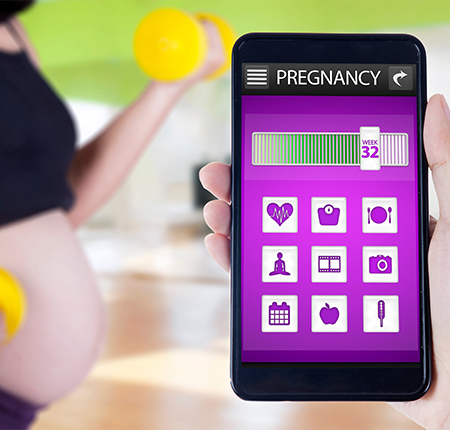
The estimated due date
In theory, the birth takes place around 38 weeks after conception, or 40 weeks after your last period. This is the basis on which the pregnancy calculator makes its estimates too.
Bear in mind, though, that statistically fewer than 4% of births happen exactly on the calculated date, and that in almost 90% of pregnancies there's a discrepancy of around 2 weeks between the calculated and the actual date of birth. It's equally normal for the baby to arrive any time between weeks 37 and 42.
So the timing of the birth can only ever be predicted approximately – never pinned down exactly.
How the due date is calculated
Working out the due date is straightforward: from the first day of your last period, you add 280 days (which equals 40 weeks). If your last period began on 1 March, for example, you add 280 days and get 8 December as your estimated due date. You'll arrive at the same result using another method: subtract 3 months from the date of your last period and then add 7 days. The calculator uses one of these two methods to estimate your due date.
You'll only get more precise results with the help of your doctor or midwife, who will take into account the size of the gestational sac and the foetus during an ultrasound scan in order to determine gestational age. Even then, though, the calculations remain estimates – the birth happens when your baby is ready.
Why it makes sense to estimate your due date
For you as a mum-to-be, knowing your due date matters above all so that you can be physically, mentally and emotionally prepared for the life as a mother that's about to begin.
It's just as important for your doctor to estimate your due date, so that every check-up is carried out at the right time and – if you go past your date – it's clear when induction becomes necessary.
Tips for using a pregnancy calculator
Thankfully, you no longer have to sit with a calendar in front of you counting, adding and subtracting weeks and days yourself, as explained above, to work out your due date.
These days there are online tools that handle the calculations automatically for you – like our pregnancy calculator on this page. All you need to know is when your last period started, and it will show you the estimated details of your pregnancy.
How accurate is the pregnancy calculator?
Worth knowing: what the calculator shows isn't set in stone – there are several reasons why these calculations might be imprecise.
First of all, the unique course of your pregnancy and the factors influencing it play a big part. How old are you? If you've been pregnant before, how long did your other pregnancies last? What's your weight at the time of the estimated birth? All of this can affect your due date.
Equally, the accuracy of the calculated dates depends directly on how correct the information you enter is. If you don't know the exact date of your last period or you have an irregular cycle, you may enter incorrect data – and the results will be correspondingly imprecise. In that case, your doctor is best placed to estimate your due date following an ultrasound scan.
Determining the months of pregnancy
Based on the calculations, the calculator can map out the three trimesters of pregnancy. It shows you when each month of pregnancy runs from and to – from the 1st to the 9th month.
Determining the weeks of pregnancy
Once the months of pregnancy are established, the weeks are easy to work out too. Knowing which week you're in also gives you a sense of the stage of development your baby has reached and the symptoms and changes you can expect. We've covered your baby's development and pregnancy week by week in far more detail HERE.
Although the birth theoretically takes place in week 40, your baby can arrive any time between weeks 37 and 42.
Frequently asked questions about the pregnancy calculator
Still have questions about the pregnancy calculator? Read the answers to the most common ones below.
How is the estimated due date calculated?
To estimate your due date with a calculator, you need to know the date of your last period. The day your baby will theoretically be born is worked out by adding 280 days to the first day of your last period.
How accurate is the information from the pregnancy calculator?
The accuracy of the information generated by the pregnancy calculator depends on how correct the data you enter is. If you haven't given the date of your last period accurately, or you have an irregular cycle, the results are likely to be less precise. What's more, these calculations are only theoretical and indicative – every pregnancy has its own rhythm of development and its own course.
What other methods can I use to calculate my pregnancy?
Pregnancy can also be calculated from the date of conception, but this method is used far less often – after all, how many women know exactly when conception took place? Assuming you know the precise date, you can work out your gestational age as the difference between today's date and the date of conception.
The most accurate way to calculate pregnancy, however, remains a medical examination by ultrasound, which takes into account the size of the gestational sac and the foetus.
When is it advisable to take a pregnancy test?
Tests can usually confirm a pregnancy one week after a missed period. By then, hCG levels are high enough to be detected in urine, indicating that the egg has been fertilised.
There are, however, highly sensitive pregnancy tests with considerably greater accuracy that can even be taken before a missed period. So do read the instructions on the test packaging, as every test states when it's recommended to be used.
Enroush products for pregnancy and the postnatal period
Whether the birth happens on the predicted date or takes you by surprise, you'll find out in due course. What you do know for certain right now, though, is that throughout your pregnancy and the postnatal period you want to give your body the gentlest, safest care possible – for your own safety and your baby's.
Discharge is normal during pregnancy, and in the period after the birth come the lochia – the vaginal bleeding that's heavy at first and then gradually eases. That's why it's a good idea to stock up now on safe intimate care products, such as Enroush pads made from 100% organic cotton and natural fibres. They contain no other toxic ingredients, so they don't cause irritation and make this time as comfortable as possible for you.
You can also choose from 3 sizes with different levels of super absorbency, depending on what you need. For the first few days after the birth, when the lochia are heavy, you need the highest possible absorbency to soak up all the blood – which is exactly what the organic night pads offer. As the bleeding eases, you can move on to the Super pads, then the Normal pads and finally the organic panty liners to protect against discharge.

Hygiene in the postnatal period is just as important, while your vagina is still recovering and is more susceptible to infection. That's why Enroush Intimate Gel contains 95% natural ingredients with antibacterial and antifungal properties, to cleanse your vulva gently on the outside and strengthen the skin's resilience.
And for those moments when you need a quick freshen-up, the biodegradable intimate wipes do the job in one easy step. Enriched with chamomile, prebiotics and lactic acid, they protect your intimate flora and remove bacteria and unpleasant odours – so you can feel comfortable in your own skin and focus fully on your new role as a mum.

Medium, super or extra absorption

Low, medium or super absorption

Low or medium absorption


and happily breaking taboos!


