

Tampons: EVERYTHING about use, risks & answers
How many times have you thought that a pad is uncomfortable? Or how often have you wished you could use a tampon at the beach so you could wear your swimsuit, but didn't dare? Or because you didn't know how to use a tampon? We're here to tell you EVERYTHING about them.
Because just like pads, tampons were designed to absorb menstrual blood. Both are practical options with their own pros and cons, and every woman should be well informed and free to choose either one. A decision based purely on personal preference – without the influence of myths or the fear of being judged.
So: what's the connection between tampons and virginity? How do you insert a tampon and how long can you wear one? What else should you know about them? If you haven't got anyone to talk to about these things, or you feel too embarrassed to ask – we're here, answering all your questions openly.
What are tampons?
Tampons are single-use period products made from soft, absorbent materials that are inserted into the vagina during menstruation to absorb menstrual blood and vaginal fluid. Once correctly inserted, you shouldn't be able to feel them and they shouldn't cause any discomfort whatsoever.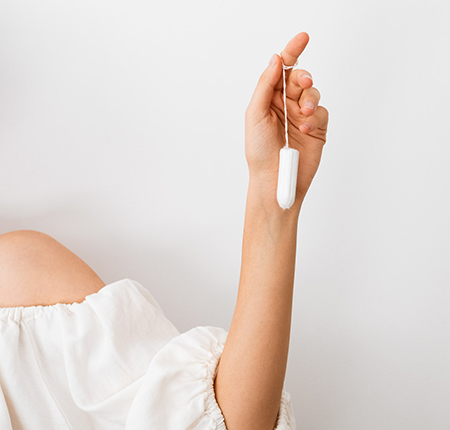
Opinions on tampons are divided, but many women prefer them because they offer more discreet protection than pads – and without the drawbacks (the nappy feeling, allergic reactions, visible wings showing through your underwear and so on).
Tampons come in various sizes, with each size corresponding to a specific amount of fluid it can absorb. The larger the tampon, the better its absorbency copes with a heavy flow.
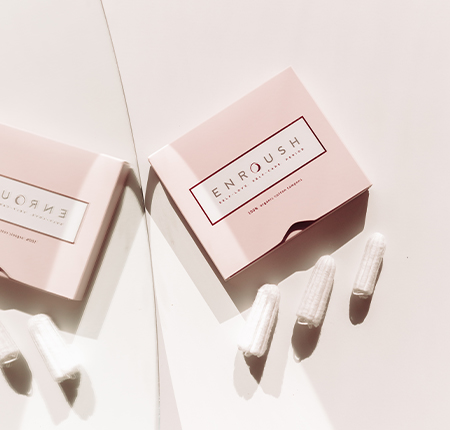
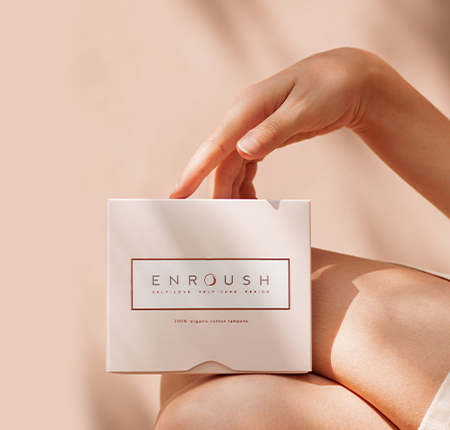
In our shop, for instance, Enroush organic tampons are available in 3 different sizes (Mini, Regular and Super), so you can choose the perfect protection for your flow.
o.b. vs tampon – what's the difference?
The term "o.b." is often used incorrectly when what's actually meant is tampons. But the two terms aren't synonyms. Tampons are all period products made from absorbent materials that are inserted into the body to absorb menstrual flow. o.b., on the other hand, is just one of many tampon brands.
So when you say you use an "o.b." during your period, it's essentially like saying you use an "Enroush" – you're only naming the brand. It would be more accurate to say: "I use o.b. tampons" or "Enroush tampons". That way you're naming both the product and the brand.
How do you use a tampon correctly?
Using them correctly matters for both your intimate health and your comfort. With good hygiene, you ensure that only the tampon goes into your vagina – and not bacteria that can cause infections. And if you insert it in the right position, you won't feel any pain or discomfort, nor will you notice the tampon's presence when you're sitting, moving about or simply wearing it.
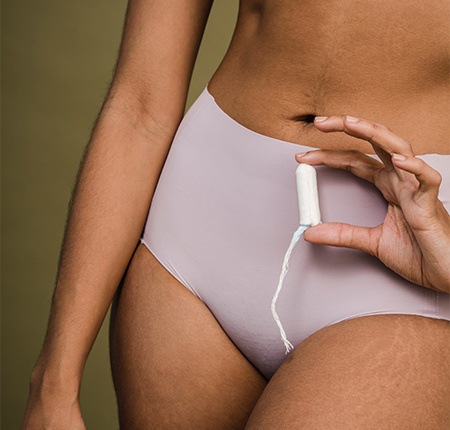
And it all starts with preparation. Here's a checklist for getting ready to use tampons properly:
- Wash your hands with soap and water so they're clean when you unwrap the tampon. This reduces the risk of transferring bacteria from your hands to your intimate area.
- Get into the most comfortable position you can – with one leg raised, for example, or sitting on the toilet with your legs apart. Whatever helps you stay relaxed. If you're tense, insertion can be painful or uncomfortable. The more relaxed you are, the more painlessly the tampon will slide in.
- Throw the tampon away if it falls on the floor – at any point before you insert it. Start the whole process again with a fresh, clean tampon.
- Wash your hands again afterwards.
With these basic hygiene rules sorted, you're ready to insert the tampon and enjoy discreet protection throughout your period.
How do you insert a tampon? And how far in?
Now that we've covered some preparation basics above, here's a step-by-step guide to inserting your tampon correctly and at the right depth, so you're protected and comfortable at the same time:
- Use one hand to part the labia and the other to guide the tampon into the vaginal canal, pushing it inwards with your index finger. Remember to stay as relaxed as possible so it slides in easily and without resistance.
- Change the angle slightly and push gently backwards, without forcing it, if you still feel resistance during insertion.
- You'll know the tampon is in the right place when you can no longer feel it. There are a great many nerve endings at the entrance to the vaginal canal – which explains why you feel discomfort when the tampon isn't in far enough and sits too close to the opening.
- Make sure the string stays accessible on the outside, as you'll need to pull on it to remove the tampon.
You'll find that the more often you use tampons, the more confident you become with them.
And even if it doesn't go perfectly the first time – don't be discouraged! Even with pads, it took a bit of trial and error before you knew exactly how to position them in your underwear to prevent leaks, didn't it? It's the same with tampons: after a few goes, you'll learn to insert them more and more easily, comfortably and without any fuss.
How long can you wear a tampon?
How often you change your tampon depends on how heavy your flow is. Once it's full, it needs to be removed and replaced with a fresh one. The heavier your flow and the lower the tampon's absorbency, the more often you'll need to change it. The more fluid the tampon can hold, or the lighter your flow, the less often.
As a general guide, though: change your tampon every 4 to 8 hours. Never wear a tampon for longer than 8 hours, because menstrual blood that stays in the vagina for too long can encourage a build-up of bacteria and therefore infections or toxic shock syndrome. That's also why it isn't advisable to wear a tampon overnight if you might sleep for longer than 8 hours.
At what age can you use tampons?
From your very first period. It's a myth that you can only use tampons after you've had sex for the first time, or only once you're 18. It's equally a myth that a teenager's body isn't ready for a tampon. Your body is ready for tampons as soon as you get your first period.
So just like pads, tampons are equally safe and suitable for all girls and women managing their periods. They're easy to insert, and if girls feel comfortable with them, the experience can even be more pleasant than with pads – because you can't feel tampons and they leave you feeling clean.
To start with, until you get used to them, you can use Enroush MINI organic cotton tampons. They're thinner and smaller, making insertion especially comfortable.
Are tampons dangerous?
Just like pads, tampons are safe and comfortable as long as you use them correctly. Doctors recommend using them whenever we want protection from leaks during our period – provided the hygiene rules are followed. Tampons only become dangerous and a health risk when hygiene and safety guidelines are ignored.
For example, there's a risk of bacteria developing and toxic shock syndrome (TSS) occurring if you keep the same tampon in for longer than 6 to 8 hours. You'll find everything you need to know about TSS on our blog. The important thing to remember, though, is that the risk of toxic shock is very low if you use tampons hygienically (changing them in good time, not sleeping in them, not forgetting one inside the vagina, never reusing the same tampon and so on).
The ingredients a tampon is made from also matter enormously. Read the label and make sure it contains only natural materials – because you're inserting them into your body month after month, where they come into contact with the vaginal lining. We've made Enroush tampons from 100% organic cotton, with no dioxin, chlorine or other toxic ingredients and chemical residues. That way we can be sure they're 100% safe for your body and pose no threat to your vaginal pH balance or your intimate health.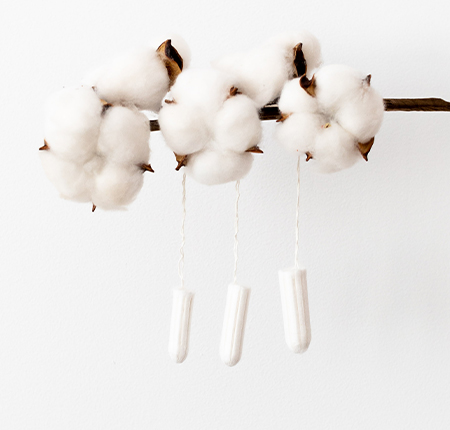
Tampons & virginity
Because there are so many myths surrounding virginity, tampons are still taboo for many teenagers and young women who aren't yet sexually active. Girls and women don't know at what age they're allowed to use o.b. or other tampons – or avoid them out of fear of losing their virginity.
So let's free ourselves from shame, fear and misinformation and look at what's really going on with tampons and virginity.
Can you use tampons if you're a virgin?
Yes, you can. And it shouldn't be virginity that determines whether you choose pads or tampons, but solely your own comfort. Virginity is a unicorn anyway – you can read why we say that HERE – in other words, an outdated social construct that does nothing for us. As soon as you get your first period, your body is ready to use both pads and tampons at any time, regardless of whether you're a virgin or not.
And although people often say that virgins should use smaller tampons so as not to "tear" the hymen, the truth is there are no tampons specifically for virgins. There are simply different sizes and absorbencies, so you can find the right protection for your flow. So what we call "tampons for teenagers" are simply smaller products that hold less fluid and fill up more quickly with a heavy flow.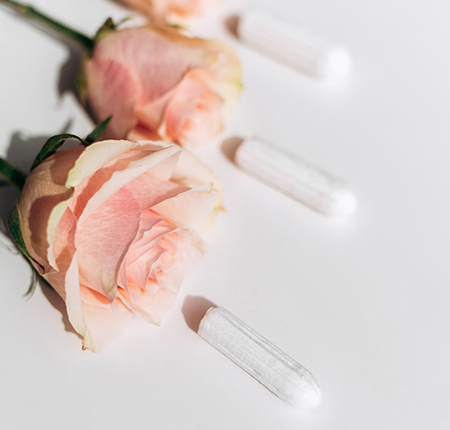
The hymen is elastic and already has one or more openings through which menstrual blood can flow out. So even a larger tampon can be inserted without tearing it. Even if you start with smaller tampons until you get used to them, you can absolutely choose larger ones later on for heavier days – even as a virgin. By choosing the right absorbency and size for your flow, you give yourself the protection you need each day.
Can you lose your virginity by using a tampon?
No, the two have nothing to do with each other. As we've already mentioned: virginity isn't a genuine medical state, nor is it something you lose. So you can use not only o.b. tampons when you're a virgin, but any tampon – including a larger one, if your flow calls for it.
But let's also clarify WHY virginity has nothing to do with using tampons.
Virginity is linked to sexual experience – or more precisely, to the lack of it. Essentially, the thinking is simple: you're considered a virgin as long as you haven't had sexual intercourse and your hymen is intact. From this we can draw two conclusions, both of which confirm that you can't lose your virginity by using a tampon:
- Virginity is about sex; tampons are about period hygiene – a completely normal and natural bodily function. When we link tampons to losing your virginity, what we're really doing is sexualising the insertion of a hygiene product. There's nothing sexual about inserting a tampon into the vaginal canal to protect yourself from menstrual blood. It isn't a sexual experience – so there can be no question of losing your virginity.
- Virginity is a contradictory concept anyway. On the one hand, it presupposes an intact hymen, which may well not be the case. The hymen is a thin, elastic tissue that can stretch or open not only through penetrative sex, but also through intense physical activity, through injury, or simply for no apparent reason. On the other hand, sexual experience isn't limited to vaginal sex. What about oral sex, masturbation and other forms of intimate contact without penetration, which constitute sexual experience and therefore nullify the concept of virginity, yet leave no trace on the hymen? The bottom line: the condition and appearance of the hymen are completely irrelevant to virginity – and in this context, any possible change caused by using a tampon has nothing to do with losing your virginity.
Which tampons are the best?
Fair enough, but how do you choose the best tampons? Well, when it comes to intimate health, we'd actively encourage you to apply strict criteria. It's crucial to choose only good tampons that you can use with a clear conscience every period, without worrying about their effect on your body.
So let's return to what we said earlier: how important it is to check the ingredients in order to minimise the risks of tampons. Doctors recommend tampons made from cotton, processed as naturally as possible and free from toxic ingredients. After all, you don't want to be inserting dangerous substances and hormone disruptors into your body month after month.
Have you ever wondered why many conventional products don't even provide a list of ingredients? It's precisely because of the high proportion of chemicals.
Have you noticed how white tampons are? Chlorine or dioxin is usually used for bleaching – substances that are harmful to your vaginal health. Plastics, fragrances and other chemical residues are also frequently found in the composition of period products, which is why they can trigger all sorts of allergies, irritation, changes to your flow and even hormonal imbalances or other health problems.
When developing Enroush tampons, we took our inspiration from your body and from nature, and made sure to use none of the harmful substances mentioned above. Enroush tampons are made exclusively from 100% organic cotton and nothing else. That means no dioxin, no chlorine, no fragrances, no plastic and no synthetic fibres. No risk to your intimate and reproductive health. Just nature's gentle touch for your vagina – so you can have a safe, healthy and sustainable period without allergies or discomfort.
Myths & facts about tampons
We've already established that tampons are safe as long as you use them hygienically and opt for natural materials. We've explained step by step how to insert a tampon, and debunked the myth surrounding virginity.
But the list of myths goes on – and we're here to clear away the stigma, fear and unfounded worries that come with rumours and misinformation. So let's look at what other myths are circulating about tampons and what the reality actually is, or what specialists have to say about it.
Can a tampon get lost or stuck inside your body?
No, that's impossible. A tampon has never been lost inside anyone's body, because it has nowhere else to go – it stays in the vagina. You may well get the feeling that a tampon is stuck – particularly if the string breaks (unlikely) or if you've forgotten you're already wearing one and insert a second, pushing the first one further in.
Even then, the tampon can't get lost inside your body. Only the vaginal opening is large enough for the size of a tampon. At the other end of the vagina is the cervix, whose opening is far too small to let a tampon (even a small one) pass through into the uterus.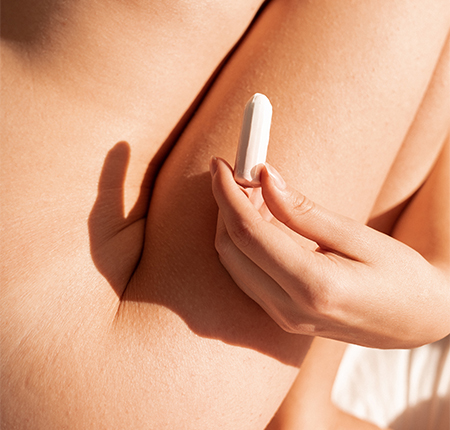
Here's what to do – and what NOT to do – if you can't get your tampon out:
- Relax: the more tense you are, the more resistance you create when pulling it out. Get into a comfortable position, breathe deeply and take your time – just as you did when inserting it. Squatting can give you a better angle for removing the tampon more easily.
- Try to find the string: it might be a little further in, near the entrance to the vaginal canal. With clean hands, insert two fingers to grasp the string and gently draw it outwards.
- It may be too dry: if you can't get the tampon out because you feel resistance, it may not be full enough. On the last days of your period, when your flow is light, it can still be dry even after 6 to 8 hours – which is why it's harder to remove and feels as though it's stuck. You can use a little water or lubricant on your fingers to moisten it and ease it out.
- Don't expect it to come out by itself: so that you can wear it comfortably, the tampon sits fairly high up in the vagina, and the chances of it slipping out on its own are very slim. It's more likely that you'll forget about it in there – and that's dangerous. If you absolutely can't get it out, see your gynaecologist.
- Never use tweezers or other risky implements: they can cause injury. This is your health we're talking about – and there's no shame in seeking medical help!
Can a tampon fall out when we go to the toilet?
No. If you've positioned the tampon correctly, it shouldn't fall out when you go to the toilet. The vagina has its own opening for menstrual blood to flow out of, while the urethra and bowel have separate openings that don't come into contact with the tampon. So you don't need to change it every time you go to the loo – only when it's full, depending on how heavy your flow is.
Can tampons stop your period?
This is another myth. Tampons absorb menstrual blood; they don't stop it. Yes, you might feel clean and as though the bleeding has stopped – but only because the tampon's absorbency is temporarily preventing the flow from coming out. That's precisely why menstrual blood can leak around or through the tampon once it's full and can no longer absorb any more fluid.
Can tampons cause cancer?
In the long term, dioxin and other toxic substances can be carcinogenic when they come into contact with our bodies. While there currently aren't enough studies proving just how harmful the chemicals in conventional tampons really are, we can't ignore the links with cervical cancer or endometriosis. And caution and prevention are always better than treatment.
The best way to protect yourself from the risk of carcinogenic or harmful substances is to make sure they aren't in your period products in the first place. Enroush tampons are made of nothing but 100% organic cotton – for the safest, healthiest period care.
Can a tampon slip out during sport or in the swimming pool?
Again: no. So that you can wear a tampon as comfortably as possible and it protects you effectively from leaks, it needs to sit far enough inside the vaginal canal that it won't slip out. Not even during sport or swimming. This is why you can wear a tampon in the swimming pool without a worry – your flow is absorbed right there inside the vagina. It's precisely because of these advantages that many women make tampons their protection of choice at the seaside.
Can you use tampons with an IUD?
Let's also talk about tampons and the IUD (coil). Tampons are inserted only into the vaginal canal, while your gynaecologist places the IUD in the uterus. In theory, then, the two don't touch, and we can use tampons with an IUD.
It's important to know, though, that the IUD's threads hang down into the lower part of the vagina. That's why it's recommended not to use tampons for the first 3 to 4 months after having an IUD fitted, as there's a chance you might pull on these threads when removing the tampon. It's best to ask your gynaecologist – they can tell you how long you should wait before using tampons safely. Sometimes it's just 4 weeks, sometimes 2 to 4 months.

Medium, super or extra absorption

Low, medium or super absorption

Low or medium absorption


and happily breaking taboos!


