

The calendar method explained
The calendar method, also known as the Ogino-Knaus method, periodic abstinence or the rhythm method, is a natural approach to contraception and family planning. It requires you to understand the phases of the female menstrual cycle – that is, the days of peak fertility as well as those when fertility is at its lowest – in order to avoid an unwanted pregnancy or, conversely, to maximise the chances of conceiving.
The calendar method – how is it calculated?
Is the calendar method an effective form of contraception even with an irregular cycle? Does it protect against sexually transmitted infections? How do you work out a woman's fertile days? You'll find the answers to these and many other questions in this article.
What does the calendar method mean?
The calendar method is about pinpointing the fertile phase of the menstrual cycle as accurately as possible – the days on which the likelihood of pregnancy is highest – and abstaining from intercourse during that window. The remaining days of the cycle are considered "safe", which is why many people forgo any other form of contraception during this time.
Although it may appear simple at first glance, in practice the calendar method is very risky and rather complicated, because it's difficult to determine the fertile phase of a woman's cycle precisely. What's more, irregular cycles need to be tracked for at least 6 months. Only then is it possible to establish which period is fertile and which can be considered safe for unprotected intercourse.
IMPORTANT!
This natural contraceptive method has a fairly high failure rate and offers no protection against sexually transmitted infections!
The calendar method – how does it work?
A woman can, in principle, become pregnant at any time if she has unprotected intercourse, but the likelihood is greatest during ovulation and on the fertile days around it.
Ovulation is the process by which one or more eggs are released from the ovary – and it happens once a month. In theory, with a regular 28-day cycle, ovulation occurs on day 14, with the first day of menstruation counting as day one of the cycle.
Following the same logic:
- with a 29-day cycle, ovulation occurs on day 15;
- with a 30-day cycle, on day 16;
- with a 32-day cycle, on day 18, and so on.
After ovulation, sperm have 24 hours to fertilise the egg released into the fallopian tube. Did you know that sperm can survive for up to 7 days after intercourse?
The calendar method – the fertile days
The fertile phase is the period in the month during which a woman can conceive. For women with a regular cycle, the calculation is straightforward and the risk of an unwanted pregnancy is lower.
As a rule, the most fertile times are:
- the days before ovulation;
- the day of ovulation;
- the 24 hours following ovulation.
If your cycle is regular, the calendar method is easy to calculate: with a 28-day cycle, ovulation takes place on day 14. Let's look at a concrete example.
EXAMPLE:
Your cycle lasts 28 days (you're certain because you've tracked it for at least 6 months). The first day of your period is 2 March, so your next period will begin on 30 March. Subtracting 12 days from that date gives 18 March – the last day of the 8-day fertile window. Intercourse between 19 and 30 March, as well as between 5 and 9 March, will therefore not result in pregnancy. The egg is capable of being fertilised between the 10th and the 18th. It's advisable to extend abstinence by 1–2 days either side of the fertile window.
On average, a woman can only conceive on 8 days of the month; the remaining days are unsuitable for fertilisation, as ovulation occurs between days 12 and 16 of the cycle. In addition, the egg's lifespan is very short.
With an irregular cycle, predicting ovulation is considerably more difficult.
If you'd like to learn more about the fertile window and the signals your body sends during these days, read our article – there you'll find everything you need to know about ovulation. In the world of ENROUSH there are no taboos and no secrets; transparency is central to what we do. You probably already know that, because on our blog we talk about all the things others keep quiet about, and on our product ingredient lists we declare everything, with nothing left out. That's not hard for us either – because the only ingredient in our pads, tampons and liners is 100% organic cotton. Your period doesn't have to be an ordeal: choose natural, organic care and you'll be thanking yourself for years to come.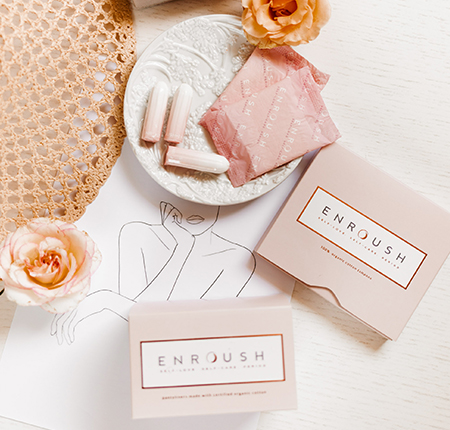
The calendar method – the infertile days
Outside the days around ovulation, you're in the infertile phase. Even though in theory there's no chance of conceiving during this time, the rule still applies: with unprotected intercourse there's always a residual risk.
Irregular cycles and the calendar method
Although the calendar method isn't recommended for an irregular cycle because of the high risk of pregnancy, there is a way of calculating your fertile days. Here's an example.
EXAMPLE:
Note down in a calendar the first day of your period and exactly how long it lasts. Count the days of each cycle, starting with the first day of menstruation. The final day is the day before your next period begins. Keep these records for at least 6–12 months before relying 100% on the calendar method.
Enter the data you've gathered into a table: the first column for the first day of your period, the second for the cycle length. Pick out the shortest cycle from the table and subtract 18 from that number. Counting from the first day of your period, the resulting number marks the start of your fertile window. Then take the longest cycle and subtract 11 from that number. Again counting from the first day of your period, the result marks the end of your fertile window.
The calendar method – effectiveness
The calendar method is a risky form of contraception and rather difficult to apply. The failure rate is over 25%, which means unwanted pregnancies can occur quite frequently.
It can also put a strain on a couple's intimate life, since intercourse has to be planned around the calendar.

Risks – how safe is the calendar method?
What's the big advantage? The calendar method is a form of contraception with no health risks. Neither your physical nor your emotional balance is affected.
On the other hand, it can sometimes be difficult for a woman to predict her fertile window precisely month after month – especially with an irregular cycle. Even with a regular cycle, small shifts or miscalculations can crop up at some point and lead to an unwanted pregnancy.
The risks also include the lack of protection against sexually transmitted infections and the fact that, unlike hormonal contraceptives, the method offers no relief from period pain.
When it comes to avoiding pregnancy, the calendar method is by no means the safest choice. It can, however, be a genuine help when a couple is trying to conceive.
Are there other ways to calculate ovulation?
Ovulation can also be identified using other methods that are less widespread but nonetheless effective. These include the basal body temperature method and the method of observing cervical mucus.
The basal body temperature method
The basal body temperature method helps women work out when they're ovulating by taking their temperature every morning. On the day after ovulation, a woman's basal body temperature rises by half a degree Celsius under the influence of the female hormone progesterone.
How can you use this method?
Take your temperature every morning (under the tongue, under the arm or rectally) immediately after waking, before you get up, and after at least 5 hours of uninterrupted rest. It's very important to measure correctly – every day with the same accurate thermometer and ideally at the same time.
Record your temperature readings each day during the phase of heightened fertility. Once you've noted 3 consecutive readings above your average, it means ovulation has taken place. This fertile phase lasts until the third day after ovulation.
If a woman has a cold or a viral or bacterial infection, this method can produce misleading results.
The cervical mucus observation method
Over the course of the month, the mucus produced by the vagina and cervix changes its characteristics due to fluctuations in the female hormones oestrogen and progesterone. This indicates how close to or far from ovulation you are.
A few days before ovulation, the mucus becomes watery, transparent and slightly yellowish. On the day of ovulation, the secretion becomes thicker and wetter, with a consistency similar to egg white, and may cause a feeling of wetness in the vagina. A day after ovulation there's noticeably less mucus, and it's thicker and stickier.
The test is simple, but it should be carried out daily and the changes noted in a diary. Check your vaginal secretions each morning by picking up a little mucus on your fingertip and rubbing it between your fingers. If it stretches into threads before breaking, you're probably ovulating.
A word of caution: vaginal secretions can change after intercourse, making them harder to assess. This method therefore offers no complete guarantee against an unwanted pregnancy either.

Medium, super or extra absorption

Low, medium or super absorption

Low or medium absorption


and happily breaking taboos!


