

What is breakthrough bleeding and when should you be concerned?
Around 13% of all people who menstruate or have menstruated are affected – metrorrhagia is most common in women over 40. But what exactly is metrorrhagia?
While it can be a harmless occurrence with no further consequences, in some cases metrorrhagia is a symptom of a more serious condition. Read our article and find out everything about the causes, symptoms and treatment!
Metrorrhagia – what is it & how does it present?
Specialists describe it as abnormal bleeding from the uterus outside of menstruation. More precisely, it is bleeding that resembles a period but is not part of a menstrual cycle.
If you notice spots of blood outside your period for the first time, don't panic! First, protect yourself against stains with panty liners made from 100% organic cotton.

Important to know: this bleeding can have various causes and may appear as a brownish or red discharge! To be sure that everything is fine, we recommend seeing a doctor. But first, let's look at what can cause metrorrhagia.
The difference between intermenstrual bleeding and menstruation
The key difference between metrorrhagia and menstruation lies in what counts as normal. Menstruation is a natural, normal bodily function that occurs regularly in every cycle, roughly every 26 to 30 days. Metrorrhagia, on the other hand, is abnormal, irregular bleeding that is unrelated to your period.
With intermenstrual bleeding (metrorrhagia), blood is shed from the uterus just as it is during a period – the difference being that it isn't an ordinary menstruation.
The cause also distinguishes the two types of bleeding. Menstruation follows ovulation: after the ovaries have released an egg, the lining of the uterus thickens. If the egg isn't fertilised, this lining is shed – and a period occurs. Metrorrhagia, by contrast, can have numerous other causes, including miscarriage, genital infections, injuries during intercourse, certain contraceptive methods, bleeding after childbirth (also known as lochia, which we've covered in full HERE) and more.
Other important differences between the two types of bleeding concern:
- Regularity: menstruation occurs every 26 to 30 days; metrorrhagia is irregular, with no recurring interval to be identified.
- Duration: periods last between 2 and 7 days; abnormal bleeding between periods may be shorter or longer.
- Flow: the heaviness of a period differs from woman to woman, but a blood loss of around 30–50 ml per period, with or without clots, is considered normal. If you'd like to read more about what is and isn't normal when it comes to blood clots during your period, take a look at our article. With intermenstrual bleeding, however, the flow can be considerably heavier or indeed very light.
Brownish bleeding between periods
There are several reasons why you might lose brownish blood between two periods. The brown colour is in fact the result of oxidation. Red vaginal bleeding turns brown when the blood remains in the body for longer before being shed.
If your body produces too little oestrogen, the uterine lining may also be shed between periods. If this takes longer, the discharge can turn brown. Such brownish intermenstrual bleeding or spotting can even occur during ovulation and in pregnancy without giving any cause for concern. It simply shows that the blood wasn't shed from the body straight away.
However, it can also happen as a result of an infection or an ectopic pregnancy – which is why it's important to speak to your doctor if the spotting is heavy or persists for longer.
Metrorrhagia – symptoms
Although there is no exact medical definition of abnormal vaginal bleeding, metrorrhagia is understood as heavy bleeding that can affect your daily life as well as your physical and emotional wellbeing. How do you recognise the symptoms? The following signs could point to metrorrhagia:
- Heavy bleeding and the need to change a tampon or pad every hour for several hours in a row
- Bleeding that lasts longer than 8 days – this may also be menometrorrhagia
- Any bleeding outside of menstruation

When should you see a doctor?
Although it is usually harmless, metrorrhagia can – as mentioned above – be a sign of cancer. Abnormal uterine bleeding may also indicate conditions that affect your fertility. It is therefore very important to see a doctor if you have bleeding outside your period or if your periods are heavy and last longer than 8 days.
Causes of metrorrhagia – why does bleeding occur between periods?
Metrorrhagia is also known as intermenstrual bleeding or breakthrough bleeding. To determine whether the spots on your pad are metrorrhagia, you need to know the length of your cycle and when your period starts – including how long it lasts. After all, menstruation is different for every woman.
There is a whole range of reasons for bleeding between periods!
Bleeding caused by contraceptives
Bleeding between periods is common in the first few months after starting hormonal contraception, such as:
- the combined pill
- the mini-pill (progestogen-only)
- the contraceptive patch
- the contraceptive implant or the three-monthly injection
- the coil (IUD)
Intermenstrual bleeding can also occur if:
- you forget to take a pill from your packet
- there's a problem with the patch or the coil
- you take the morning-after pill (find out more about emergency contraception here)
Implantation bleeding
Metrorrhagia can also take the form of implantation bleeding. This is very light bleeding – a few drops of blood between periods, which can appear around 10 to 14 days after conception. How does it come about?
It isn't the rule for everyone (only around a third of women experience this bleeding), but it occurs when the fertilised egg implants in the uterine lining – and small blood vessels can be damaged in the process. This is normal and requires no treatment. If you have further questions about this type of bleeding, we've gathered everything you need to know HERE.
Miscarriage or termination of pregnancy
Complications in pregnancy can trigger bleeding: metrorrhagia may therefore be the result of a miscarriage, but an ectopic pregnancy can also cause bleeding. An ectopic pregnancy occurs when a fertilised egg implants in the fallopian tube rather than in the uterus.
As already mentioned, however, spotting doesn't necessarily indicate a miscarriage – it may also be implantation bleeding. Even so, we recommend contacting your doctor immediately if you experience vaginal bleeding during pregnancy.
Bleeding as a symptom of a sexually transmitted infection
Another reason to see a doctor is vaginal bleeding between periods, which can point to an infection or a sexually transmitted disease. An infection can cause both bleeding and inflammation. Besides sexually transmitted infections, other causes may include:
- douching
- sexual intercourse
- inflammation in the pelvic area (pelvic inflammatory disease)
Vaginal injuries
Vaginal dryness or injuries to the vagina – for example from penetrative sex – can also be causes of metrorrhagia. Find out more about vaginal dryness and its treatment here: see article.
Hormonal causes of metrorrhagia
Oestrogen and progesterone are the two hormones that govern your cycle. Spotting occurs when these hormones become unbalanced for various reasons:
- ovarian dysfunction
- thyroid problems
- starting or stopping the contraceptive pill
Some women also experience metrorrhagia during ovulation, triggered by hormonal changes. A very high oestrogen level can sometimes lead to a thickening of the uterine lining, which can result in heavier blood loss and more blood clots.
In addition, hormone levels are often unstable during perimenopause, which can cause irregular periods, spotting and heavy bleeding. Perimenopause is the phase before the menopause. It can last up to 10 years as hormone levels in the body change.
Conditions that can cause metrorrhagia
Various conditions affecting the female reproductive organs can trigger metrorrhagia. These include:
endometriosis – which we've told you all about HERE
- adenomyosis
- polycystic ovary syndrome
- cervical polyps
- cervical cancer
If you're between 25 and 64 years old, it's recommended that you attend regular cervical screening so that any changes can be detected early. Consult a doctor if you have irregular bleeding – particularly after intercourse – in order to rule out conditions such as cancer of:
- the cervix
- the vagina
- the fallopian tubes
- the ovaries
- the vulva
- the womb lining
Risk factors for abnormal bleeding
There are several risk factors for developing metrorrhagia; the most common are:
- hormonal imbalances
- certain medications
- metabolic disorders
- stress
- a later onset of menstruation (adolescence)
- premenopause
- the onset of menopause
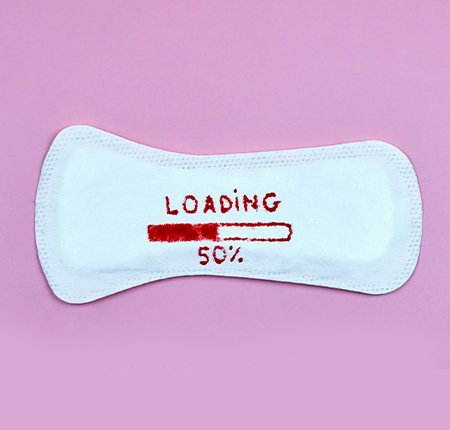
Something else worth knowing: abnormal vaginal bleeding can take different forms:
- menorrhagia or hypermenorrhoea – when you have a very heavy period
- metrorrhagia – when bleeding occurs outside of menstruation
- menometrorrhagia – when you have both very heavy periods and bleeding outside of menstruation
Diagnosing metrorrhagia
If you have abnormal bleeding, we recommend seeing a gynaecologist. The doctor will carry out all the necessary examinations and together you'll establish what is causing the metrorrhagia in your case. Depending on the findings, your gynaecologist will prescribe treatment to prevent complications.
How can you prepare for this appointment with the gynaecologist? Blood tests may be required – such as a pregnancy test (since a few drops of blood between periods can be one of the first signs of pregnancy), a smear test (to rule out cancer) or further investigations such as a colposcopy or a biopsy.
Treatment of metrorrhagia
Every patient receives individual treatment, as there are various therapeutic approaches that don't work equally well for everyone. Hormone therapy, for instance, may be effective.
Possible recommended treatments include:
Hormone therapy
If bleeding between periods is due to hormonal imbalances, your doctor may recommend hormone treatment.
This includes the contraceptive pill, non-steroidal anti-inflammatory drugs, progestogens (by injection or via a hormonal coil) or other medicines that act on hormone levels.
Hormone therapy may also be recommended for metrorrhagia after the menopause.
Curettage
If metrorrhagia begins after a miscarriage, or if hormone treatment proves ineffective, your doctor may recommend dilatation and curettage. The same treatment may also be offered to post-menopausal women who suffer from metrorrhagia.
The procedure is carried out under anaesthetic and serves to remove the uterine lining so that the body can replace it with a new layer.
Treating other conditions
Often, vaginal bleeding between periods is in fact due to other health problems. In these cases, it stops of its own accord once the underlying causes are treated.
Patients who are bleeding because of a sexually transmitted infection, for example, will receive treatment for that infection. Patients whose bleeding is due to clotting disorders or thyroid problems will see a specialist and receive appropriate therapy.
Lifestyle changes
Chronic stress, excessive exercise, weight problems or an irregular, nutrient-poor diet can also be causes of temporary intermenstrual bleeding.
In such cases, a change of lifestyle is the first measure your doctor will recommend. If there are no other underlying conditions, the bleeding will stop by itself once you start using stress-management techniques, get enough sleep or work with a dietitian on improving your diet and achieving a healthy body weight.
Complications of untreated metrorrhagia
Unfortunately, metrorrhagia doesn't always pass without consequences. This abnormal bleeding can affect your health, particularly if it is very heavy – in which case it can cause anaemia (a lack of red blood cells). Anaemia, in turn, manifests itself in weakness and chronic fatigue. It's a warning sign if metrorrhagia points to cancer or another serious illness. To avoid potential health problems, always consult a doctor if you have heavy periods or abnormal bleeding!
And whenever you have spotting, always use panty liners made from 100% organic cotton to protect the skin and maintain the pH of the vulva with natural ingredients – no chemicals and no plastic!

Preventing vaginal bleeding between periods
Vaginal bleeding between periods can't be prevented. What you can do, however, is help prevent certain conditions or health problems that may trigger bleeding between periods. For example:
- pay attention to your diet and body weight to avoid intermenstrual bleeding caused by hormonal imbalances.
- see a doctor to have conditions such as cysts or endometriosis treated and monitored – they can cause metrorrhagia as well as ovarian pain and severe period pain.
- avoid risk factors such as smoking and other harmful habits that can increase your risk of cancer.
- protect yourself during sexual intercourse to reduce the risk of sexually transmitted infections.
References
- Cleveland Clinic, “Abnormal uterine bleeding”: https://my.clevelandclinic.org/health/diseases/15428-uterine-bleeding-abnormal-uterine-bleeding
- VeryWell Health, “An Overview of Metrorrhagia”: https://www.verywellhealth.com/an-overview-of-metrorrhagia-4584380
- NIH, “Abnormal Vaginal Bleeding”, Chapter 173: https://www.ncbi.nlm.nih.gov/books/NBK282/
- NHS, “Vaginal bleeding between periods or after sex”: https://www.nhs.uk/conditions/vaginal-bleeding-between-periods-or-after-sex/
- Mayo Clinic Health System, “Heavy, Intermenstrual or Irregular Bleeding”: https://www.mayoclinichealthsystem.org/locations/menomonie/services-and-treatments/obstetrics-and-gynecology/heavy-or-irregular-bleeding
- Healthline, “Vaginal Bleeding Between Periods”: https://www.healthline.com/health/vaginal-bleeding-between-periods

Medium, super or extra absorption

Low, medium or super absorption

Low or medium absorption


and happily breaking taboos!


