

Yoga & Pilates: Poses and Exercises to Relieve Period Cramps
That time of the month can really make life difficult. Cramps, bloating and mood swings throw us off balance and spoil our good mood. And although period pain is entirely normal, it can — when it's particularly severe — be a sign of endometriosis, a chronic condition affecting the pelvis.
Fortunately, research shows that low-impact forms of exercise, such as yoga and Pilates, can have a profoundly positive effect on our health and wellbeing during menstruation and throughout the cycle.
Yoga and Pilates are excellent forms of movement for women who experience discomfort around their menstrual cycle. One of the foundations of both is a strong focus on diaphragmatic breathing. Deep breathing promotes relaxation, boosts concentration, lifts the mood and allows the chest, abdomen and pelvis to stretch.
For diaphragmatic breathing, place your hands on either side of your ribcage at waist level. Close your eyes and breathe in slowly and deeply, directing the breath sideways and backwards into the lower ribs so that you feel the air pushing your hands outwards. This is exactly the breathing technique you should use during your yoga or Pilates practice.
The nature and duration of period cramps
But why do period cramps happen in the first place? Why does a period sometimes become so painful, and how normal is that really? You've surely asked yourself this at least once — some of us ask it every single month. And rightly so, because it's an important question: what intensity and what duration count as normal, and when does period pain become a problem?
Yes, period pain is genuinely normal, and every woman experiences it differently. Some feel it as sharp, stabbing pain, others as persistent cramping. Some feel it during the first days of their period, others more towards the end. Sometimes the pain is stronger and can even vary from cycle to cycle — depending on factors such as diet, exercise, stress or sleep. Some cramps disappear on their own, others only with medication. All of this is perfectly natural.
What isn't normal, however, is pain so severe that it stops you getting on with your daily life. If the intensity is so high that you can't walk for the pain or you feel sick, or if the discomfort lasts a long time and doesn't improve even with treatment, then that isn't normal.
The role of prostaglandins in period cramps
Prostaglandins are a group of hormone-like substances that play a decisive role in the contractions of the uterus during menstruation. They stimulate contractions of the muscles and blood vessels in the uterus, which helps to shed blood and the uterine lining during your period. And that automatically makes them responsible for the period pain that occurs during these contractions.
Prostaglandin levels are highest during the first days of menstruation and trigger more frequent contractions. This explains why period pain is usually stronger in the early phase of the period and eases in intensity towards the end.
The importance of the pelvic floor
Like all the other muscles in our body, the pelvic floor muscles need to be strengthened and stretched. Yoga and Pilates are among the few forms of exercise that give them particular attention during sessions.
During menstruation — especially with severe period pain, heavy bleeding and spotting — the pelvic floor muscles can become tight and tense. By training them specifically, you improve circulation, support the clearing of old blood and encourage muscular relaxation. This noticeably eases uncomfortable period symptoms.
There are many yoga and Pilates exercises that stretch the pelvis and pelvic floor, helping to regulate menstruation and relieve cramps and PMS symptoms.
Discover them with us below!
If you'd like to give your pelvic floor even more attention, you can also combine your yoga or Pilates routine with Kegel exercises! These have a positive effect on sexual health and strengthen the pelvic floor muscles (find out more here!).
Yoga poses to relieve period pain
Baddha Konasana
Diarrhoea and constipation are perfectly normal during menstruation — triggered by the release of prostaglandins, which cause the uterus to contract. It's not pleasant, but fortunately the Baddha Konasana pose can help. Not only does it calm the digestive system, it can also ease painful period cramps. This position revitalises and gives you fresh energy.
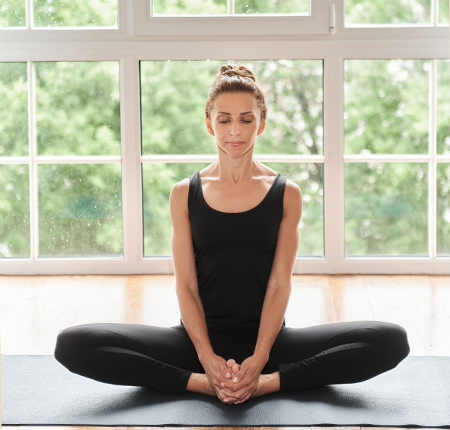
Here's how to get into this position:
- Sit on the floor
- Bend your knees
- Bring the soles of your feet together and draw them as close to your pelvis as possible
- Rest your hands on the floor or on a support
- Hold the position for 1–2 minutes
Supta Baddha Konasana, or the Goddess Pose
Period-related anxiety can have a negative impact on your physical health. Supta Baddha Konasana is similar to Baddha Konasana and has a positive effect on anxiety levels. The difference between the two positions is that you perform Supta Baddha Konasana lying down.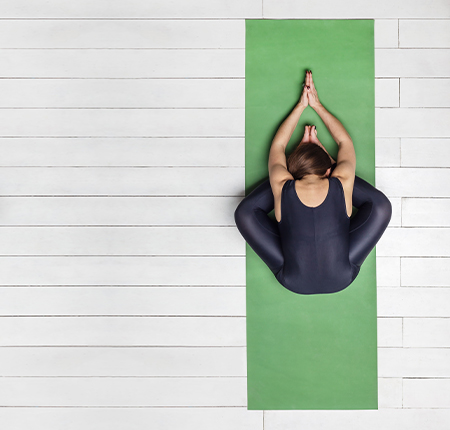
The list of period symptoms this pose relieves is a long one — from fatigue and insomnia to anxiety, headaches and joint pain. Because you lean back in this position, the abdominal muscles also relax, which can further ease cramping.
Balasana, or Child's Pose
Child's Pose, or Balasana, is one of the first and simplest positions in any yoga routine. It's ideal for beginners too, because it's easy not only to get into Balasana but also to genuinely relax in it.
Child's Pose helps you stretch the back and relax the abdomen, which eases tension in the abdominal area and reduces period cramps. Here's how to do it:
- Kneel on the floor with your knees apart and your big toes touching.
- Rest your weight on your heels.
- Stretch your arms out in front of you.
- Rest your chest on your thighs and your forehead on the floor.
- Breathe calmly in and out for 1–3 minutes.
Janu Sirsasana, or Head-to-Knee Pose
At its heart, Janu Sirsasana is a yoga pose focused on relaxing the legs — one at a time. The Head-to-Knee Pose, as it's known in English, stretches the hamstrings (the backs of the thighs).
What's more, Janu Sirsasana relaxes the hips and lower abdomen, thereby also easing period cramps. Here's how to get into this position:
- Stretch one leg out in front of you.
- Place the foot of the other leg against the thigh of the extended leg.
- Shift your body weight over the extended leg.
- Fold forwards and try to take hold of the extended leg with your hands.
- Repeat the same steps with the other leg.
Bitilasana & Marjaiasana, or Cow and Cat Pose
Cow Pose and Cat Pose are two excellent movements for relieving period pain, as they alternately relax the abdominal and back muscles. Here's how it works:
- Begin in a neutral position on all fours.
- Make sure your hands are aligned under your shoulders and your knees under your hips.
- Look straight ahead and breathe in as you lift your tailbone upwards and let your belly sink down. This is Cow Pose, or Bitilasana.
- Return to the neutral starting position.
- Breathe out and round your back so that your head and tailbone now point downwards. This is Cat Pose, or Marjariasana.
- Return to the neutral position.
Repeat the two positions 15 to 20 times, breathing in and out in a controlled way.
Bhujangasana, or Cobra Pose
Cobra Pose is another simple exercise for relaxing the back, shoulders, neck and the abdomen too. It's also excellent for relieving stress, making it all the more helpful during menstruation. Follow these simple steps for Bhujangasana:
- Lie face down on the floor with your legs together.
- Place your palms flat on the floor, directly beneath your shoulders.
- Slowly lift yourself up, raising your chest and head.
- You can come all the way up or support yourself on your forearms.
- Make sure you distribute your weight evenly across both arms and look up towards the sky (or the ceiling).
- Stay in Cobra Pose for a few minutes, breathing in a controlled way and trying to relax.
Matsyasana, or Fish Pose
In pictures, Matsyasana (Fish Pose) might look complicated. But it's not that difficult at all, and it's perfect for stretching the back, shoulder and chest muscles and partly relieving lower abdominal pain during menstruation. Here's how to get into Fish Pose in a few simple steps:
- Lie on your back with your arms by your sides.
- Slide your hands, palms down, underneath your buttocks, keeping your elbows close to your body.
- Lift your head and chest as high as you can.
- Try to let your head drop back and touch the floor.
- Make sure your legs and thighs stay in contact with the floor throughout.
Pilates exercises to relieve period pain
Pilates lunges
Pilates lunges boost circulation to the large muscle groups and draw your awareness out towards the body's periphery — away from those monthly cramps. By engaging larger muscle groups, you increase your metabolic rate and counteract the fatigue that comes with menstruation. You can use Pilates lunges as a warm-up or as a workout in their own right.
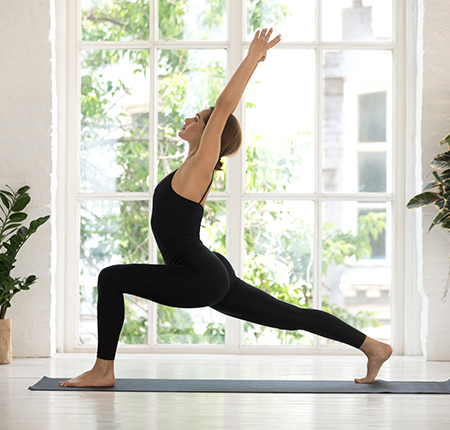
For these lunges, stand upright with your feet together in a "Y" shape, with the heel of the front foot against the arch of the back foot. Hold a weight of 1–3 kilograms in each hand. You can also use a medicine ball.
Breathe in as you step the front foot forwards, transfer your weight onto it and lean your upper body forwards, extending the back leg as far as you can. Your arms lift overhead during the lunge movement. Breathe out as you return to the starting position. Repeat 8 to 10 times, then switch legs.
Wall roll-down
The wall roll-down relieves the back pain that accompanies PMS or menstruation by releasing tight back muscles. You can use this wall exercise at any time of day to ease that monthly backache.
Lean your back against the wall with both feet stepped forwards. Keep your feet in a small "V", heels together and toes turned slightly outwards. Let your arms hang loosely by your sides. Draw your stomach in and up to open the lower back and press it against the wall. You can bend your knees slightly to stretch the back.
Lower your head first, then your shoulders and arms, slowly peeling away from the wall vertebra by vertebra. Keep rolling down until you reach the middle of the spine, letting your arms hang freely. As you roll back up, press each section of your back firmly into the wall. Keep breathing naturally throughout. Repeat three times in total.
What do you make of these simple exercises for relieving period pain and the other uncomfortable symptoms that "that time of the month" brings?
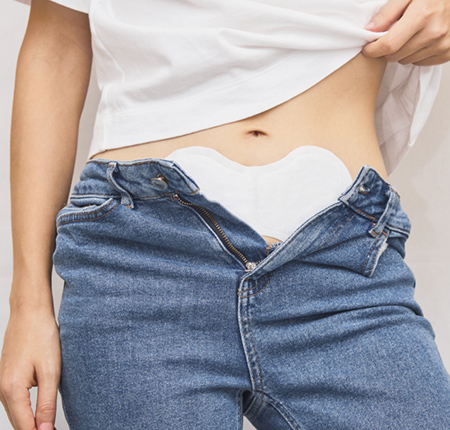
Whichever you choose — we've got one more tip for you! Use ENROUSH period patches during your workout routine so you can find your rhythm more easily and relax from the very first minutes!
The importance of sleep in managing period cramps
Sleep is hugely important at every stage of life — but especially if you suffer from severe period pain. Stress and a lack of overnight recovery are among the factors that can make period cramps worse, as they raise cortisol levels in the body.
Studies and surveys confirm that insomnia or poor sleep quality intensifies pain. Sleep quality has also repeatedly been linked to various menstrual disorders, including heavy bleeding and irregular cycles.
Make sure you rest well, because restorative sleep helps the body function optimally, improves your mood during the day and eases cramping.
Positions for period cramps at night:
Night-time period pain can be one of the reasons you don't get enough rest. This creates a vicious circle: the period pain robs you of sleep, and the lack of sleep in turn makes the cramps worse.
And while during the day you can move around and turn to yoga exercises and poses, at night you simply want to lie comfortably and sleep. Fortunately, there are a few positions that can ease your discomfort in bed at night too, so you can lie comfortably and sleep better. Find out which ones in the section below.
Sleeping in the foetal position
The foetal position essentially mimics the posture of a foetus in the womb. To sleep in this position, lie on your side and draw your knees up towards your chest.
According to research, some women find this sleeping position very effective against period cramps. It allows the spine to rest in a natural alignment, supports relaxation of the abdominal muscles and reduces tension in the lower abdomen.
The foetal position is also considered one of the most popular sleeping positions among adults, as it reduces stress and anxiety — another important factor both for sleep quality and for managing pain.
Sleeping with a pillow under your knees
If you like sleeping on your side, it's a good idea to place a pillow under your knees at night. A small detail, but one that can reduce pressure on the abdomen and help you sleep more restfully.
And not just under your knees! Try out different sleeping positions and vary where you put the pillow until you find the arrangement that's most comfortable for you. Some women prefer a pillow between their legs to ease period cramps. It all depends on you and your personal comfort — so find the position that gives you the most restful sleep.
Sleeping in Child's Pose
Remember Balasana, the Child's Pose? Earlier on we explained how to get into this yoga position and how it helps relieve cramps.
For some women, sleeping in this pose really is the best solution for getting some rest during their period. We know it sounds a little uncomfortable and unnatural to sleep with your knees tucked beneath you and your forehead on the mattress. But with a few small adjustments it can actually become a very comfortable sleeping position.
If it relaxes you and feels good, there's nothing stopping you sleeping in Balasana. Place a pillow beneath you where you can rest your hands and support your head to one side in a comfortable position.
How lifestyle affects period cramps
Severe period pain can also be the result of a chaotic lifestyle. Did you know that even endometriosis — one of the most common causes of severe period pain — is initially treated through lifestyle changes? That's how crucial your habits around diet, exercise, sleep and stress management are.
Smoking and other harmful habits, chronic stress, lack of sleep, a diet lacking essential nutrients and a sedentary lifestyle can all contribute to hormonal imbalances and thus make period cramps worse. Weight issues (both being overweight and being underweight) can also affect hormone balance and worsen menstrual symptoms.
Studies show that active women who exercise regularly suffer less often from period pain, as well as from mood swings and other typical symptoms of premenstrual syndrome.
Sex during your period
You may have heard from friends or read online that sex during your period can relieve period cramps. And yes, it's true: sex and orgasm can ease discomfort during menstruation, quite simply because they aid relaxation and trigger the release of pain-relieving endorphins.
If you and your partner feel comfortable with it, there's nothing to stop you trying sex during your period. Just make sure you take the necessary precautions to protect yourself and enjoy it safely — without leaving too much mess behind.
Tips for managing period pain
Alongside as balanced a lifestyle as possible, plenty of sleep and all the yoga poses recommended above, there are other home remedies for period pain you can add to your self-care routine to make getting through your period easier:
- Take a warm bath to relax and ease the pain.
- Wear Enroush period patches during the day — they relieve cramps for up to 8 hours with heat therapy and 100% natural ingredients.
- Try acupuncture treatment — according to some studies, it can help relieve pain.
- Turn to herbal remedies such as Pycnogenol (pine bark extract) or fennel, which can ease cramps.
When to seek medical advice
See a doctor as soon as you can if any of the following applies to you:
- Your period is extremely painful and stops you getting on with your daily life.
- You have severe period pain accompanied by nausea, fever, large blood clots, heavy bleeding or other unusual symptoms.
- The period pain is getting worse month by month.
- The severe pain only started after the age of 25.
What we as women should understand is this: menstruation is a natural and healthy part of our lives. Yes, it can cause discomfort, but it shouldn't stop us from carrying on with life as normal. So if it becomes a genuine obstacle, that isn't normal — and we need a specialist assessment.
Sources used:
For this article and its many practical tips, we drew on information from the following sources:
- NIH, "The effectiveness of self-care and lifestyle interventions in primary dysmenorrhea: a systematic review and meta-analysis": https://www.ncbi.nlm.nih.gov/pmc/articles/PMC6337810/
- Mayo Clinic, "Menstrual cramps": https://www.mayoclinic.org/diseases-conditions/menstrual-cramps/symptoms-causes/syc-20374938
- WebMD, "13 Ways to Get Rid of Your Period Cramps": https://www.webmd.com/women/ss/slideshow-get-rid-of-cramps
- Healthline, "The Best Positions to Help Period Cramps at Work, in Bed, or on the Mat": https://www.healthline.com/health/positions-to-help-period-cramps
- Very Well Health, Ann Pizer, "6 Yoga Poses for Your Period": https://www.verywellhealth.com/yoga-poses-for-your-period-3567221
- Moreland ObGyn, "5 of the Best Yoga Poses for Menstrual Cramps": https://www.morelandobgyn.com/blog/best-yoga-poses-for-menstrual-cramps
- Pinkishe Foundation, "5 Yoga Poses to Reduce Period Pain and Regulate Your Cycle": https://www.pinkishe.org/blog-post/5-yoga-poses-to-reduce-period-pain-and-regulate-your-cycle
- TimesOfIndia, Zeenia Baria, "Yoga poses to ease menstrual cramps": https://timesofindia.indiatimes.com/life-style/health-fitness/health-news/yoga-poses-to-ease-menstrual-cramps/articleshow/54581908.cms
- Medical News Today, "What to know about sleeping positions for menstrual cramps": https://www.medicalnewstoday.com/articles/sleeping-positions-for-menstrual-cramps
- My Cleveland Clinic, "Prostaglandins": https://my.clevelandclinic.org/health/articles/24411-prostaglandins

Medium, super or extra absorption

Low, medium or super absorption

Low or medium absorption


and happily breaking taboos!


