

Contraceptive methods: how to find the right contraception for you and your partner
A topic that many girls never covered at school, and one on which a great many women have only patchy – or even incorrect – information: contraception! And yet it's such an important subject, one that's part of family planning and affects us in every area of life.
You have a right to know! And we're here because we want to help you be as well informed as possible about the contraceptive methods available (because from the ancient and once-only option of coitus interruptus, there are now dozens of alternatives), as well as the pros and cons of each, so you can decide which suits you and your partner best. So there's plenty to cover – let's get started!
Which is the most effective contraceptive method
The best… We're all looking for the best solution to problem x, y and z. But when it comes to the female body, each of us is different. You're unique, and so are your body and your preferences. And when it comes to your sex life, it gets even more individual: every relationship is unique, as is every partner and what they want.
Given all that, we can't talk about a universally "best" contraceptive method, because there's no single "best" that applies to everyone. What we can talk about is what's best, most comfortable, most practical and most effective for you. We'd encourage you to speak to your gynaecologist and to your partner – that way you can decide which method of contraception suits you both best.
Types of contraception
Perhaps the oldest contraceptive method, one we know of from ancient civilisations, is coitus interruptus. The withdrawal method was used for many years to reduce the risk of unwanted pregnancy – but over time we became increasingly aware of its weaknesses: it isn't 100% effective. And it offers no protection against sexually transmitted infections.
Later, in the pursuit of ever more effective solutions, people began using other methods too: condoms made from animal materials, silk or plants. Spermicides made from salt, honey or acacia. And many more besides. Needless to say, many of these weren't exactly kind to vaginal pH, and they didn't always work either.
Fortunately, medicine has come on enormously, as has research. Today there are a great many different contraceptive methods, so you can choose one that suits you and your partner as well as possible. Depending on how the method works, how long it lasts, the price, availability, ease of use and which partner uses it, there's a suitable option for every couple who don't want a pregnancy.
Below you'll find out what they are, plus plenty of other useful information about each one (including the reasons why you might or might not want to use them):
Barrier methods
You can probably tell from the name how they work: barrier methods prevent pregnancy by blocking semen and sperm from entering the vagina – like a barrier in between.
Because they don't work hormonally or over the long term, barrier methods also have the distinguishing feature that they must be used every time you have sex in order to work. Just one act of intercourse without a barrier method can lead to pregnancy, because in that moment the barrier that stops sperm entering the vaginal canal is missing.
Barrier methods do, however, have the advantage of being readily available and fairly easy to use – most of them without any medical assistance. Here are the options:
The male or female condom
The condom is the only contraceptive method with a dual function: it protects against both unwanted pregnancy and the transmission of sexually transmitted infections and diseases.
That's because it entirely prevents contact between female and male genitals: the male condom is like a thin sheath that covers the penis before penetration, while the female condom is like a ring inserted into the vagina before penetration. Both form a protective layer that prevents direct intimate contact and so safeguards the sexual health of both partners.
Condoms can be latex or latex-free, they're thin and stretchy, very inexpensive, and are used by the partners immediately before intercourse with no medical involvement. Used correctly every time, they're 98% effective at preventing unwanted pregnancy.
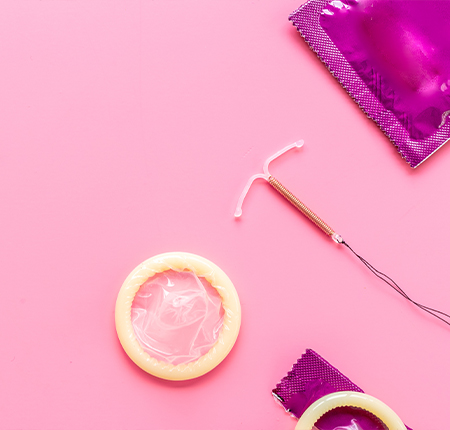
The diaphragm
The diaphragm is a device inserted into the vagina to cover the cervix, acting as a barrier that stops sperm entering the womb. It needs to be inserted 6 hours before intercourse and left in place for a further 6–8 hours afterwards, but for no longer than 24 hours in total.
A gynaecologist doesn't need to do this for you each time – you can insert the diaphragm yourself. Before using it for the first time, however, a gynaecological examination is needed, as your doctor will help you choose the right size and show you how to insert and remove it correctly.
The main drawback of the diaphragm is that it can increase the risk of irritation and vaginal infections, as well as the risk of toxic shock syndrome or allergic reactions if you forget it and leave it in for more than 24 hours. The price is also higher than a condom. That said, it only needs replacing after 1–2 years, so in the long run it can actually work out cheaper.
The cervical cap
Also known as a cervical or cervix cap, this is another barrier method made of soft silicone that covers your cervix and so blocks sperm from reaching the womb and fallopian tubes. It's therefore very similar to the diaphragm, with a few small differences:
- The cervical cap is generally smaller than the diaphragm.
- The diaphragm is dome- or bowl-shaped, while the cap is shaped like a little hat.
- You can wear the diaphragm for a maximum of 24–30 hours, whereas the cervical cap can stay in the vagina for up to 2–3 days.
- According to the statistics, the cervical cap is 71–86% effective, while the diaphragm is 83% effective.
Otherwise, as mentioned, everything is fairly similar to the diaphragm. The cervical cap needs to be filled with spermicide before use, and the right size should be determined together with your gynaecologist. They'll also explain how to use it properly.
The contraceptive sponge
Another method used since ancient times but modernised for greater effectiveness is the contraceptive sponge. The name itself gives you an intuitive sense of how it's used: a round sponge with a soft texture, soaked in spermicide and inserted into the vagina before intercourse.
For it to work, you need to leave it in the vagina for at least 6 hours after intercourse. At the same time, you must be very careful not to forget it and leave it in for more than 24 hours, as allergic reactions, irritation or even toxic shock syndrome can occur – due to the changes it can trigger in the vaginal flora.
The effectiveness of a correctly used contraceptive sponge is 76–88%. On the one hand, it's inserted up to the cervix and forms a barrier between sperm and the womb. On the other, thanks to its spermicide content, it slows down or destroys sperm.
Spermicides
The last method in this category is the one we've already mentioned several times, since it's used alongside the diaphragm, the cervical cap and the contraceptive sponge. A spermicide is in fact a substance in the form of a spray, cream, gel or pessary that kills sperm.
Be aware, though: spermicides are designed to be used together with one of the barrier methods described above, in order to maximise their effectiveness. As a standalone contraceptive method, without any other device, they have low effectiveness of just 60–80%.
The spermicide is inserted into the vaginal canal an hour before intercourse and must then remain there for at least 6–8 hours so the chemical substances can destroy the sperm. The drawback of this method is that it can cause allergic reactions and irritation.
Hormonal contraceptives
Barrier methods work locally, as the name suggests, which is why they generally don't trigger hormonal reactions or major changes in the body – they're non-invasive. Hormonal contraceptives, on the other hand, act directly on your hormones to prevent pregnancy.
To put it another way: in order to become pregnant, ovulation has to take place. To suppress this natural biological function and avoid pregnancy, hormonal contraceptive methods introduce hormones into the body that:
- either prevent ovulation;
- or thicken cervical mucus, which in turn blocks sperm from reaching the womb;
- or thin the lining of the womb so that a fertilised egg can't implant;
- or have two or all three of the effects above.
So when we talk about hormonal contraceptives, we're talking about introducing substances into the body that act directly on your hormones.
And since hormonal balance is extremely important for all bodily functions, this is something to be handled carefully and exclusively by professionals. That's why it isn't advisable to choose a contraceptive method on a whim: even if it works well for your friends, it may not be the right one for you. A hormonal contraceptive should only be chosen together with your gynaecologist and used regularly according to their recommendations.
Although the pill is the best-known form of hormonal contraception, it isn't the only one. There are numerous hormonal contraceptives in various forms, and each is used differently. While oral contraceptives have to be taken daily to work, there are also other methods such as the three-monthly injection or contraceptive implants, which work for 2–3 months or up to 3 years respectively. Here's what's available and how each can protect you from unwanted pregnancy.
Oral contraceptives (the pill)
You've certainly heard of oral contraceptives – as mentioned, the pill is one of the most widespread forms of hormonal contraception. They're easy to obtain and easy to use tablets (you just have to swallow them), and when used correctly (i.e. when you don't forget a tablet, don't forget to pick up a new pack from the pharmacy, and so on), they're highly effective at 93%.
The pills themselves differ according to the substances they contain. Depending on your state of health, your doctor may therefore recommend:
- The combined pill: this contains synthetic oestrogen and progesterone, which prevent ovulation (so the ovaries can't release an egg), thicken cervical mucus (to block sperm from reaching the womb) and thin the lining of the womb (so a fertilised egg can't implant). All these effects of the combined pill prevent a possible pregnancy, but they can also have side effects (headaches and stomach pain, mood swings, breast tenderness, high blood pressure and thrombosis). To be effective, this type of pill must be taken daily for 21 days, ideally always at the same time, so you get into the habit and don't miss a dose.
- The mini pill: this contains not two but just one synthetic hormone – a progestogen – at a low dose (hence the "mini"), which also reduces the risk of thrombosis as a side effect. Otherwise, the mini pill works in exactly the same way as the combined pill and can reduce menstrual bleeding and pain. The side effects are similar too, namely breakthrough bleeding (spotting), breast tenderness, headaches or nausea. It has the advantage of reducing the risk of pelvic inflammatory disease as well as ovarian and endometrial cancer.
As well as their role in protecting you from pregnancy, oral contraceptives may also be recommended to regulate your menstrual cycle, reduce period cramps or treat endometriosis and premenstrual syndrome. We've written more about this in another blog article, where we covered everything you need to know about the contraceptive pill.
The three-monthly injection
One of the most effective contraceptive methods, the contraceptive injection prevents pregnancy in 96% of cases and has the advantage of not needing to be used daily, as well as being discreet. You only need to repeat it every 3 months (that's 4 injections a year) and you're protected from pregnancy without having to do anything else. Your gynaecologist will give you this injection intramuscularly.
The hormone introduced into your body by the contraceptive injection is progesterone, though there are also combined versions containing progesterone and oestrogen.
These hormones work in much the same way as the pill: on the mucus around the cervix, which they thicken and make very sticky, so sperm can't travel any further towards the womb. At the same time, the lining of the womb is thinned, so implantation can't occur even if a fertilised egg reaches the uterus. Ovulation also stops as a result of the synthetic hormones being introduced.
Side effects such as breakthrough bleeding, headaches and breast tenderness, mood swings and osteoporosis with long-term use can occur.
Subdermal contraceptive implants
A contraceptive method that has become increasingly popular in recent years is the subdermal contraceptive implant. Its main advantage – besides the fact that only you know it's there – is that it can stay in place for up to 5 years. What's more, like the coil, it's extremely effective and prevents pregnancy in 99% of cases.
That means once it's fitted, you won't have to worry about unwanted pregnancy for up to 5 years. It's a very suitable option for women who are sure they don't want to become pregnant in the near future.
The subdermal contraceptive implant is fitted exclusively by a gynaecologist under local anaesthetic. It takes the form of a small rod made of soft, flexible plastic containing a synthetic hormone similar to natural progesterone. The implant is inserted under the skin of the upper arm and releases the active ingredient steadily and slowly into the body over the following 3–5 years.
Like other progestogen-based hormonal contraceptives, the subdermal implant acts on ovulation (by preventing it) as well as on cervical mucus and the lining of the womb. The possible side effects are the same too, namely headaches and breast tenderness. There's also the possibility of cycle irregularities and the risk of local scar tissue forming, which can make removing the implant after 5 years more difficult.
The contraceptive patch
The contraceptive patch is also 93% effective at preventing pregnancy. It contains oestrogen and progesterone and works in almost exactly the same way as the oral contraceptive pill. The difference is that you don't have to take tablets every day – you simply stick the patch on your lower abdomen or thigh (not on the breast area!) for 3 weeks of the month (it needs changing every week). In the fourth week you don't apply a patch and your period starts.
Alongside the side effects shared by all the hormonal contraceptives already discussed, the patch also carries a risk of skin irritation and blood clots, as well as stroke and heart attack in people over 35 who smoke.
The vaginal ring
The vaginal ring is also worn for 3 weeks of the month and is in fact used and works very similarly to the contraceptive patch, with 93% effectiveness at preventing pregnancy. Once a month it's removed for a week so your period can start after 1–2 days; after that a new ring is inserted for a further 3 weeks of protection against pregnancy.
As the name suggests, it's a small, ring-shaped device made of flexible, transparent plastic that's inserted into the vagina. As mentioned, it works much like the patch, since it contains the same active ingredients, oestrogen and progesterone, which are released slowly and gradually over the 3 weeks of use, preventing ovulation, blocking sperm from reaching the womb and stopping a fertilised egg from implanting.
The side effects are identical to those of the contraceptive patch.
The intrauterine coil
With similar advantages to the subcutaneous contraceptive implant, the intrauterine device (which you probably know as the coil) is 99% effective over a period of 3 to 12 years. It's an equally discreet option (only you know it's there!) that prevents fertilised eggs from implanting and prevents pregnancy without you having to use any other contraceptive method.
The differences compared with the contraceptive patch lie in its appearance, location and active ingredient. So here's what the coil looks like, where it's fitted and how it works:
- The coil is a small device shaped like the letter T.
- It's made of soft, flexible plastic.
- It is fitted into the womb and removed exclusively by a gynaecologist.
- There are two types of coil, depending on the substance they contain: progestogen or copper.
- The hormonal coil with progestogen can be used for up to 3–6 years and prevents pregnancy in the same way as other hormonal contraceptives (it stops ovulation and thickens cervical mucus to block sperm from getting through).
- The copper coil can be used to prevent pregnancy for up to 10–12 years, as it's wound with a small amount of copper that stops a fertilised egg implanting in the womb.
Although it's very effective at preventing pregnancy, it can have side effects such as cycle irregularities, amenorrhoea or breakthrough bleeding, and may also make infections and pelvic inflammatory disease more likely.
For this reason, this form of contraception is generally recommended for women who have already become mothers and aren't planning another pregnancy. It isn't a permanent contraceptive method, but because of the risk of infertility it isn't recommended for people who haven't had children.
Emergency contraception
Before we talk about this way of preventing unwanted pregnancy, it's very important to stress one thing: emergency contraception is used in an emergency, that is, only when the contraceptive method you were using has failed (for example if the condom split) or if intercourse took place without any other form of contraception (such as unexpected, unplanned sex for which you and your partner hadn't prepared another method).
But under no circumstances should emergency contraception be used daily or regularly like normal barrier or hormonal contraception. That's because it has a high hormone content, which if taken regularly could lead to hormonal imbalances and the health problems that follow. A barrier method or a hormonal contraceptive, by contrast, either contains no hormones at all or introduces only small amounts into the body slowly and in a controlled way, so no major disruption occurs.
Having made clear how important it is not to overuse emergency contraception, because it can pose a risk to your health, here are the options available:
- The morning-after pill: this is the best-known method of emergency contraception and is easy to use. You can get it without a prescription at the pharmacy, and it prevents ovulation through higher amounts of oestrogen and progesterone compared with the contraceptive pill. To prevent pregnancy effectively, the morning-after pill must be taken no later than 12–72 hours after unprotected intercourse. The sooner you take it, ideally within the first 24 hours, the more effective it is. It's recommended that you use this method no more than twice a year (once every 6 months). One more thing to bear in mind: even if you've taken the morning-after pill, you still need to use contraception every time you have sex afterwards in order to prevent pregnancy. The morning-after pill does not prevent pregnancies resulting from intercourse that takes place after you've taken it!
- The copper coil: we talked about this above; it can also be used as emergency contraception if it's fitted no later than 5 days (that's 120 hours) after unprotected intercourse. As mentioned above, its effectiveness at preventing pregnancy is 99%, and the advantage is that once it's fitted you remain protected for up to 10–12 years without having to use any other contraceptive method.
Permanent contraception
The final category of medically effective contraceptive methods we'll discuss is permanent contraception – the methods that ensure no act of intercourse can ever lead to pregnancy again.
Both women and men can opt for a permanent contraceptive method if they're sure they don't want to become parents and won't want to in the future either. Both procedures mean sperm can no longer reach the womb, and their effectiveness is 99.9%.
These are methods carried out surgically and exclusively by specialist doctors, and they aren't always reversible. And even when they are, there's no guarantee that a successful pregnancy will be possible afterwards.
So it's a decision with long-term, potentially permanent consequences, and one that should therefore only be made after gathering full information, thinking it through carefully and having open conversations with your partner and your gynaecologist.
Vasectomy
A vasectomy involves cutting the vas deferens, the tubes leading from the testicles through which semen is ejaculated – with the result that sperm can no longer reach the penis. That way, no sperm can be released into the vagina during ejaculation and the egg isn't fertilised.
The procedure is surgical, carried out by a urologist, and takes effect after about 3 months. In the meantime it's recommended that you use another contraceptive method alongside it "just to be safe", until a semen analysis shows the complete absence of sperm.
Recovery after a vasectomy can take up to 7 days.
Tubal ligation
Women can also choose a permanent contraceptive method, namely tubal ligation. Naturally, the egg and sperm meet in the fallopian tubes so that fertilisation and pregnancy can occur. By cutting and tying the fallopian tubes, this process can no longer take place, making pregnancy impossible.
The procedure is carried out by a gynaecologist, and medical technique has advanced to the point where the operation is minimally invasive, performed through a small incision near the navel (laparoscopically). The main risk following this procedure is an ectopic pregnancy, where the pregnancy develops in the fallopian tubes, but this risk is very low.
Recovery time after a tubal ligation can take up to 2 weeks.
Natural methods
We said that permanent contraception was the last medically effective category we'd discuss in this article. That's because there's one more to come, but it has a major drawback: uncertainty, and the fact that the likelihood of failure due to incorrect planning or calculation is very high.
These are natural methods that have been used since ancient times to prevent pregnancy, when there weren't as many near-100% effective contraceptives available, or they simply weren't known about. Even so, they're a better option than nothing (in other words, better than using no method at all) – so let's take a look at the natural contraceptive methods out there.
The withdrawal method
Also known as coitus interruptus, the withdrawal method has been used since antiquity. It involves the partner interrupting penetration during unprotected intercourse and withdrawing the penis from the vagina before ejaculating. In theory, without ejaculation and without entering the vagina, sperm can't travel on to the cervix and fertilise an egg.
In practice, however, there are a great many risks with this method. The best-known reasons why the withdrawal method can fail are:
- Reacting too slowly: if the partner doesn't have very good self-control and doesn't withdraw in time, there's a risk of ejaculating inside the vagina.
- Choosing an unsuitable place to ejaculate: even if the partner withdraws in time, sperm can get into the vagina very quickly and easily if he ejaculates near the vulva/vagina (for example onto his partner's thighs or stomach).
- Sperm in pre-ejaculate: even without ejaculation, it's possible for pre-ejaculate to contain sperm and lead to an unwanted pregnancy during penetration.
The calendar method
The calendar method means only planning unprotected intercourse during the infertile phases of your menstrual cycle. It therefore assumes you know exactly when your fertile window is, when ovulation takes place and where the infertile window falls each month – based on signs such as body temperature and the consistency of cervical mucus.
That's very difficult, particularly for people with irregular cycles, and also rather stressful, because you have to keep daily records of mucus and body temperature. As a result, these records can be highly inaccurate, which leads to the calendar method failing in 20–25% of cases among inexperienced couples. If you'd still like to read more about this method, we've explained it all in detail HERE.
Frequently asked questions about contraception
We've tried to give you as much information as possible about each contraceptive method throughout this article, but we're sure some questions remain. So in this section we'd like to answer the most common questions about contraception.
Where can I get contraceptives?
In principle, all types of contraceptive are available at the pharmacy, but there are exceptions. It's very important to know which contraceptives you can also buy elsewhere and which are only available on prescription and exclusively from a pharmacy.
Condoms, for example, can also be found in supermarkets, sex shops and other shops, and you can use them without concern because they're non-invasive. Contraceptive pills are available from other sources too, but it's recommended that you only buy them from a pharmacy and only on your gynaecologist's recommendation. That's because they involve introducing a specific amount of hormones into your body, and the wrong dose or unsuitable active ingredients can cause hormonal imbalances and serious health problems. So it's best to seek a specialist's advice.
Which contraceptive method is right for me?
There's no single answer that applies to every woman. Every body, every relationship and every woman is different. The right contraceptive method for you depends on how often you want to use it, which partner wants to use it, whether you'd like children later or not, and many other individual factors. The best approach is to choose a contraceptive method together with your gynaecologist, who will help you make the best decision based on your medical history, your needs and your plans for the future.
How is contraception used after giving birth?
In theory, after giving birth prolactin prevents ovulation while you're breastfeeding, which is why your period may not return until as late as a year after the birth. You should bear in mind, though, that breastfeeding and the prolactin it releases is not an effective contraceptive method, and ovulation can occur, leading to a new pregnancy. It's best to seek your doctor's advice, as they'll talk you through the options for contraception after birth.
Can I use contraception while breastfeeding?
Yes, you can use hormonal contraception while breastfeeding without any harm to your baby. The subcutaneous contraceptive implant, the contraceptive injection, the mini pill and the coil are some of the methods that can safely be used after giving birth. Always speak to your gynaecologist, though, to establish what is and isn't suitable for you.
What risks am I exposing myself to by using contraception?
The biggest risk with all contraceptive methods other than the condom is contracting a sexually transmitted infection. Apart from the condom (female or male), no other contraceptive method protects you against HIV, genital herpes, gonorrhoea, chlamydia or other sexually transmitted infections. You're also exposed to the side effects of whichever method you're using – from headaches, migraines, heightened sensitivity and mood swings to other conditions such as thrombosis, osteoporosis or infertility (rarely).
Does contraception help with period pain too?
Some do, some don't. Hormonal contraceptives such as the pill, for example, are often recommended to ease cramps during very painful periods (and in the treatment of endometriosis too). If you have severe period pain, talk to your gynaecologist about it so further investigations can be carried out and a suitable solution found.

Medium, super or extra absorption

Low, medium or super absorption

Low or medium absorption


and happily breaking taboos!


