

Myths about menstruation – what's true and what isn't about your period
Have you ever been told that you mustn't exercise during your period? Or that it's best not to go swimming at that time of the month? We've heard it all before – along with plenty of other nonsense about menstruation. Myths like these only reinforce our fears and insecurities about something that is entirely normal and should never be a source of shame.
So today we're tackling each of these myths one by one to see whether there's any grain of truth in them. Let's find out what's real about everything you've heard regarding periods – and what is simply misinformation.
What is menstruation?
Menstruation is the most noticeable and visible phase of the menstrual cycle. Month after month it shows itself through normal vaginal bleeding, during which the body sheds blood and tissue from the lining of the womb. Typically, menstruation occurs every 21 to 35 days and lasts between 2 and 7 days.
It's important to understand that this is an entirely normal and natural process that occurs from puberty onwards in all women with a healthy reproductive system, and through which the body prepares for a possible pregnancy.
It's proof that your body is working well and that you have the ability to give life. So there is nothing impure or shameful about menstruation itself, or about talking openly about the menstrual cycle. The better you know your period, the better you understand yourself.
Why does it matter to debunk menstruation myths?
As important as it is to recognise that periods and conversations about intimate health are completely normal, it's equally important that the information reaching you is accurate and truthful.
You deal with your period every single month – it's an essential part of your life. That's why everything to do with menstrual hygiene, and with the question of what you can and can't do during your period, is closely bound up with your intimate and general health.
Unfortunately, menstruation was long considered a taboo subject, and the stigma and shame surrounding it have given rise to countless myths that persist to this day. Some claim there are negative consequences to going into water or having sex during your period. Others deny the possibility of pregnancy.
With no scientific basis or medical grounding, claims like these can leave you feeling helpless, give you the impression that menstruation is an illness – and, in the worst case, even lead to an unwanted pregnancy.
That's precisely why it's so important to expose these myths and set the record straight: to counter misinformation, to protect your health and safety, and to help you truly understand your body, your period and your femininity.
Menstruation myths – what you should know
Today we know that menstruation is a normal function of the female body – a gift, and the remarkable power to give life. But people haven't always understood this.
For centuries, nobody knew what menstruation was or how to explain it. So they attributed it to superhuman forces. They linked it to mysticism, witchcraft, punishment or impurity. Some of the myths born in those times have survived right up to the present day.
Yet it's unacceptable that women should continue to suffer from misinformation, be excluded from certain activities simply because they're menstruating, and ignore genuine warning signs because they lack the knowledge they need.
In this section, then, we'll take each myth in turn and tell you how things really are.
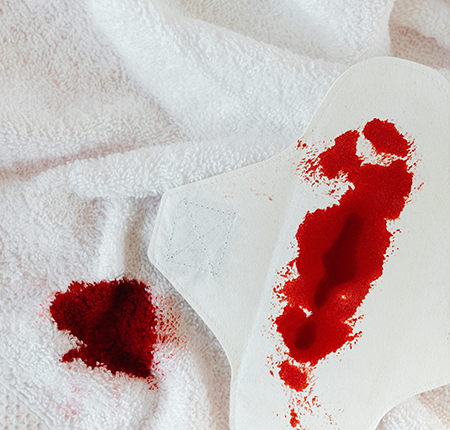
You can't get pregnant during your period
One of the most common – and most dangerous – myths about the menstrual cycle is the belief that you can't get pregnant while you're on your period. The result? Many women assume unprotected sex is perfectly safe as long as they're bleeding.
Not only can this lead to an unwanted pregnancy, it also increases the risk of infection, including sexually transmitted infections. The cervix is more sensitive during menstruation, and the environment favours the entry of bacteria and the development of infection.
The truth: Although it's unlikely, you can become pregnant through unprotected intercourse during your period – especially if your cycle is irregular. Sperm can survive in the female reproductive tract for up to 5 days. If ovulation occurs close to your period, pregnancy is entirely possible.
Neither menstruation nor the calendar method is an effective form of natural contraception. If you don't want to become pregnant, speak to your doctor and choose a reliable method of contraception.
Ovulation doesn't happen during your period
The more the menstrual cycle has been studied and understood, the more women have learned that it consists of 4 phases: the follicular phase, ovulation, the luteal phase and menstruation.
From this, many conclude that these phases are clearly separated from one another and that ovulation happens exactly mid-cycle, on day 14 – at least in theory. But that isn't always the case, and the reality differs from woman to woman.
The truth: While it's an exceptional situation, it's not impossible for ovulation to occur during your period or immediately afterwards.
The menstrual cycle and its phases don't follow a fixed calendar. Some women have a regular cycle, others an irregular one. For some it lasts 21 days, for others 35.
Likewise, ovulation doesn't always happen on day 14. Sometimes it occurs very early, sometimes later. Factors such as stress, diet and hormonal changes can also influence when ovulation takes place.
Premenstrual syndrome affects all women
Sugar cravings, migraines, breast tenderness and irritability are the "classic" symptoms of premenstrual syndrome (PMS) and are very common in many women before their period. What this overlooks, however, is that every woman experiences it differently, and symptoms can vary from person to person and from month to month.
As a result, PMS symptoms are wrongly presented as universal. What's more, women's emotions and complaints are often dismissed with the suggestion that they must be "on their period".
The truth: Studies show that premenstrual syndrome affects around 47.8% of women and manifests differently in each individual. Severe symptoms that interfere with daily life occur in only around 3–8% of cases. In reality, then, most women manage their reactions and behaviour so well that those around them don't even notice they're experiencing PMS.
Severe period pain is normal
Even if you didn't grow up with this idea, you've surely heard it at least once. Women have long been told – sadly, even by doctors – that pain is a fundamental feature of menstruation and perfectly normal. But that's just a myth.
The truth: It is indeed normal to feel mild discomfort during your period as the muscles of the womb contract to shed the endometrium and menstrual blood. What isn't normal is pain so severe that you can't get up, you feel sick, you faint, or you can't get on with your usual daily routine.
Severe period pain can point to a more serious health problem such as endometriosis. Do discuss your symptoms with your gynaecologist. They can help you find ways to manage the pain so that you can carry on with normal life even while you're bleeding.
Physical exertion is forbidden during your period
Be honest: did you get out of PE at school when you had your period? So did we – along with entire generations of girls who were told that exercise was contraindicated during menstruation. The only problem is, it isn't true.
The truth: Moderate physical activity and any form of gentle movement are safe and have no negative effect on your period. Quite the opposite: studies show that exercise stimulates blood circulation and the production of endorphins – and that can ease cramps.
A missed period always means pregnancy
The absence of menstruation, known as amenorrhoea, is indeed one of the first signs of pregnancy. That's why many women assume that a late or missed period automatically means they're pregnant. But the truth is more complex.
The truth: There are many other causes of a late or missed period. Changes in diet, chronic stress, weight fluctuations, intense physical exertion, certain medicines and health conditions, as well as hormonal imbalances – all of these can delay your period or cause it to stop temporarily.
A pregnancy test is the most reliable way to confirm a pregnancy. If the result is negative, you should see your gynaecologist for further investigation to establish the actual cause.
Sexual intercourse is forbidden during menstruation
Sex during your period can be a little … messy. Some couples may also find it uncomfortable. It's easy to see how the myth arose that intercourse is off-limits while you're bleeding. But it isn't true.
The truth: Menstruation isn't an illness and shouldn't put your life on pause. In fact, you can do almost everything you normally do while you're on your period. And sex at this time isn't forbidden – it's optional. The choice is yours.
If you feel uncomfortable, it's perfectly fine not to have sex – during your period or on any other day. But if you want to, there's no medical reason to avoid intercourse during menstruation. Some women even notice a heightened libido at this time, feel more aroused thanks to the natural lubrication, and find that period pain eases after sex.
Hot baths aren't advisable during your period
Warm water promotes vasodilation. The hotter the bathwater, the more the blood vessels dilate and the more blood circulation is stimulated – which can lead to heavier bleeding. And so a whole raft of new myths took hold: that hot baths are harmful during your period, that hot water can trigger uncontrollable bleeding, and that baths aren't advisable at all.
The truth: Warm showers and baths won't harm you during your period and won't trigger uncontrollable bleeding. On the contrary: specialists recommend warm baths because they relax the muscles, ease cramps and reduce discomfort.
Just make sure the water is at a comfortable temperature – not too hot – to avoid heavier bleeding.
Using tampons breaks the hymen
Because of the traditional association of the hymen with virginity, girls were long told to avoid tampons in order to prevent the hymen from tearing and to avoid "losing their virginity". The subject is a broad one, however, and calls for far more education.
The truth: Virginity is merely a social construct linked to the beginning of one's sex life – and tampons have nothing to do with such concepts. Tampons are menstrual hygiene products, designed solely to protect against and manage vaginal bleeding, with no sexual significance whatsoever.
The hymen itself is a very elastic tissue. It can be so resilient that simply using a tampon won't tear it at all. And it can be equally delicate, tearing while cycling or during intense physical activity.
Using tampons is a safe method of menstrual hygiene – just as using pads is. It's purely a matter of personal preference, and your only priorities should be comfort and safety. Choose 100% organic tampons, made exclusively from 100% organic cotton and free from toxic chemicals that can cause allergies, irritation or discomfort.
Blood loss during menstruation can make you faint
Sometimes period bleeding seems far heavier than it actually is. This impression can fuel the fear of losing so much blood that you faint or develop anaemia.
The truth: Although it looks like more because the blood is mixed with endometrial tissue, cervical mucus and vaginal secretions, a woman loses on average only 30–80 ml of actual blood over the course of a period. That's the equivalent of 2 to 6 tablespoons of fluid. For healthy individuals, that isn't enough to cause fainting.
If you do faint during your period, it's most likely due to a cause other than the amount of blood lost. That said, if your bleeding is unusually heavy or you need to change your pad every hour, speak to your doctor – it may be a warning sign.
You mustn't go swimming during your period
It's the same story as with warm baths and sex during your period. Citing hygiene or supposedly uncontrollable bleeding, the myth persists that swimming is off-limits at this time of the month. But the truth is precisely the opposite.
The truth: Swimming during your period is a form of exercise well worth recommending: it stimulates blood circulation, helps the muscles relax and contributes to easing period pain. Use a tampon to prevent leaks and enjoy your swim without a care.
What's more, water pressure can temporarily slow menstrual flow, making any leakage of menstrual blood highly unlikely. And as for hygiene: that's exactly what the chlorine and other specialist substances in pool water are there for – to prevent the transmission of bacteria and infections.
Menstruation means shedding "dirty" blood
Because people long associated menstruation with a curse or divine punishment, the myth persists even today that women are "cleansing" themselves of "dirty", "bad" or "impure" blood. This idea is completely false and only reinforces shame and stigma.
The truth: Menstruation is not a cleansing, a curse or a blemish. It's a natural process in which the body sheds the endometrial tissue that builds up month after month in preparation for a possible pregnancy. There's nothing dirty or impure about menstrual blood – it's simply a mixture of blood, womb tissue, cervical mucus and vaginal secretions.
And if we want to look at things from a mystical perspective, menstruation is a woman's superpower: the power to renew herself every month and to create new life within her, to bring into the world.
Frequently asked questions about menstruation myths
Menstruation is a complex process that doesn't unfold in the same way for everyone and that every woman experiences differently. So it's perfectly normal to have lots of questions. What matters is answering them without shame – with accurate, scientifically grounded information. Below, we've gathered some of the most common questions about period myths, along with the right answers:
Does a period have to come every 28 days?
The 28 days figure is merely an average for the normal length of the menstrual cycle. In reality, a healthy cycle can last anywhere between 21 and 35 days. In fact, cycle length can vary from month to month – depending on diet, stress levels, weight fluctuations or physical activity.
Do speak to your doctor, however, if your cycle is shorter than 21 days or longer than 35 days, or if you notice any unusual changes.
Should exercise be avoided during your period?
No. Light and moderate physical activity is in fact recommended during menstruation, because it can ease cramps, bloating and mood swings. Movement boosts blood circulation and the release of endorphins, the "happy hormones". So go ahead and swim, go for a gentle jog, do some yoga or try other low-impact forms of exercise.
Do women become more emotionally unstable during their menstrual cycle?
Describing women as emotionally unstable during their period is an unfair generalisation and an exaggeration. Some women do experience mood changes, irritability or heightened sensitivity around their period because of hormonal fluctuations. But that doesn't mean all women become unstable or irrational.
Every woman experiences her period differently. Explaining away every emotional reaction with "you must be on your period" often serves only to discredit women unfairly.
Is it embarrassing to talk about periods?
No, absolutely not. There is nothing embarrassing about discussing the human body or a process as natural as menstruation. Roughly half the world's population is made up of girls and women, and open conversations about periods are essential if we are to counter misinformation and educate ourselves properly about menstrual hygiene and intimate health.
Do you lose your virginity by using tampons?
No. Virginity isn't a genuine physical concept but a social and cultural one, linked to the beginning of one's sex life and the tearing of the hymen. Using a tampon is purely a matter of menstrual hygiene, has no sexual significance, and certainly doesn't mean you've "lost your virginity".
In some cases, inserting a tampon may stretch or partially tear the hymen – but the same can happen during activities such as sport or cycling. Using tampons is a decision that comes down solely to personal comfort and hygiene, not an act that defines your morality or your sexuality.
Image source: Pexels.com

Medium, super or extra absorption

Low, medium or super absorption

Low or medium absorption


and happily breaking taboos!


