

Resuming your sex life after childbirth (vaginal birth / caesarean section). Sex positions after giving birth
Our sex lives play an important role in a relationship – above all because they maintain the connection and intimacy between partners. But what happens to all that romance after giving birth?
In the period following birth, sex often seems like a distant thought, largely because of hormonal changes. When oestrogen and progesterone drop dramatically after pregnancy, the desire for sex falls significantly too. The baby takes centre stage. Even so, your relationship with your partner matters as well, and once your body recovers and your hormonal balance is restored, you'll notice that interest in sex returns too – so let's talk about it. Here's what to look out for, and when and how you can resume your sex life after giving birth.
Resuming your sex life after a caesarean
From a psychological and emotional point of view, there's no hard and fast rule about when to resume your sex life after giving birth. Every woman recovers at her own pace – depending on her general health, physical condition and hormonal fluctuations. Only you know when you're physically ready, but more importantly, when you're mentally and emotionally ready to resume your sex life and feel comfortable with your partner again.
From a medical point of view, the standard recommendation is to wait around 6 weeks.
From the outside, you might assume the waiting time would be shorter than after a vaginal birth, simply because the same changes in the vaginal area don't occur. The truth, however, is that even after a caesarean it takes time for the cervix to close completely and for the body to recover and be ready for intercourse.
That's why many women wait 4 to 6 weeks after a caesarean before becoming sexually active again. It's best, though, to wait for your consultant's assessment – they'll give you recommendations tailored to your individual healing process.
Recovery after a caesarean
After a caesarean, the hospital stay is usually 2 to 4 days. During this time you recover, you're looked after and cared for, and pain relief or other medical support is gradually reduced.
As already mentioned: even though you haven't given birth vaginally, you need time to recover. Vaginal bleeding can last up to 4–8 weeks. It takes just as long for the cervix to close and for the uterus to return to its normal size.
So the recovery time needed is roughly the same, regardless of the type of birth. During this period, it's recommended that you avoid intercourse, using tampons and inserting any foreign objects into the vagina.
What you should know to avoid possible pain
Pain during sex after a caesarean isn't unusual. Your body is still in its recovery phase, and patience is needed when you resume your sex life. Bear the following in mind:
- Your body still has a low oestrogen level.
- A low oestrogen level leads to reduced blood circulation in the body.
- Reduced blood circulation means the vaginal tissue becomes thinner and more sensitive.
- Another consequence of hormonal fluctuations is reduced natural lubrication and vaginal dryness – particularly if you're breastfeeding.
So one issue leads to the next, ultimately causing discomfort, sensitivity or pain when you resume your sex life. If this sounds familiar, use a lubricant or speak to your gynaecologist about a moisturising cream or oestrogen pessaries.
Take your time resuming your sex life after birth
Patience and communication between partners are key when it comes to resuming your sex life after birth – whatever kind of birth it was. If you rush yourself, you'll only put yourself under physical and emotional pressure, increasing your tension and, of course, your frustration if things don't go as expected.
Take the time to reconnect with your partner, and give your body the chance to feel comfortable with sexual activity again. Alongside lubricant, foreplay, communication, Kegel exercises, oral sex, masturbation and other techniques can all play an important role in returning to a normal sex life.
Comfort is crucial when having sex after a caesarean
And since we're on the subject of comfort: it's crucial on both a physical and emotional level if sex after birth is to feel good again.
Physically speaking, the abdominal area recovers more slowly and can remain sensitive after a caesarean – even after the stitches have been removed about a week after the birth. Numbness, tingling or mild discomfort can persist for several months, even beyond the 6 weeks in which the scar heals.
As long as this doesn't develop into pain and isn't accompanied by a fever, such discomfort is generally no cause for concern. That said, it doesn't mean there's nothing you can do to feel more comfortable and enjoy intercourse. For example, you can try positions that don't put pressure on the abdominal area and the scar.
Psychologically, it's equally normal to experience feelings of anxiety, panic or fear that make you hesitate at the thought of sex – even when the desire is there. So comfort needs to be felt on an emotional level too, so that stress and worry don't spoil your experience. And here too, your relationship with your partner plays a very important role.
Communicate openly, talk about what's troubling you, what you want or don't want at the moment. Be patient and use ways to relax and grow close again – starting with non-sexual closeness such as hugs. In another blog article we've written in more detail about how to create intimacy without sex – that might be helpful for you. Massage, foreplay and lubricant can also be reliable allies in resuming your sex life in a comfortable way.
Which contraceptive methods are suitable after a caesarean
And as with any conversation about sex, we need to address contraception too. It's not just about protecting yourself from an unwanted pregnancy if you don't want another baby. Even if you do want to become pregnant again in the future, contraception matters until your body has fully recovered.
As a general rule, it's recommended that you wait at least 12 to 18 months after a caesarean before your next pregnancy, so that your body has enough time to recover fully and be ready for all the challenges of a new pregnancy. So here's what you should know about contraception after a caesarean:
- The absence of menstruation and breastfeeding are not reliable criteria for effective contraception. There's still a chance you could become pregnant as soon as the first 3 weeks after your caesarean.
- Condoms are the primary recommended method of contraception, because they not only protect you from an unwanted pregnancy but also from vaginal infections.
- If you'd like to use the pill, it's best to speak to your doctor and follow their recommendations. Your body has just been through a phase of major hormonal fluctuation, and you'll want to make sure that hormonal contraception doesn't cause a hormonal imbalance or interfere with breastfeeding.
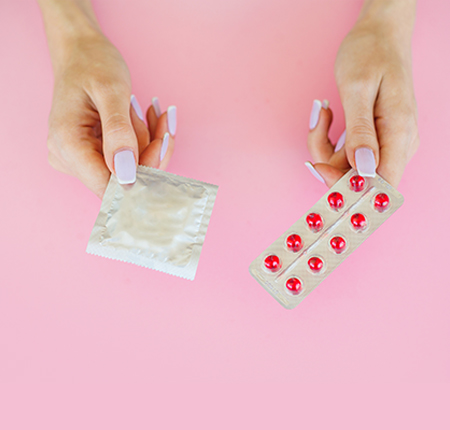
How soon can you become pregnant again after giving birth?
Whether you're breastfeeding or not, whether you gave birth vaginally or by caesarean, whether your periods have returned or not – in theory you can become pregnant again as soon as 3 weeks after giving birth. That's why it's so important to use a method of contraception as soon as you resume your sex life, so that you don't become pregnant again before your body is ready for it.
When you should seek medical advice
Your gynaecologist's advice is very important, because they closely monitor how your body is healing and can give you the most appropriate recommendations for you. So don't hesitate to ask for advice in the following situations:
- When you can safely resume your sex life: the green light is usually given after about 6 weeks, but that's not a hard and fast rule. Your doctor will check whether your cervix has closed before you can have intercourse again without an increased risk of infection.
- How to choose your method of contraception: especially if you're thinking of opting for hormonal contraception.
- Pain during intercourse: if the discomfort in the vaginal area or at the caesarean scar is too severe, mention it so that you can receive the appropriate treatment or guidance.
Sex after birth and sex positions
As mentioned, it's a good idea to change your sex position and choose one that doesn't put pressure on the abdominal area, to avoid discomfort and pain during sex after birth.
Doggy style, the classic missionary position and sex standing up are among the positions that allow deeper penetration or put pressure on the abdominal area. That's precisely why they generally rank among the best sex positions. After a caesarean, however, it's also the reason to save them for later – until your body has fully recovered.
Instead, we'd recommend positions in which you can control the depth and rhythm of penetration yourself, so that you can stop immediately or adjust the position if something doesn't feel right. A few options would be:
- Spooning
- The Amazon position (and other variations in which you're on top of your partner)
- The anchor position (similar to missionary, but slightly modified to give you more comfort and avoid putting pressure on the abdominal area)
How Kegel exercises can help you resume your sex life
Kegel exercises can improve your sexual experiences generally – but even more so in the period after giving birth. They strengthen the pelvic floor muscles, which can influence your arousal, your sense of pleasure and your sexual satisfaction, as well as your ability to reach orgasm.
If you need a bit of guidance on how to do them, we're here for you. In another article on the Enroush blog we've explained everything you need to know about Kegel exercises – how and why you should do them.
Tips for resuming your sex life after a caesarean
A lot may change and feel different, but the point of sex stays the same – whether before, during or after pregnancy: feeling good together with your partner. To sum up everything we've discussed in this article, here are a few recommendations to make sex after a caesarean as enjoyable as possible:
- Set realistic expectations: it's normal for your sex life after birth not to be exactly as it was before pregnancy straight away. Be realistic about the recovery time needed.
- Be patient with yourself and your body: don't rush anything and treat yourself with understanding and patience, even if you don't yet feel attraction or sexual desire. Just as your body follows its natural rhythm of at least 4–6 weeks to recover and can't be hurried, your hormones, emotions and libido also need time to settle.
- Communicate openly with your partner: both beforehand and during intercourse. If something doesn't feel good or hurts, say so. You can adjust the position, change it, take a break or simply stop.
- Connect emotionally before you take that connection to a sexual level: this helps you let go of the inhibitions and anxieties that can arise after a longer period with less intimacy.
- Make time for foreplay: it begins with hugs and other intimate gestures that don't involve sex.
- Use lubricant: if your natural lubrication hasn't returned to normal yet, a lubricant can help prevent pain or discomfort caused by vaginal dryness.
- Choose comfortable positions: in the beginning, avoid positions that put pressure on your abdomen and scar, or those involving penetration that's too deep and potentially painful.
- Follow medical advice and ask questions: it's essential to stay in touch with your gynaecologist. Wait for the all-clear before resuming your sex life. Ask for their view on hormonal contraception. Seek advice if sex after birth is painful. Raise anything you're unsure about. That way you can be confident you're enjoying a healthy, safe sex life that doesn't put your health at risk.

Medium, super or extra absorption

Low, medium or super absorption

Low or medium absorption


and happily breaking taboos!


